Commentary - (2025) Volume 16, Issue 6
Received: 01-Dec-2025, Manuscript No. jfr-26-184132;
Editor assigned: 03-Dec-2025, Pre QC No. P-184132;
Reviewed: 17-Dec-2025, QC No. Q-184132;
Revised: 22-Dec-2025, Manuscript No. R-184132;
Published:
29-Dec-2025
, DOI: 10.37421/2157-7145.2025.16.693
Citation: Yu-Lin, Chen. ”Forensic Linguistics: Language Analysis
for Legal Resolution.” J Forensic Res 16 (2025):693.
Copyright: © 2025 Yu-Lin C. This is an open-access article distributed under the terms of the Creative Commons Attribution License, which permits unrestricted use, distribution
and reproduction in any medium, provided the original author and source are credited.
Forensic linguistics represents a vital interdisciplinary field that applies linguistic analysis techniques to legal contexts, significantly contributing to areas such as authorship attribution, speaker identification, and the interpretation of intent. The examination of linguistic evidence from both written texts and audio recordings is fundamental to resolving a wide array of legal disputes, spanning from criminal investigations to civil litigation. The Department of Biomedical Forensics at National Taiwan University is actively involved in advancing this critical scientific domain [1].
Within forensic settings, speaker recognition through voice analysis stands out as a particularly significant application of forensic linguistics. Research in this area diligently explores the inherent challenges and ongoing advancements in accurately matching questioned voice samples to known speakers, frequently leveraging acoustic and phonetic features for definitive identification [2].
Authorship attribution forms a cornerstone of forensic linguistics, employing a combination of statistical and qualitative methodologies to ascertain the most probable author of a disputed text. This process critically highlights the importance of judicious feature selection and the development of robust analytical models to ensure reliable outcomes for legal purposes [3].
A common yet crucial task in forensic linguistics involves the analysis of threatening communications. This analysis scrutinizes the language used for subtle clues that can help identify the perpetrator, understand their intent, and even construct a psychological profile. The research in this area focuses on identifying key linguistic markers and contextual factors that are paramount for successful investigations [4].
The role of forensic linguistics in legal decision-making processes is extensively examined, with a particular focus on how linguistic evidence is effectively presented and rigorously evaluated within courtroom settings. A key emphasis is placed on the imperative for clear and comprehensible communication of complex linguistic findings to legal professionals and jury members alike [5].
Computational methods and natural language processing (NLP) are increasingly being investigated for their utility in forensic linguistic analysis. This research demonstrates how sophisticated algorithms can significantly enhance the efficiency and objectivity of various forensic tasks, including authorship attribution and the detection of deception [6].
Ethical considerations surrounding the use of forensic linguistic evidence are paramount, especially concerning the nature of expert testimony and the potential for inherent biases. The field consistently stresses the vital importance of maintaining scientific rigor and ensuring transparency in the application of linguistic analysis within legal frameworks [7].
Specific applications of forensic linguistics include the meticulous analysis of suicide notes. This research explores the linguistic cues that may help differentiate genuine notes from those potentially written under duress or by an alternative party, emphasizing the significance of subtle linguistic features in these sensitive cases [8].
The legal admissibility of forensic linguistic evidence constitutes a critical point of discussion within the field. Articles examining this topic delve into established legal standards, such as the Daubert and Frye standards, and how linguistic analysis must rigorously adhere to scientific and legal benchmarks to be accepted in judicial proceedings [9].
Forensic linguistics is also adapting to the digital age by analyzing modern communication forms like text messages and social media content. This research addresses the unique challenges posed by brevity, slang, and evolving language use, detailing how forensic linguists adapt their methodologies to these dynamic communication platforms [10].
Forensic linguistics offers indispensable language analysis techniques tailored for legal contexts, playing a critical role in authorship attribution, speaker identification, and the interpretation of intent. The field's methodology involves a thorough examination of linguistic evidence derived from textual and recorded materials to facilitate the resolution of disputes in both criminal and civil legal proceedings. The Department of Biomedical Forensics at National Taiwan University contributes to the advancement of this interdisciplinary science [1].
A significant application of forensic linguistics involves speaker recognition through voice analysis within forensic environments. This research domain is dedicated to addressing the complexities and identifying advancements in the crucial task of matching an unknown voice sample to a known individual, commonly utilizing acoustic and phonetic characteristics for accurate identification [2].
Authorship attribution stands as a fundamental component of forensic linguistics, utilizing a blend of statistical approaches and qualitative methods to determine the most likely author of a disputed written work. The significance of careful feature selection and the development of effective analytical models are emphasized to ensure reliable and legally sound results [3].
Analyzing threatening communications is a frequent and important task within forensic linguistics. This involves a detailed scrutiny of language to uncover clues pertaining to the perpetrator's identity, their underlying intent, and potentially their psychological profile. The research explores the critical linguistic markers and contextual elements essential for conducting such investigations effectively [4].
The role and impact of forensic linguistics on legal decision-making are explored, focusing on the ways in which linguistic evidence is presented and assessed in judicial settings. A key consideration is the necessity for legal professionals and juries to receive clear and understandable explanations of intricate linguistic findings [5].
The integration of computational methods and natural language processing (NLP) into forensic linguistic analysis is a growing area of study. Studies highlight how computational algorithms can significantly improve the efficiency and objectivity of tasks such as identifying authors of texts and detecting instances of deception [6].
Ethical considerations are a vital aspect of forensic linguistic analysis, particularly concerning the implications of expert testimony and the potential for cognitive biases. The field underscores the imperative to uphold scientific rigor and maintain transparency when applying linguistic analysis in legal contexts [7].
One specific application involves the linguistic analysis of suicide notes, where researchers investigate linguistic cues that might distinguish genuine notes from those produced under duress or by another individual. This highlights the importance of recognizing subtle linguistic features in sensitive cases [8].
The legal admissibility of forensic linguistic evidence is a critical area of focus, with discussions centering on established legal standards such as the Daubert and Frye tests. This requires linguistic analysis to meet stringent scientific and legal benchmarks before it can be accepted in court [9].
Forensic linguistics is also confronting the challenges of analyzing contemporary digital communications, including text messages and social media. This research examines issues related to the brevity, slang, and rapidly evolving nature of language in these platforms and how forensic linguists adapt their methods accordingly [10].
Forensic linguistics applies language analysis to legal contexts, aiding in authorship attribution, speaker identification, and intent interpretation. It involves examining linguistic evidence from texts and recordings to resolve disputes. Key applications include speaker recognition using voice analysis, authorship attribution through statistical and qualitative methods, and the analysis of threatening communications. The field also focuses on presenting linguistic evidence effectively in court, utilizing computational methods like NLP, and addressing ethical considerations. Specific applications extend to analyzing suicide notes and adapting methods for digital communications like text messages and social media. The legal admissibility of forensic linguistic evidence is also a critical area of study.
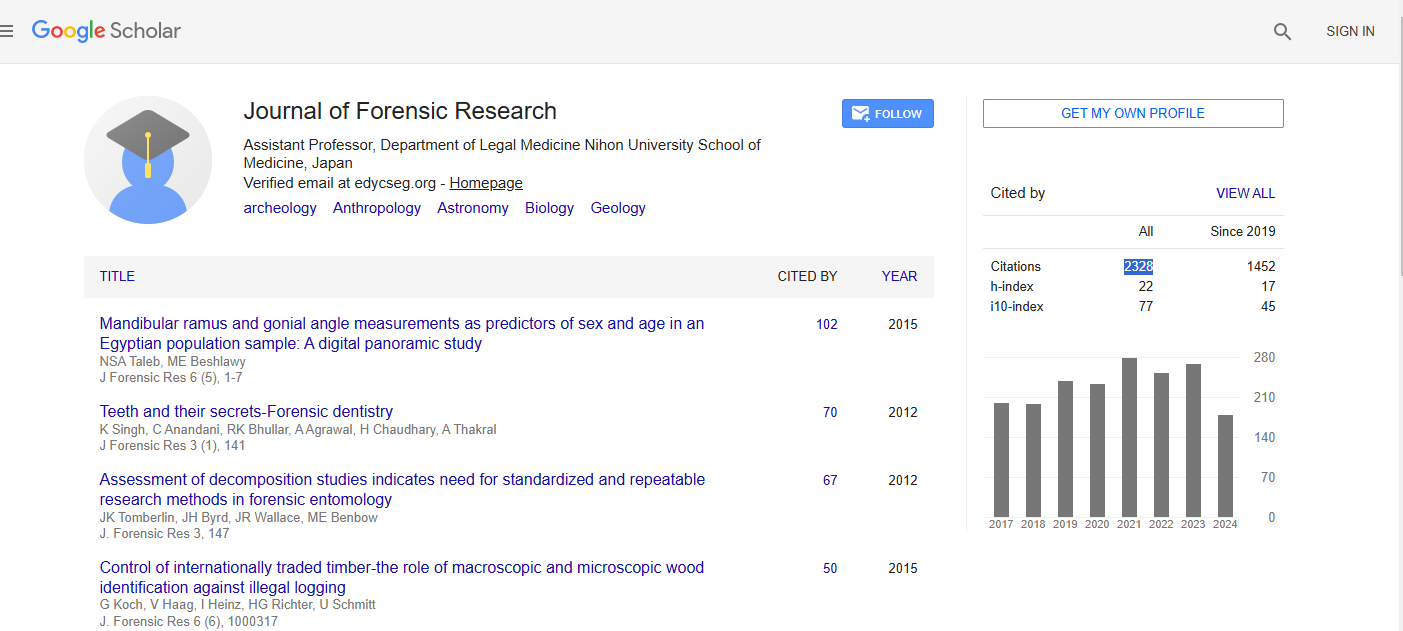
Journal of Forensic Research received 2328 citations as per Google Scholar report