Perspective - (2025) Volume 16, Issue 5
Received: 01-Oct-2025, Manuscript No. jfr-26-184126;
Editor assigned: 03-Oct-2025, Pre QC No. P-184126;
Reviewed: 17-Oct-2025, QC No. Q-184126;
Revised: 22-Oct-2025, Manuscript No. R-184126;
Published:
29-Oct-2025
, DOI: 10.37421/2157-7145.2025.16.687
Citation: Zahir, Salma. ”Forensic DNA: Ethical Challenges and
Privacy Concerns.” J Forensic Res 16 (2025):687.
Copyright: © 2025 Zahir S. This is an open-access article distributed under the terms of the Creative Commons Attribution License, which permits unrestricted use, distribution
and reproduction in any medium, provided the original author and source are credited.
The ethical landscape of forensic DNA testing is increasingly complex, driven by technological advancements and expanding applications. A primary concern revolves around the privacy implications of widespread DNA database usage, both for criminal investigations and familial searching. These practices raise significant questions about individual privacy rights and the potential for misuse of sensitive genetic information, necessitating a careful balance between law enforcement needs and the public's right to genetic privacy, encompassing issues like data security, consent, and the broad implications of DNA collection.
The rapid evolution of DNA sequencing technologies, particularly next-generation sequencing (NGS), has introduced novel ethical dilemmas within forensic science. NGS enables the retrieval of highly detailed genetic information, which, while advantageous for investigations, simultaneously amplifies existing privacy risks. This advancement necessitates addressing concerns about the potential for inferring sensitive personal traits, identifying familial relationships beyond the immediate scope of an investigation, and establishing robust ethical frameworks to govern the use of such detailed genetic data. Familial DNA searching, a technique that leverages DNA databases to identify potential suspects by locating close relatives, stands as a significant point of ethical contention. This approach raises profound privacy implications for family members who may not be direct suspects but can be implicated through a relative's genetic profile. Consequently, a thorough exploration of the legal and ethical justifications for and against familial searching is crucial, with careful consideration given to issues of consent, notification, and the potential for genetic discrimination. The integration of consumer genetic testing services with established forensic DNA databases presents a complex ethical and privacy challenge. This intersection raises questions about the potential for law enforcement access to direct-to-consumer (DTC) genetic databases, which are often populated for personal genealogical purposes. Significant ethical concerns emerge regarding user consent, the transparency of data sharing agreements, and the unforeseen use of genetic information for criminal investigations without the explicit knowledge or consent of the individuals involved. Legal and ethical frameworks governing the retention and use of DNA profiles within forensic databases are under continuous scrutiny. The practice of indefinite retention of DNA profiles, even for individuals not convicted of crimes, raises concerns about potential violations of privacy rights and the risk of data misuse. This underscores the urgent need for clear policies on DNA profile retention, expungement, and access to ensure proportionality and prevent the establishment of a pervasive surveillance state. The ethical considerations surrounding forensic DNA phenotyping (FDP), a technique used to predict an individual's physical appearance, are significant. While FDP can aid investigations by narrowing suspect pools, it introduces profound privacy concerns related to the inference of characteristics such as eye color, hair color, and biogeographical ancestry. Navigating the ethical boundaries of FDP requires careful attention to issues of accuracy, potential for bias, and the implications of generating probabilistic predictions about individuals based on their genetic makeup. The ethical challenges associated with employing familial DNA searching in criminal investigations are amplified within current legal frameworks. A central tension exists between the societal benefit of solving crimes and the potential infringement upon the privacy rights of individuals who are not suspects but share genetic material with them. The development of ethical guidelines for implementing familial DNA searches, emphasizing transparency, proportionality, and robust oversight, is therefore paramount. Forensic investigations often generate genetic information that can have implications beyond the immediate case. The ethical considerations surrounding the secondary use of this data, such as for population genetics studies or the development of new forensic tools, are critical. Concerns about secondary use, consent for de-identified samples, and the potential for re-identification even from anonymized datasets highlight the need for stringent ethical protocols governing the secondary use of forensic DNA data. The potential for bias and discrimination in forensic DNA testing warrants careful examination. Technological limitations and interpretive challenges can disproportionately affect certain populations, leading to ethical issues stemming from the risk of false positives or negatives, particularly with mixed or degraded DNA profiles. Continuous validation of forensic DNA methods and transparent reporting of uncertainties are essential to mitigate these ethical concerns and protect individual privacy. The ethical challenges presented by forensic DNA databases are continually shaped by evolving privacy expectations and technological capabilities. A critical assessment of the balance between public safety interests, which often drive the expansion of these databases, and the fundamental right to privacy for individuals whose genetic information is stored is necessary. The development of robust regulatory frameworks, clear consent protocols, and mechanisms for accountability is vital for the responsible use of forensic DNA technology and the protection of individual privacy.The ethical dimensions of forensic DNA testing are multifaceted, with a significant focus on the privacy concerns arising from the expanding use of DNA databases. These databases, employed for both criminal investigations and familial searching, necessitate a careful balancing act between the needs of law enforcement and the fundamental right of individuals to genetic privacy. Issues such as data security, informed consent, and the broad implications of genetic data collection are central to this debate.
Advancements in DNA sequencing technologies, particularly next-generation sequencing (NGS), have introduced a new layer of ethical complexity into forensic science. NGS allows for a more granular retrieval of genetic information, which, while beneficial for investigative purposes, significantly heightens privacy risks. Key ethical considerations include the potential for inferring sensitive personal characteristics, identifying broader familial connections than initially intended, and the urgent need for well-defined ethical guidelines to govern the utilization of this highly detailed genetic data. Familial DNA searching represents a particularly contentious area within forensic genetics. This technique relies on DNA databases to identify potential suspects by searching for matches with their close relatives. The ethical debate intensifies when considering the privacy implications for family members who are not suspects themselves but are indirectly implicated through a relative's genetic profile. A comprehensive examination of the legal and ethical arguments surrounding familial searching, including consent, notification procedures, and the risk of genetic discrimination, is therefore essential. The intersection of consumer genetic testing services and forensic DNA databases poses a complex ethical and privacy challenge. This confluence raises concerns about the potential for law enforcement agencies to access data held within direct-to-consumer (DTC) genetic databases, which are typically amassed for personal genealogical research. Critical ethical issues include the adequacy of user consent, the transparency of data-sharing agreements, and the possibility of genetic information being used for criminal investigations without the explicit knowledge or consent of the individuals who provided it. The legal and ethical frameworks governing the retention and subsequent use of DNA profiles within forensic databases are subjects of ongoing discussion and revision. The practice of retaining DNA profiles indefinitely, even for individuals who are not convicted of any crime, raises significant concerns regarding privacy violations and the potential for data misuse. This underscores the critical need for clear, well-defined policies concerning the retention, expungement, and access to DNA profiles to ensure proportionality and prevent the emergence of a pervasive surveillance apparatus. Forensic DNA phenotyping (FDP), a technology used to infer an individual's physical characteristics from their DNA, presents substantial ethical considerations. While FDP can be a valuable tool for narrowing down suspect pools in investigations, it also introduces profound privacy concerns related to the prediction of traits such as eye color, hair color, and biogeographical ancestry. The ethical boundaries of FDP are shaped by issues of accuracy, the potential for inherent biases, and the implications of generating probabilistic estimations about individuals based solely on their genetic information. The ethical challenges inherent in employing familial DNA searching within the context of criminal investigations and current legal systems are considerable. A fundamental tension exists between the societal imperative to solve crimes and the potential for infringing upon the privacy rights of individuals who are not suspects but share genetic material with them. Consequently, the development and implementation of ethical guidelines for familial DNA searches, emphasizing transparency, proportionality, and stringent oversight mechanisms, are of paramount importance. The secondary use of genetic information obtained from forensic investigations, whether for population genetics studies or the development of new forensic tools, raises significant ethical questions. Concerns about the unauthorized secondary use of DNA data, the adequacy of consent for the use of de-identified samples, and the potential for re-identification of individuals even from supposedly anonymized datasets are critical. The establishment of strict ethical protocols is imperative to govern the secondary use of forensic DNA data responsibly. The potential for bias and discrimination within forensic DNA testing methodologies is a serious ethical concern. Limitations in technology and the interpretation of results can disproportionately impact certain demographic groups, leading to ethical dilemmas related to the risk of false positive or false negative outcomes, particularly when dealing with mixed or degraded DNA profiles. Continuous validation of forensic DNA techniques and transparent communication of uncertainties are crucial for mitigating these ethical issues and safeguarding individual privacy. Forensic DNA databases are continually evaluated in light of evolving societal expectations of privacy and advancements in technological capabilities. A critical examination of the equilibrium between public safety interests, which often motivate the creation and expansion of these databases, and the fundamental right to privacy for individuals whose genetic information is stored is essential. The implementation of robust regulatory frameworks, clear consent protocols, and effective accountability mechanisms is vital for the responsible application of forensic DNA technology and the comprehensive protection of individual privacy.Forensic DNA testing presents significant ethical and privacy challenges. The use of DNA databases for investigations and familial searching raises concerns about individual privacy rights and potential data misuse, necessitating a balance between law enforcement needs and public privacy. Advanced technologies like next-generation sequencing (NGS) amplify these risks by providing more detailed genetic information. Familial DNA searching and the integration of consumer genetic data with forensic databases further complicate privacy issues, particularly regarding consent and unforeseen data usage. Indefinite retention of DNA profiles and forensic DNA phenotyping also raise ethical questions about surveillance and the inference of personal characteristics. Bias and discrimination in DNA analysis, along with the secondary use of genetic data, require careful ethical consideration and robust regulatory frameworks to ensure responsible application and the protection of individual privacy.
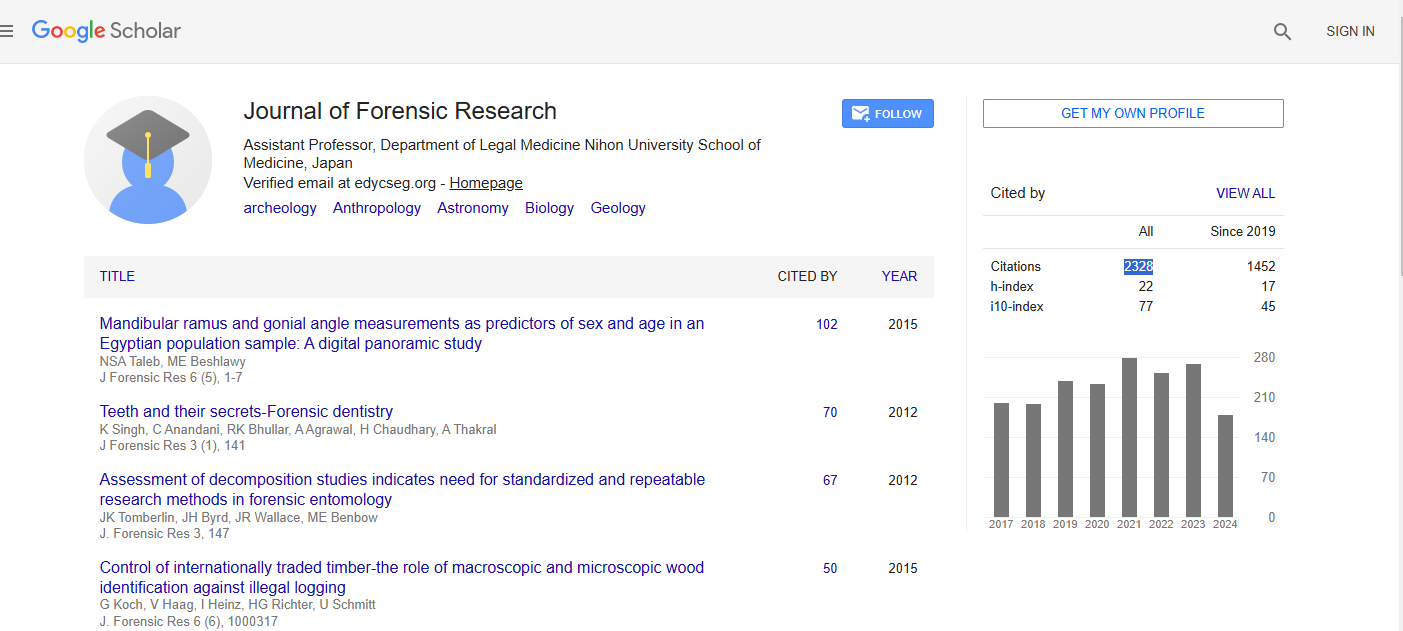
Journal of Forensic Research received 2328 citations as per Google Scholar report