Commentary - (2025) Volume 16, Issue 3
Received: 02-Jun-2025, Manuscript No. jfr-26-184101;
Editor assigned: 04-Jun-2025, Pre QC No. P-184101;
Reviewed: 18-Jun-2025, QC No. Q-184101;
Revised: 23-Jun-2025, Manuscript No. R-184101;
Published:
30-Jun-2025
, DOI: 10.37421/2157-7145.2025.16.662
Citation: Rosenfeld, Maya. ”Forensic Arson and Explosives: Advancements
and Challenges.” J Forensic Res 16 (2025):662.
Copyright: © 2025 Rosenfeld M. This is an open-access article distributed under the terms of the Creative Commons Attribution License, which permits unrestricted use,
distribution and reproduction in any medium, provided the original author and source are credited.
The forensic investigation of arson and explosives is a critical field that demands rigorous scientific analysis and interdisciplinary collaboration to accurately reconstruct events and identify perpetrators. Significant advancements have been made in identifying trace evidence, such as accelerants and explosive residues, which are crucial for establishing the cause and origin of fires and detonations [1].
These investigations often involve complex post-blast environments, presenting unique challenges for scene documentation and evidence recovery. The integration of various scientific disciplines, including chemistry and engineering, alongside legal expertise, is paramount to ensure comprehensive and reliable findings [1].
Central to arson investigations is the detailed characterization of ignitable liquids and explosive trace evidence. Techniques like gas chromatography-mass spectrometry (GC-MS) and various spectroscopic methods are employed to identify the chemical signatures left behind. Understanding the persistence of these residues and how environmental factors influence their detection and interpretation is vital for accurate analysis. The scientific community emphasizes the need for validated methodologies to ensure the reproducibility and reliability of results in forensic laboratories [2].
Emerging technologies are continuously being developed to enhance the capabilities of forensic investigators. Advanced imaging techniques, such as hyperspectral imaging, are showing promise in the non-destructive detection of materials and patterns at fire and explosive scenes. These methods can aid in distinguishing between accidental occurrences and deliberate acts, providing valuable insights into the nature of the event. A thorough understanding of both the benefits and limitations of these new technologies is essential for their effective implementation [3].
In parallel with physical evidence examination, digital forensics plays an increasingly important role in arson and explosives investigations. Digital devices can offer crucial contextual information, including communication logs and search histories, which can either corroborate or contradict hypotheses about intent and modus operandi. The seamless integration of digital and physical crime scene investigation is now considered a standard practice, providing a more holistic view of the incident [4].
The practical application of ignitable liquid detection methods is a key concern for forensic practitioners. Research has focused on evaluating the effectiveness and limitations of various detection kits used in complex fire debris scenarios. Comparative analyses of presumptive and confirmatory testing methods are conducted to determine their accuracy and reliability. Furthermore, the impact of sample collection techniques on the final results is a critical factor that influences the integrity of the evidence [5].
Explosive residues are subject to environmental degradation, which significantly impacts their forensic analysis. Studies investigate how factors like weather, soil composition, and the passage of time can affect the detection and identification of common explosive compounds. These investigations provide essential insights into the inherent challenges faced when analyzing post-blast scenes, where evidence may be compromised [6].
The forensic examination of improvised explosive devices (IEDs) requires specialized knowledge and meticulous attention to detail. This area of study focuses on the analysis of homemade explosive formulations, trigger mechanisms, and component materials. The safe handling and analysis of IED evidence, coupled with detailed scene documentation, are of utmost importance due to the inherent dangers involved [7].
Understanding fire dynamics and interpreting burn patterns are fundamental to arson investigations. By studying how fires behave, investigators can more accurately differentiate between accidental fires and those intentionally set. The accurate assessment of a fire scene relies heavily on the expertise of skilled fire investigators who can interpret the subtle clues left by the fire's progression [8].
Novel analytical techniques are being explored to improve the speed and sensitivity of explosive detection. Ion mobility spectrometry, for instance, is being investigated for its potential in the rapid detection of explosive vapors and residues. Comparing its performance with traditional methods highlights its advantages for field deployment, offering faster and more sensitive results [9].
Finally, the legal and ethical considerations surrounding arson and explosives forensic investigations are paramount. This includes navigating the complexities of expert witness testimony, ensuring the admissibility of scientific evidence in court, and mitigating potential biases in forensic analysis. Upholding scientific integrity and adhering to professional ethics are crucial for maintaining public trust in the justice system [10].
The field of forensic investigation for arson and explosives is characterized by a constant drive for methodological advancement and interdisciplinary synergy. Early efforts focused on establishing foundational techniques for identifying accelerants and explosive residues, laying the groundwork for modern investigative practices [1].
The complexities of post-blast environments necessitate sophisticated approaches to scene reconstruction, often requiring specialized equipment and training to navigate hazardous conditions. Multidisciplinary collaboration, involving chemists, engineers, and legal professionals, is not merely beneficial but essential for a comprehensive understanding of these incidents [1].
The scientific underpinnings of trace evidence analysis in these cases are constantly refined. Sophisticated analytical instrumentation, such as gas chromatography-mass spectrometry (GC-MS) and various spectroscopic techniques, are indispensable tools for deciphering the chemical fingerprints of ignitable liquids and explosive materials. A thorough understanding of the chemical stability and environmental fate of these residues is crucial for interpreting analytical data and drawing reliable conclusions. The emphasis on validated analytical protocols ensures that forensic findings are scientifically sound and defensible in legal proceedings [2].
Innovation in detection and analysis is continually reshaping forensic capabilities. Advanced imaging technologies, including hyperspectral imaging, offer promising avenues for non-destructive examination of fire debris and explosive remnants. These techniques can potentially reveal subtle material compositions and spatial distributions that might be missed by conventional methods. As these technologies mature, their integration into standard casework requires careful validation and assessment of their practical utility and limitations [3].
The evolving landscape of crime scenes now includes a significant digital dimension. In arson and explosives cases, digital forensics complements physical evidence by providing contextual information derived from electronic devices. Communications, browsing histories, and location data can offer critical insights into motive, planning, and execution, thereby strengthening or refuting hypotheses formed from the physical scene. The synergy between digital and physical investigations is thus a cornerstone of modern forensic practice [4].
Practical field analysis of ignitable liquids is a cornerstone of arson investigations. Significant research effort is dedicated to assessing the efficacy of various detection kits and analytical methods used in the examination of fire debris. Comparative studies of presumptive and confirmatory tests help forensic scientists choose the most appropriate and reliable techniques. Moreover, the influence of how samples are collected and preserved on the accuracy of test results is a recurring theme in methodological development [5].
The impact of environmental factors on the survivability and detectability of evidence is a critical consideration, particularly for explosive residues. Research into the degradation pathways of explosives in various environmental conditions, such as exposure to moisture, sunlight, and soil, informs the interpretation of analytical results from aged crime scenes. Understanding these degradation processes is vital for reconstructing events and estimating timelines [6].
The investigation of improvised explosive devices (IEDs) presents a unique set of challenges due to the often unpredictable nature of their construction and components. Forensic analysis in this domain requires specialized knowledge of energetic materials, detonation trains, and the assembly of homemade explosives. Meticulous scene documentation, safe handling protocols, and expert analysis are indispensable for successfully investigating IED incidents [7].
Interpreting the physical evidence left by a fire is fundamental to determining its cause. The study of fire dynamics and the analysis of burn patterns are essential skills for arson investigators. By understanding the principles of fire behavior, investigators can differentiate between accidental ignition sources and those indicative of deliberate intent. The expertise of the investigator in interpreting these patterns is often as critical as the laboratory analysis of collected samples [8].
The pursuit of rapid and sensitive detection methods for explosives is an ongoing area of research. Techniques like ion mobility spectrometry (IMS) are being explored for their potential to provide immediate alerts for the presence of explosive vapors or residues at a scene. The development of field-deployable instruments that offer speed and sensitivity can significantly enhance the efficiency and effectiveness of initial response and evidence collection efforts [9].
Ultimately, the integrity and impact of forensic investigations are shaped by their legal and ethical frameworks. Forensic practitioners must navigate complex issues related to the admissibility of scientific evidence, the responsibilities of expert witnesses, and the potential for cognitive bias in their analyses. Adherence to strict ethical guidelines and a commitment to scientific rigor are essential for ensuring that forensic science serves the cause of justice impartially and effectively [10].
This compilation explores advancements and challenges in the forensic investigation of arson and explosives. It highlights the importance of identifying accelerants and explosive residues using techniques like GC-MS [1, 2]. The review covers emerging technologies such as hyperspectral imaging for scene examination [3] and the integration of digital forensics with physical evidence [4].
Methodological evaluations of ignitable liquid detection kits are discussed [5], alongside the impact of environmental degradation on explosive residues [6].
The analysis of improvised explosive devices (IEDs) [7], interpretation of burn patterns [8], and rapid detection methods like ion mobility spectrometry [9] are also covered. Finally, the legal and ethical considerations crucial for maintaining scientific integrity in these investigations are examined [10].
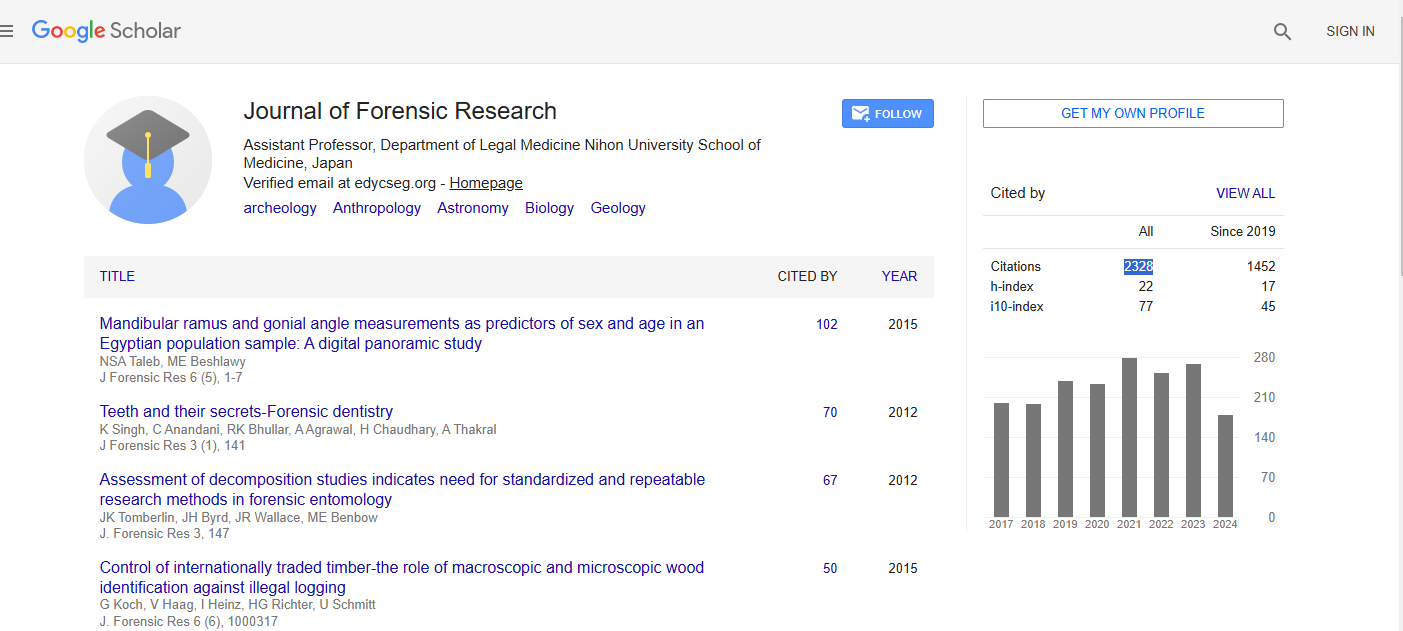
Journal of Forensic Research received 2328 citations as per Google Scholar report