Opinion - (2025) Volume 16, Issue 2
Received: 01-Apr-2025, Manuscript No. jfr-26-184093;
Editor assigned: 03-Apr-2025, Pre QC No. P-184093;
Reviewed: 17-Apr-2025, QC No. Q-184093;
Revised: 22-Apr-2025, Manuscript No. R-184093;
Published:
29-Apr-2025
, DOI: 10.37421/2157-7145.2025.16.654
Citation: Dlamini, Nolwazi. ”Forensic Anthropology: Identifying the Dead, Revealing Truths.” J Forensic Res 16 (2025):654.
Copyright: © 2025 Dlamini N. This is an open-access article distributed under the terms of the Creative Commons Attribution License, which permits unrestricted use,
distribution and reproduction in any medium, provided the original author and source are credited.
Forensic anthropology is a vital scientific discipline dedicated to the identification of human remains through the meticulous examination of skeletal evidence. This field employs a multidisciplinary approach, integrating principles from physical anthropology, archaeology, and forensic science to establish an individual's identity. The process involves a comprehensive analysis of skeletal morphology, alongside other biological and historical data, to build a profile that can lead to identification. Crucially, forensic anthropology plays a significant role in both the criminal justice system and humanitarian efforts worldwide. It is instrumental in resolving cases involving missing persons, providing closure to families, and identifying victims in the aftermath of mass casualty incidents. The ability to accurately identify individuals from fragmented or degraded remains is paramount for justice and remembrance.
The ongoing evolution of forensic anthropology is marked by the continuous development of innovative techniques and technologies that enhance its capabilities and precision. These advancements are crucial for overcoming the challenges inherent in analyzing skeletal material, which can be affected by various postmortem processes. The scope of forensic anthropology extends to understanding and interpreting the effects of decomposition and environmental factors on skeletal structures. This requires a deep knowledge of taphonomy, the study of how organisms decay and become fossilized, applied to the context of human remains. The application of sophisticated analytical tools allows for a more refined examination of skeletal features. This includes the detailed study of bone microstructure and the patterns of injury that may be present, offering insights into the events preceding death. The development and refinement of these methodologies are driven by the need for greater accuracy and reliability in identification processes. The integration of diverse scientific methodologies ensures a robust approach to identification. This includes the comparison of skeletal characteristics with antemortem records, such as dental records and medical imaging, when available. The establishment of a biological profile, encompassing attributes like age, sex, ancestry, and stature, is a foundational step in the identification process. Such profiles are constructed through the careful measurement and analysis of specific skeletal landmarks. Forensic anthropology also contributes to understanding the dynamics of skeletal trauma. The analysis of injuries on bones can provide crucial information about the type of force applied and the sequence of events, which can be critical in legal investigations. Furthermore, the discipline is increasingly benefiting from technological innovations that improve the visualization and analysis of skeletal data. Advanced imaging techniques offer non-invasive ways to examine remains, revealing details that might otherwise be missed. The role of genetic analysis has also become increasingly important, providing a powerful tool for confirmation when other methods are inconclusive. The ultimate goal of forensic anthropology is to provide accurate and reliable identification, serving justice and offering solace to those affected by loss. The continuous pursuit of knowledge and technological advancement ensures that forensic anthropology remains at the forefront of human identification science. The integration of computational methods and artificial intelligence represents a significant frontier, promising to enhance the efficiency and accuracy of analytical tasks. The ethical responsibilities inherent in working with human remains and communicating findings are also a critical aspect of the discipline. Forensic anthropologists must adhere to the highest ethical standards to ensure the dignity of the deceased and the integrity of the investigative process. The collaborative nature of forensic anthropology, often involving partnerships with medical examiners, law enforcement, and other scientific experts, underscores its importance in the broader landscape of death investigation. The ongoing research and development within the field are crucial for adapting to new challenges and improving identification outcomes in diverse and complex cases. The systematic application of established protocols and the exploration of novel techniques are hallmarks of a dynamic and evolving scientific discipline. The commitment to scientific rigor and ethical practice ensures the continued relevance and impact of forensic anthropology in society. The disciplineâ??s role in mass disaster response highlights its critical importance in situations where large numbers of individuals may need to be identified. The ability to process and identify remains efficiently and accurately in such scenarios is of immense humanitarian value. The continuous refinement of techniques for estimating biological characteristics from skeletal remains is a core focus. This includes developing more precise methods for determining age at death, sex, ancestral background, and stature, which are all essential for building a comprehensive identification profile. The study of how skeletal remains interact with their environment is also a key area of research, influencing how evidence is interpreted and how remains are recovered and preserved. The field's reliance on precise measurements and statistical analysis underscores the quantitative nature of much of its work. These quantitative approaches are essential for ensuring objectivity and reproducibility in identification processes. The ongoing adaptation to new forms of evidence, such as advanced imaging and digital data, demonstrates the field's commitment to leveraging technological progress. The integration of diverse data sources, from skeletal morphology to DNA, provides a multi-layered approach to identification. The fundamental principle of comparing antemortem data with postmortem findings remains central to the identification process. Forensic anthropology continually seeks to improve the reliability and efficiency of these comparisons. The disciplineâ??s commitment to education and training ensures that practitioners are equipped with the latest knowledge and skills necessary to meet the demands of modern forensic investigations. The pursuit of scientific excellence is a driving force behind the progress and innovation seen within forensic anthropology. The collaborative exchange of knowledge and research findings among experts globally contributes to the advancement of the field as a whole. The disciplineâ??s role in providing answers and closure to grieving families underscores its profound societal impact. The careful and systematic approach employed by forensic anthropologists is crucial for achieving accurate and definitive identifications. The ongoing exploration of new analytical techniques, such as those utilizing advanced computational algorithms, promises to further enhance the capabilities of the discipline. The development of standardized protocols and best practices is essential for maintaining consistency and quality across different cases and jurisdictions. The dedication to scientific integrity and ethical conduct is paramount in all aspects of forensic anthropological work. The continuous evolution of forensic science necessitates a proactive approach to research and development within forensic anthropology. The disciplineâ??s ability to adapt to emerging challenges, such as the identification of remains from novel scenarios, highlights its resilience and adaptability. The systematic analysis of skeletal trauma provides invaluable insights into the circumstances surrounding death, aiding in criminal investigations. The understanding of taphonomic processes is critical for interpreting the condition of skeletal remains and their postmortem history. The ongoing refinement of methods for sex estimation, age estimation, and ancestry determination are central to building an accurate biological profile. The increasing use of non-invasive imaging techniques offers new avenues for examining skeletal structures without compromising valuable evidence. The integration of DNA analysis with traditional anthropological methods provides a powerful synergistic approach to definitive identification. The development of sophisticated facial reconstruction techniques aids in visualizing unidentified individuals and soliciting public assistance. The analysis of dental records continues to be a reliable and well-established method for individual identification. The application of computational methods and artificial intelligence is opening up new possibilities for data analysis and pattern recognition in skeletal data. The ethical considerations surrounding the handling of human remains and the communication of findings are integral to the practice of forensic anthropology. The disciplineâ??s commitment to scientific advancement and its impact on justice and humanitarian efforts are ongoing and essential contributions to society. The multidisciplinary nature of forensic anthropology ensures a holistic approach to the complex challenges of human identification. The rigorous application of scientific methodologies is fundamental to the credibility and effectiveness of forensic anthropology. The field's ongoing contributions to understanding human variation and adaptation also provide valuable insights into broader anthropological research. The constant pursuit of improved accuracy and efficiency in identification processes drives innovation within forensic anthropology. The collaborative efforts of researchers and practitioners worldwide contribute to the continuous growth and refinement of this critical scientific discipline. The fundamental role of forensic anthropology in establishing identity from skeletal remains is a cornerstone of modern forensic science. The adaptation of techniques to address diverse environmental conditions and preservation states of remains is a testament to the field's versatility. The ongoing development of advanced analytical tools, including those utilizing artificial intelligence, promises to further revolutionize the field. The ethical imperative to treat human remains with respect guides all aspects of forensic anthropological practice. The discipline's commitment to providing answers and closure to families underscores its profound humanitarian value. The systematic examination of skeletal evidence, coupled with an understanding of postmortem changes, is essential for accurate interpretation. The continuous evolution of forensic anthropology is driven by the need to address increasingly complex identification challenges. The global collaboration among forensic anthropologists fosters the sharing of knowledge and best practices, advancing the field as a whole. The disciplineâ??s foundational role in human identification is critical for both legal proceedings and humanitarian endeavors. The meticulous analysis of skeletal morphology, alongside other biological indicators, forms the basis of identification. The ongoing integration of new technologies, such as advanced imaging and molecular techniques, is expanding the capabilities of forensic anthropology. The ethical framework governing the handling of human remains is paramount to maintaining public trust and ensuring respectful treatment. The disciplineâ??s contribution to establishing identity is vital for resolving missing persons cases and identifying victims of mass disasters. The systematic approach to assessing skeletal trauma provides crucial information about the circumstances of death. The understanding of taphonomic processes is fundamental to accurately interpreting the condition of skeletal remains. The continuous refinement of methods for estimating biological characteristics from skeletal remains is a core area of ongoing research. The increasing reliance on non-invasive imaging techniques allows for detailed examination of skeletal structures without damaging the evidence. The synergy between DNA analysis and traditional anthropological methods offers a powerful approach to definitive identification. The development and application of facial reconstruction techniques assist in visualizing unidentified individuals. The enduring importance of dental record analysis as a reliable identification method remains a cornerstone of the field. The exploration of computational methods and artificial intelligence promises to enhance analytical efficiency and discover new patterns in skeletal data. The ethical considerations surrounding forensic anthropological work are crucial for maintaining the integrity of investigations and respecting the deceased. The discipline's multifaceted contributions to justice and humanitarian efforts are essential and continually evolving. The inherent multidisciplinary nature of forensic anthropology ensures a comprehensive approach to human identification. The unwavering commitment to scientific rigor and ethical practice underpins the reliability of forensic anthropological findings. The ongoing research into human variation and adaptation provides broader anthropological insights alongside forensic applications. The drive for enhanced accuracy and efficiency in identification processes fuels continuous innovation in forensic anthropology. The global exchange of research and expertise among forensic anthropologists collectively advances the field. The fundamental importance of forensic anthropology in identifying human remains is a critical element of modern forensic science. The adaptability of techniques to diverse conditions and states of skeletal remains highlights the field's versatility. The continuous integration of emerging technologies, including artificial intelligence, is poised to transform forensic anthropology. The ethical responsibility to treat human remains with dignity and respect guides all practices within the discipline. The discipline's vital role in providing answers to families and aiding in humanitarian crises underscores its profound societal impact. The systematic analysis of skeletal evidence, combined with an understanding of postmortem changes, is essential for accurate interpretation. The dynamic evolution of forensic anthropology is driven by the necessity to address increasingly complex identification challenges. The collaborative efforts of forensic anthropologists worldwide foster the dissemination of knowledge and best practices, propelling the field forward. The foundational role of forensic anthropology in establishing individual identity is indispensable for both legal accountability and humanitarian objectives. The meticulous examination of skeletal morphology, alongside other biological indicators, forms the bedrock of the identification process. The ongoing incorporation of novel technologies, such as advanced imaging modalities and molecular techniques, is significantly expanding the capabilities of forensic anthropology. The ethical framework governing the respectful handling of human remains is paramount for maintaining public trust and ensuring the dignity of the deceased. The discipline's critical contributions to resolving missing persons cases and identifying victims of mass disasters are essential for closure and remembrance. The systematic assessment of skeletal trauma offers invaluable insights into the circumstances surrounding death. The understanding of taphonomic processes is fundamental for accurately interpreting the postmortem history and condition of skeletal remains. The continuous refinement of methodologies for estimating biological characteristics from skeletal remains remains a central area of ongoing research and development. The increasing utilization of non-invasive imaging techniques provides detailed examination of skeletal structures without compromising the integrity of the evidence. The synergistic integration of DNA analysis with traditional anthropological methods offers a robust and powerful approach to achieving definitive identification. The development and application of sophisticated facial reconstruction techniques play a crucial role in visualizing unidentified individuals and facilitating public engagement in identification efforts. The enduring importance and reliability of dental record analysis as a primary method for individual identification remain a cornerstone of forensic anthropology. The exploration of computational methods and the integration of artificial intelligence into forensic anthropology promise to significantly enhance analytical efficiency and uncover novel patterns within skeletal data. The ethical considerations that permeate all aspects of forensic anthropological work are critical for upholding the integrity of investigations and ensuring the respectful treatment of the deceased. The multifaceted contributions of forensic anthropology to the spheres of justice and humanitarian aid are indispensable and are in a continuous state of evolution. The inherent multidisciplinary nature of forensic anthropology ensures a comprehensive and holistic approach to the complex challenges of human identification. The unwavering commitment to scientific rigor, coupled with the highest ethical standards, underpins the profound reliability and trustworthiness of forensic anthropological findings. The ongoing research into human variation and adaptation not only aids in forensic applications but also contributes valuable insights to broader anthropological scholarship. The relentless pursuit of enhanced accuracy and efficiency in identification processes serves as a constant catalyst for innovation within the field of forensic anthropology. The global exchange of cutting-edge research and practical expertise among forensic anthropologists collectively propels the entire field forward. The fundamental importance of forensic anthropology in the scientific and societal context of identifying human remains cannot be overstated, serving as a critical element within the broader landscape of forensic science. The remarkable adaptability of forensic anthropological techniques to a wide spectrum of environmental conditions and diverse states of skeletal remains underscores the field's inherent versatility and resilience. The continuous integration and refinement of emerging technologies, including sophisticated artificial intelligence algorithms, are poised to fundamentally transform the practice and capabilities of forensic anthropology in the coming years. The profound ethical responsibility to treat all human remains with the utmost dignity and respect serves as a guiding principle that informs and governs all established practices within the discipline. The vital role of forensic anthropology in providing answers and closure to grieving families, as well as its indispensable contribution to humanitarian crises, collectively highlight its immense and undeniable societal impact. The systematic and detailed analysis of skeletal evidence, when augmented by a comprehensive understanding of postmortem changes and taphonomic processes, is absolutely essential for achieving accurate and reliable interpretations. The dynamic and ongoing evolution of forensic anthropology is primarily driven by the necessity to effectively address and surmount the increasingly complex and challenging identification scenarios encountered in contemporary forensic investigations. The collaborative endeavors and dedicated efforts of forensic anthropologists across the globe foster the crucial dissemination of vital knowledge and the sharing of effective best practices, thereby collectively and significantly advancing the entire field. The foundational role that forensic anthropology plays in the scientific and societal framework of establishing individual identity from skeletal remains is absolutely indispensable, serving as a critical and integral element within the expansive and multifaceted domain of forensic science.Forensic anthropology plays a crucial role in human identification from skeletal remains, employing a multidisciplinary approach. This involves analyzing skeletal morphology, dental records, and even DNA to establish identity. The process is vital for both criminal investigations and humanitarian efforts, aiding in the resolution of missing persons cases and the identification of victims of mass disasters. Advances in imaging techniques and computational analysis are further refining the accuracy and efficiency of these identifications. The accurate estimation of biological profile characteristics, such as age, sex, ancestry, and stature, is fundamental to skeletal identification.
Techniques like metric analysis of long bones for stature estimation and cranial analysis for sex estimation are standard. Challenges can arise with fragmented or commingled remains, necessitating advanced methods for individualization. Advanced imaging technologies, including CT scans and MRI, are increasingly used in forensic anthropology to visualize skeletal features and aid in identification. These non-invasive methods can reveal subtle details not visible externally and are particularly useful for comparing antemortem and postmortem data, especially in cases of decomposition or damage. The role of DNA analysis in conjunction with traditional anthropometric methods has become indispensable for definitive identification. While skeletal analysis provides a preliminary profile, DNA profiling from bone or teeth offers a high degree of certainty, especially in cases where other methods are inconclusive. Facial reconstruction, both two-dimensional and three-dimensional, is a valuable tool when skeletal remains are unidentified and a visual representation is needed to solicit public assistance. While it is not a definitive identification method on its own, it can provide crucial leads when combined with other evidence. The analysis of dental records remains a cornerstone of identification from skeletal remains. Antemortem dental records, such as radiographs and charts, are compared to postmortem findings. This method is highly reliable due to the uniqueness of dental anatomy and restorative work. The anthropological assessment of trauma on skeletal remains provides critical information about the circumstances of death, including the type of force applied. Blunt force trauma, sharp force trauma, and projectile trauma can often be differentiated, offering valuable clues for forensic investigations. The study of buried human remains presents unique challenges for forensic anthropologists due to taphonomic processes. Understanding how decomposition, environmental factors, and animal activity alter skeletal material is essential for accurate interpretation and identification. The integration of computational methods and artificial intelligence in forensic anthropology is an emerging area. These technologies hold promise for automating certain analytical tasks, improving the consistency of estimations, and developing new tools for identifying patterns in skeletal data. The ethical considerations in forensic anthropology, particularly concerning the respectful handling of human remains and the communication of findings, are paramount. Ensuring accurate and sensitive reporting is crucial for families and legal proceedings. The application of forensic anthropology in mass disaster investigations, as highlighted in systematic reviews, demonstrates its critical role in identifying numerous individuals in catastrophic events. This necessitates efficient and accurate methodologies to process large volumes of remains under challenging circumstances. The systematic review of forensic anthropology in mass disaster investigations emphasizes the need for established protocols and rapid response capabilities to manage the identification process effectively. The accurate estimation of biological profile characteristics, such as age, sex, ancestry, and stature, is fundamental to skeletal identification. Techniques like metric analysis of long bones for stature estimation and cranial analysis for sex estimation are standard, but challenges can arise with fragmented or commingled remains, necessitating advanced methods for individualization. Advanced imaging technologies, including CT scans and MRI, are increasingly utilized in forensic anthropology to visualize subtle skeletal features and aid in identification, proving particularly useful for comparing antemortem and postmortem data in cases of decomposition or damage. The integration of DNA analysis with traditional anthropometric methods has become indispensable for definitive identification, offering a high degree of certainty, especially when other methods are inconclusive. Facial reconstruction, whether two-dimensional or three-dimensional, serves as a valuable tool when skeletal remains are unidentified, providing a visual representation to solicit public assistance and generate crucial leads. The analysis of dental records remains a steadfast cornerstone of identification from skeletal remains, with antemortem records like radiographs and charts being compared to postmortem findings due to the unique nature of dental anatomy and restorative work. Skeletal trauma analysis offers critical information about the circumstances of death by differentiating between types of force applied, such as blunt force, sharp force, and projectile trauma, thereby providing vital clues for forensic investigations. The study of taphonomy in buried human remains presents unique challenges due to decomposition and environmental factors, making an understanding of these processes essential for accurate interpretation and identification. The emerging integration of computational methods and artificial intelligence in forensic anthropology holds significant promise for automating analytical tasks, enhancing the consistency of estimations, and developing innovative tools for pattern recognition in skeletal data. The ethical principles governing forensic anthropology, particularly the respectful handling of human remains and the sensitive communication of findings, are paramount for ensuring accuracy and providing crucial support to families and legal proceedings. The multidisciplinary nature of forensic anthropology, as detailed in reviews of the discipline, underscores its comprehensive approach to human identification by integrating various scientific fields. The continued advancements in imaging techniques and computational analysis are significantly refining the accuracy and efficiency of identification processes. The fundamental importance of accurately estimating biological profile characteristics is underscored by the challenges posed by fragmented or commingled remains, which demand sophisticated analytical methods. The utility of advanced imaging technologies in forensic anthropology extends to visualizing subtle skeletal features, offering a non-invasive means of comparison, especially in cases of degradation. The indispensable role of DNA analysis, when combined with traditional methods, provides a high level of certainty in identification, particularly when other avenues are exhausted. Facial reconstruction, while not a definitive method on its own, is a critical tool for generating leads by providing a visual representation of unidentified individuals. The reliability of dental identification stems from the unique characteristics of dental anatomy and restorative treatments, making it a consistently strong method. The anthropological assessment of skeletal trauma provides crucial insights into the mechanics of injury, aiding in the reconstruction of events leading to death. Understanding taphonomic processes is essential for accurately interpreting the postmortem history of buried remains and mitigating the effects of environmental degradation. The integration of artificial intelligence and computational methods into forensic anthropology represents a forward-looking development with the potential to revolutionize analytical capabilities. The paramount importance of ethical considerations in forensic anthropology ensures that investigations are conducted with respect for the deceased and sensitivity towards their families. The systematic review of forensic anthropology in mass disaster investigations highlights its critical capacity to manage large-scale identification efforts efficiently and effectively. The ongoing development of techniques for estimating age, sex, ancestry, and stature from skeletal remains is a continuous pursuit aimed at improving the precision of biological profiling. Advanced imaging, such as CT and MRI, offers new possibilities for examining skeletal structures non-invasively, aiding in comparisons of antemortem and postmortem data. The synergy between DNA analysis and anthropological methods provides a robust framework for achieving conclusive identifications, especially in challenging cases. Facial reconstruction serves as a vital adjunct to identification, aiding in public appeals and generating potential leads when other methods are insufficient. The steadfast reliability of dental record comparison remains a cornerstone of forensic identification due to the inherent individuality of dental characteristics. Skeletal trauma analysis contributes essential details about the nature and circumstances of death by interpreting patterns of injury. The study of taphonomy is fundamental for reconstructing the postmortem environment and understanding the transformations that skeletal remains undergo. The emergence of computational tools and artificial intelligence offers novel approaches to analyzing vast amounts of skeletal data and identifying subtle patterns. The ethical imperative to treat human remains with dignity and to communicate findings with sensitivity is a defining characteristic of forensic anthropological practice. The fundamental principles of forensic anthropology, including the systematic analysis of skeletal morphology and the estimation of biological characteristics, are applied across diverse contexts. The continuous evolution of the field is marked by the integration of new technologies, such as advanced imaging and molecular techniques, to enhance identification capabilities. The importance of understanding taphonomic processes cannot be overstated, as it directly impacts the interpretation of skeletal evidence and the accuracy of identification. The synergistic combination of DNA analysis with traditional anthropological methods provides a powerful and reliable approach to achieving definitive identification. Facial reconstruction, while not a standalone method, is an invaluable tool for generating public awareness and potential leads in unidentified cases. The analysis of dental records remains a highly reliable method for identification due to the unique and often permanent nature of dental work. The assessment of skeletal trauma offers critical insights into the forces and mechanisms involved in death, aiding in legal investigations. The ethical considerations in forensic anthropology are central to ensuring that investigations are conducted with respect for the deceased and their families. The multidisciplinary approach employed in forensic anthropology, integrating various scientific disciplines, is essential for comprehensive human identification. The ongoing advancements in imaging technologies and computational analysis are continually improving the accuracy and efficiency of identification processes. The accurate estimation of biological profile characteristics is a foundational element of skeletal identification, with ongoing research addressing challenges posed by fragmented remains. The use of advanced imaging techniques, such as CT and MRI, provides a non-invasive means to visualize and analyze skeletal features, crucial for detailed comparisons. The integration of DNA analysis with traditional anthropological methods has become indispensable, offering a high degree of certainty in identification cases. Facial reconstruction serves as a vital tool for generating leads and soliciting public assistance when skeletal remains are unidentified. The analysis of dental records remains a cornerstone of identification due to the unique and often permanent nature of dental anatomy and restorative work. Skeletal trauma analysis provides critical information about the circumstances of death by distinguishing between various types of applied forces. The study of taphonomic processes is essential for understanding how environmental factors and postmortem changes affect skeletal remains, influencing interpretation. The emerging integration of computational methods and artificial intelligence in forensic anthropology promises to enhance analytical efficiency and accuracy. The ethical principles guiding forensic anthropologists, particularly regarding the respectful handling of human remains, are paramount for maintaining professional integrity. The systematic review of forensic anthropology in mass disaster investigations highlights its critical role in managing large-scale identification efforts under immense pressure. The accurate estimation of biological profile characteristics, including age, sex, ancestry, and stature, is fundamental for building an identification profile. Advanced imaging technologies, such as CT scans and MRI, are increasingly employed to visualize subtle skeletal features and aid in comparisons, especially in challenging cases. The combination of DNA analysis with traditional anthropometric methods has become indispensable for definitive identification, providing a high degree of certainty. Facial reconstruction, both 2D and 3D, is a valuable tool for generating visual representations of unidentified individuals to solicit public assistance. The analysis of dental records remains a highly reliable method for identification due to the uniqueness of dental anatomy and restorative work. The anthropological assessment of trauma on skeletal remains provides critical information about the circumstances of death, helping to differentiate types of force. The study of taphonomic processes is essential for understanding how decomposition and environmental factors alter skeletal material, impacting interpretation. The integration of computational methods and artificial intelligence offers promising new avenues for automating tasks and identifying patterns in skeletal data. The ethical considerations in forensic anthropology, focusing on the respectful handling of human remains and sensitive communication, are paramount for legal and familial support. The multidisciplinary approach of forensic anthropology, integrating various scientific fields, is crucial for comprehensive human identification. The continuous advancements in imaging technologies and computational analysis are significantly refining the accuracy and efficiency of identification processes. The accurate estimation of biological profile characteristics is fundamental, with challenges arising from fragmented remains requiring advanced methods. Advanced imaging techniques, including CT and MRI, provide non-invasive means to visualize skeletal features and aid in comparisons, particularly in cases of decomposition. The integration of DNA analysis with traditional anthropometric methods has become indispensable for definitive identification, offering high certainty. Facial reconstruction, a valuable tool for soliciting public assistance, provides a visual representation of unidentified individuals. The analysis of dental records remains a cornerstone of identification due to the unique nature of dental anatomy and restorative work. Skeletal trauma analysis provides critical information about the circumstances of death by differentiating types of applied force. The study of taphonomic processes is essential for understanding how environmental factors affect skeletal remains, influencing interpretation. The integration of computational methods and artificial intelligence holds promise for automating tasks and identifying patterns in skeletal data. The ethical considerations in forensic anthropology, emphasizing respectful handling of human remains, are paramount for families and legal proceedings. The role of forensic anthropology in human identification from skeletal remains involves a multidisciplinary approach, analyzing skeletal morphology, dental records, and DNA. It is vital for criminal investigations and humanitarian efforts, aiding in missing persons cases and mass disaster victim identification. Advances in imaging and computational analysis are improving accuracy and efficiency. The accurate estimation of biological profile characteristics (age, sex, ancestry, stature) is fundamental, with techniques like metric analysis of long bones and cranial analysis being standard. Challenges with fragmented or commingled remains necessitate advanced methods. Advanced imaging technologies like CT scans and MRI are increasingly used to visualize skeletal features and aid identification, useful for comparing antemortem and postmortem data. DNA analysis, combined with anthropometric methods, is indispensable for definitive identification, offering high certainty, especially when other methods are inconclusive. Facial reconstruction, 2D and 3D, is valuable for soliciting public assistance by providing a visual representation of unidentified skeletal remains. Dental record analysis remains a cornerstone of identification, comparing antemortem records to postmortem findings due to the uniqueness of dental anatomy. Skeletal trauma analysis provides critical information about the circumstances of death by differentiating types of applied force, offering clues for investigations. The study of taphonomic processes is crucial for understanding how decomposition and environmental factors alter skeletal material, essential for accurate interpretation. The integration of computational methods and artificial intelligence is an emerging area with potential for automating tasks, improving estimations, and identifying patterns. Ethical considerations, including respectful handling of remains and sensitive communication of findings, are paramount.Forensic anthropology is a multidisciplinary field crucial for human identification from skeletal remains. It employs methods like skeletal morphology analysis, dental records, and DNA testing, serving both criminal investigations and humanitarian efforts such as identifying victims of mass disasters. Key to this process is the accurate estimation of biological profile characteristicsâ??age, sex, ancestry, and statureâ??using established techniques, though fragmented remains present challenges. Advanced imaging technologies, including CT scans and MRI, aid in visualizing skeletal features and comparing antemortem with postmortem data. DNA analysis, in conjunction with traditional methods, provides definitive identification with high certainty. Facial reconstruction offers a visual aid for public assistance, while dental record analysis remains a highly reliable identification method due to the uniqueness of dental anatomy. Analysis of skeletal trauma provides critical information on the circumstances of death, and understanding taphonomic processes is essential for interpreting altered skeletal material. Emerging computational methods and artificial intelligence are enhancing analytical tasks and pattern recognition. Ethical considerations, particularly the respectful handling of human remains, are paramount throughout the identification process.
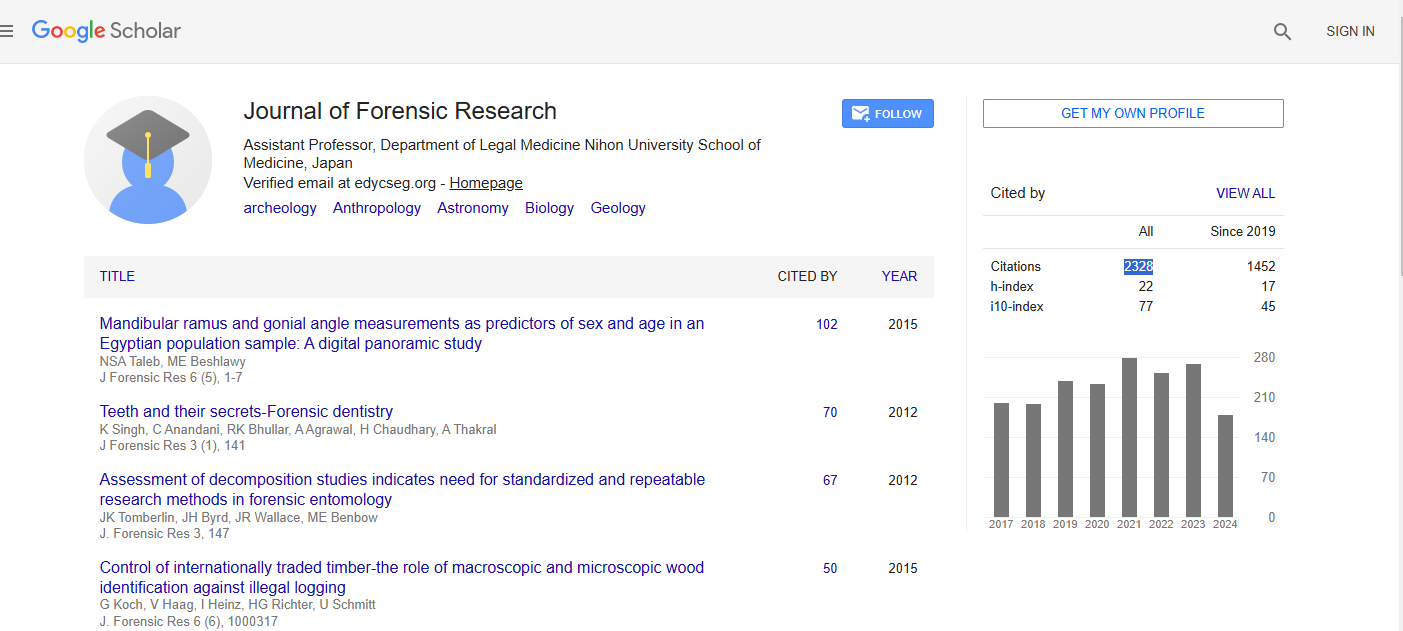
Journal of Forensic Research received 2328 citations as per Google Scholar report