Perspective - (2025) Volume 16, Issue 3
Received: 02-Jun-2025, Manuscript No. jfr-26-184105;
Editor assigned: 04-Jun-2025, Pre QC No. P-184105;
Reviewed: 18-Jun-2025, QC No. Q-184105;
Revised: 23-Jun-2025, Manuscript No. R-184105;
Published:
30-Jun-2025
, DOI: 10.37421/2157-7145.2025.16.666
Citation: Murphy, Liam. ”Forensic Accounting: Combating Financial
Crimes With Precision.” J Forensic Res 16 (2025):666.
Copyright: © 2025 Murphy L. This is an open-access article distributed under the terms of the Creative Commons Attribution License, which permits unrestricted use,
distribution and reproduction in any medium, provided the original author and source are credited.
Forensic accounting is a specialized field that integrates accounting, auditing, and investigative skills to address financial crimes. It is instrumental in identifying, investigating, and prosecuting a wide range of illicit financial activities, playing a critical role in maintaining the integrity of financial systems. The application of these skills aids in tracing the flow of illegally obtained funds and uncovering complex fraudulent schemes, thereby contributing to the recovery of stolen assets [1].
Investigating the intricate web of money laundering activities heavily relies on the sophisticated techniques of forensic accounting. By meticulously following the money trail from its origin through various stages of placement, layering, and integration, forensic accountants can unmask criminal enterprises. This process involves in-depth analysis of transactions, the utilization of advanced data mining capabilities, and the deployment of specialized software to pinpoint suspicious patterns and establish connections to illicit financial flows [2].
The effectiveness of fraud detection and prevention strategies is significantly amplified by the expertise brought forth by forensic accounting. Employing advanced methods such as data analytics, forensic data analysis, and continuous auditing allows for the identification of anomalies that may signal fraudulent behavior, including embezzlement, bribery, or the manipulation of financial statements, at an early stage [3].
Within the legal arena, forensic accountants serve as vital expert witnesses, possessing the unique ability to translate complex financial data into clear and comprehensible terms for legal professionals, judges, and juries. Their objective is to present findings, substantiated by robust evidence, to facilitate the fair resolution of disputes in cases involving financial misconduct and to ensure justice is served [4].
In the digital age, cybercrime and its associated financial ramifications are increasingly becoming a focus for forensic accounting. Investigations extend to examining digital footprints, restoring compromised data, and scrutinizing financial transactions conducted online to identify perpetrators and minimize financial losses stemming from these evolving threats [5].
Asset tracing and recovery represent fundamental components of forensic accounting, particularly in cases characterized by fraud and corruption. This demanding process involves the meticulous tracking of asset movements, both domestically and internationally, to locate concealed illicit funds and to orchestrate their return to their rightful owners, thereby upholding financial order [6].
The ethical dimension of forensic accounting is of utmost importance, given the sensitive nature of the investigations undertaken and the profound impact these can have on individuals and organizations. Forensic accountants are bound by stringent ethical codes that mandate independence, objectivity, and a consistent application of professional skepticism throughout their engagements [7].
Forensic accounting significantly contributes to robust corporate governance by fostering an environment of financial transparency and accountability. This, in turn, serves to diminish the opportunities for fraud and misconduct within organizations. The insights derived from forensic examinations can be instrumental in shaping policy and fortifying internal control mechanisms [8].
The integration of big data and artificial intelligence is revolutionizing the field of forensic accounting. These advanced technologies empower more sophisticated analyses of massive datasets, enhancing the capabilities for fraud detection, risk assessment, and the identification of subtle patterns and anomalies in financial data, thereby increasing efficiency and accuracy [9].
Forensic accounting plays an indispensable role in ensuring regulatory compliance within various sectors. It assists organizations in adhering to legal and financial reporting standards, thereby identifying and rectifying instances of non-compliance, which helps in avoiding potential penalties and safeguarding their reputations [10].
Forensic accounting's core function lies in the systematic application of accounting, auditing, and investigative expertise to unearth financial misconduct. This discipline is paramount in the identification, investigation, and prosecution of financial crimes, significantly contributing to the robustness and integrity of global financial systems. Its methodologies are crucial for tracing illicit financial flows, detecting sophisticated fraud schemes, and providing expert testimony in legal proceedings, all of which are essential for recovering stolen assets and maintaining confidence in financial markets [1].
Investigating the pervasive issue of money laundering is a primary domain where forensic accounting techniques are extensively employed. The process involves meticulously tracking the movement of funds, from the inception of the predicate offense through the critical stages of placement, layering, and integration within the legitimate financial system. This detailed examination encompasses comprehensive transaction analysis, advanced data mining, and the use of specialized software to discern suspicious activities and link individuals to criminal proceeds [2].
The effectiveness of strategies designed to detect and prevent fraud is profoundly enhanced by the specialized knowledge and skills offered by forensic accounting. Through the application of techniques such as sophisticated data analytics, detailed forensic data analysis, and continuous auditing processes, forensic accountants can identify subtle anomalies that often indicate fraudulent activities like embezzlement, bribery, or misrepresentation of financial statements, thereby allowing for early intervention [3].
In the context of financial litigation, forensic accountants assume the critical role of expert witnesses. They are tasked with the responsibility of interpreting and presenting complex financial information in a manner that is readily understandable to legal professionals, judges, and juries. Their objective presentation of findings, rigorously supported by verifiable evidence, is crucial for assisting in the equitable resolution of disputes involving financial impropriety [4].
The increasing prevalence of cybercrime presents unique challenges, and forensic accounting is at the forefront of addressing its financial implications. This involves the detailed investigation of digital evidence, the recovery of compromised financial data, and the thorough analysis of financial transactions that occur through online channels to identify those responsible and to mitigate the resulting financial losses [5].
Asset tracing and recovery are fundamental and often complex aspects of forensic accounting, especially in cases involving significant fraud or corruption. This function requires meticulous tracking of asset movements, both within national borders and across international jurisdictions, to pinpoint the locations where illicit funds have been concealed and to facilitate their repatriation to their rightful owners [6].
Ethical considerations are of paramount importance in the practice of forensic accounting due to the sensitive nature of investigations and the potential for significant consequences for individuals and organizations involved. Forensic accountants must consistently uphold principles of independence, objectivity, and professional skepticism throughout their professional engagements to ensure the integrity of their work [7].
The contribution of forensic accounting to corporate governance is substantial, as it helps to ensure a high degree of financial transparency and accountability within organizations. By identifying and reporting on potential weaknesses, forensic reviews can help reduce the likelihood of fraud and misconduct and inform necessary improvements to internal controls and governance policies [8].
The transformative impact of big data analytics and artificial intelligence is reshaping forensic accounting practices. These technologies enable the analysis of vastly larger and more complex datasets, leading to more effective fraud detection, more accurate risk assessments, and the identification of intricate patterns and anomalies that might otherwise go unnoticed, thereby enhancing investigative efficiency [9].
Forensic accounting is a vital component of regulatory compliance for businesses, particularly in the financial sector. It assists organizations in meeting stringent legal and financial reporting standards and in identifying and rectifying any instances of non-compliance, thereby helping to avert substantial penalties and protect their reputations from damage [10].
Forensic accounting is a critical discipline that employs accounting, auditing, and investigative skills to combat financial crimes, trace illicit funds, and uncover fraud. It plays a vital role in money laundering investigations, enhancing fraud detection, and providing expert testimony in legal proceedings. The field is also crucial for investigating cyber financial crimes, tracing and recovering stolen assets, and ensuring corporate governance and regulatory compliance. Advances in big data and artificial intelligence are further transforming forensic accounting practices, improving efficiency and detection capabilities. Ethical considerations such as independence and objectivity are paramount in this field.
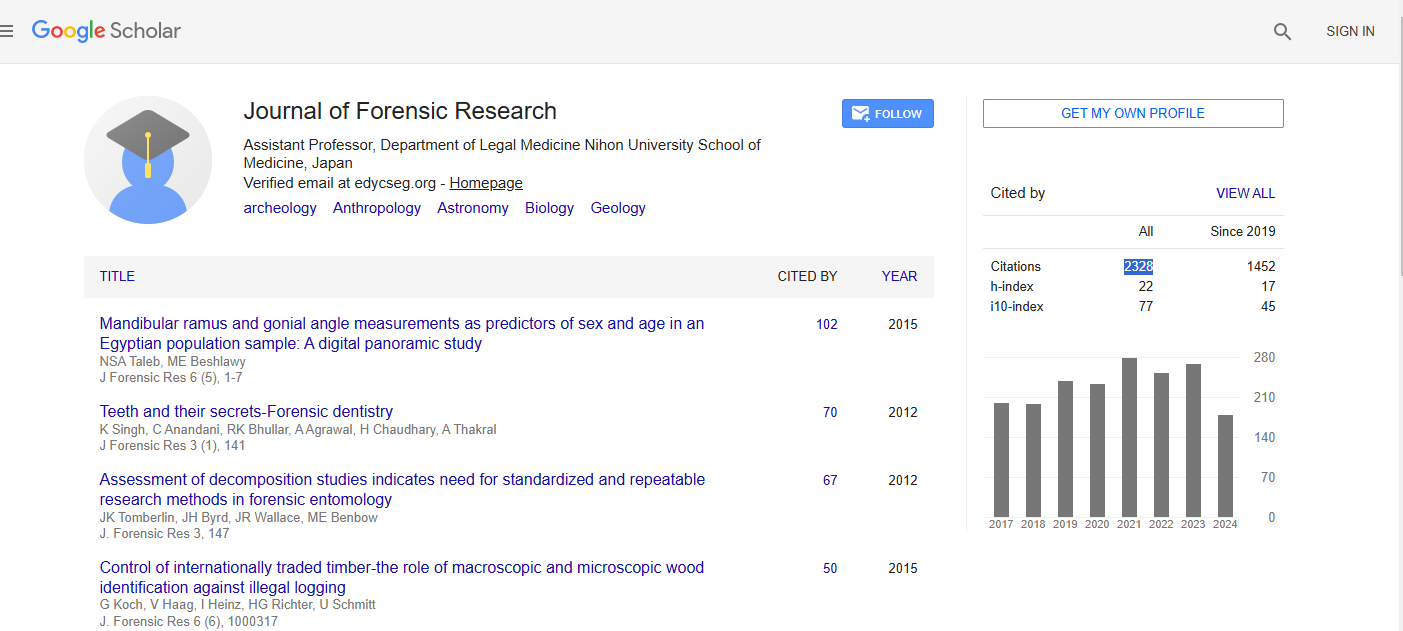
Journal of Forensic Research received 2328 citations as per Google Scholar report