Opinion - (2025) Volume 13, Issue 6
Received: 03-Nov-2025, Manuscript No. economics-26-186083;
Editor assigned: 05-Nov-2025, Pre QC No. P-186083;
Reviewed: 19-Nov-2025, QC No. Q-186083;
Revised: 24-Nov-2025, Manuscript No. R-186083;
Published:
01-Dec-2025
, DOI: 10.37421/2375-4389.2025.13.556
Citation: Markovic, Sofia. ”Foreign Aid’s Variable Impact: Factors
for Effectiveness.” J Glob Econ 13 (2025):556.
Copyright: © 2025 Markovic S. This is an open-access article distributed under the terms of the Creative Commons Attribution License, which permits unrestricted use,
distribution and reproduction in any medium, provided the original author and source are credited.
The effectiveness of foreign aid in low-income countries is a multifaceted and continuously debated topic within development economics and policy circles. While the intention behind providing aid is invariably to foster economic growth and alleviate poverty, the actual outcomes often diverge significantly due to a complex interplay of factors including the type of aid, the quality of governance in recipient nations, and the specific design of aid programs. Some research endeavors have pointed towards a positive correlation between foreign aid and improvements in economic indicators such as GDP growth and reductions in poverty levels. These studies often highlight instances where well-directed aid has facilitated crucial investments in infrastructure, human capital, and institutional development, thereby catalyzing progress. Conversely, other scholarly contributions raise critical concerns about potential adverse effects, such as the fostering of aid dependency, the exacerbation of corruption, and the distortion of local markets. These outcomes can arise when aid is not carefully managed or when it inadvertently undermines local initiative and self-sufficiency. The prevalent academic and policy consensus, informed by empirical evidence, increasingly leans towards the efficacy of targeted, sector-specific aid. Such approaches prioritize strengthening domestic institutions and actively promoting good governance, which are seen as more reliable pathways to sustainable development than broad, untargeted budgetary support. Furthermore, the conditionalities often attached to foreign aid packages present a nuanced picture. While these conditions can serve as powerful incentives for essential reforms, including fiscal discipline and enhanced anti-corruption measures, their implementation requires careful consideration to avoid unintended negative consequences. Overly stringent or poorly aligned conditionalities risk undermining the sense of ownership among recipient countries and diminishing their capacity for adaptive planning. This can lead to outcomes that are counterproductive, negatively impacting local economies and the intricate social fabric of these nations. The sectoral allocation of aid also plays a pivotal role in determining its impact. Evidence suggests that investments directed towards specific sectors, such as health and education infrastructure, tend to yield more consistent and positive long-term spillover effects on human capital development. This contrasts with direct budgetary support for general government functions, which, while offering flexibility, can be more susceptible to mismanagement and diversion of funds, thereby limiting its developmental impact. Crucially, the presence of good governance and robust institutional capacity within recipient countries stands out as a prerequisite for effectively translating foreign aid into tangible developmental achievements. Aid that flows through nations with transparent financial management and strong accountability mechanisms is demonstrably more likely to be utilized efficiently and effectively. Ultimately, a comprehensive understanding of foreign aid effectiveness necessitates a nuanced appreciation of these diverse factors, moving beyond simplistic metrics to embrace the complex realities of development assistance in low-income contexts.
The efficacy of foreign aid in low-income nations is a topic marked by considerable complexity and variation in outcomes. Research has indicated that the impact of aid is not uniform and is contingent upon a confluence of elements, including the specific type of aid provided, the quality of governance within the recipient country, and the meticulous design of the programs themselves [1].
While certain scholarly investigations have illuminated positive associations between foreign aid and key development indicators such as economic growth and poverty reduction, this perspective is not universally held. These studies often emphasize how aid can facilitate necessary investments and policy reforms that contribute to upward economic trajectories [1].
In contrast, other research highlights potential drawbacks, including the fostering of dependency on external assistance, the entrenchment of corruption, and the creation of market distortions. These negative externalities can emerge when aid mechanisms are not properly calibrated or when they inadvertently diminish local incentives and capacities [1].
A general consensus is emerging within academic and policy circles, suggesting that aid programs that are narrowly targeted and sector-specific tend to yield superior results. Such approaches aim to bolster domestic institutions and foster an environment of good governance, which are considered more sustainable drivers of development than broad financial infusions [1].
The conditionalities imposed on foreign aid can represent a double-edged sword in the development process. On one hand, these stipulations can serve as powerful catalysts for implementing critical reforms, such as enforcing fiscal discipline and adopting stringent anti-corruption measures [2].
On the other hand, an overly rigid or misaligned set of conditions can significantly undermine the sense of ownership and the adaptive capacity of the recipient country. This can inadvertently lead to detrimental consequences for the local economy and social structures, counteracting the intended developmental goals [2].
The effectiveness of aid also manifests differently across various sectors. Studies have shown that investments channeled into specific areas, such as health and education infrastructure, tend to produce more consistent and positive ripple effects on long-term human capital development compared to direct budgetary support [3].
Direct budgetary support, while offering a degree of flexibility, can be more vulnerable to mismanagement and diversion of funds. This makes it harder to track and ensure the efficient allocation of resources for developmental purposes, thus potentially limiting its impact [3].
The role of good governance and strong institutional frameworks in recipient countries is paramount in determining how effectively foreign aid can be translated into tangible development outcomes. Aid that is channeled through countries possessing transparent financial management systems and robust accountability mechanisms is considerably more likely to be used efficiently and effectively [4].
Furthermore, the modality of aid, specifically the distinction between tied and untied aid, carries significant implications for its value and flexibility. Untied aid, which does not obligate the recipient to procure goods and services from the donor nation, generally provides greater flexibility and better value for money, allowing recipients to source the most suitable and cost-effective solutions [5].
Foreign aid's effectiveness in low-income countries is highly variable, influenced by factors like aid type, recipient governance, and program design. While some studies show positive impacts on growth and poverty reduction, others point to risks of dependency, corruption, and market distortions. Targeted, sector-specific aid that strengthens domestic institutions and promotes good governance is considered more effective than broad budgetary support. Conditionalities can incentivize reforms but may also undermine local ownership if too stringent. Investments in health and education tend to have better long-term human capital effects than general budget support, which carries higher mismanagement risks. Good governance and strong institutions are crucial for aid efficacy. Untied aid offers more flexibility and value than tied aid. Aid volatility hinders planning, and alignment with national strategies fosters local ownership and sustainability. Addressing corruption risks and focusing on long-term capacity building rather than dependency are key for impactful aid.
None
None
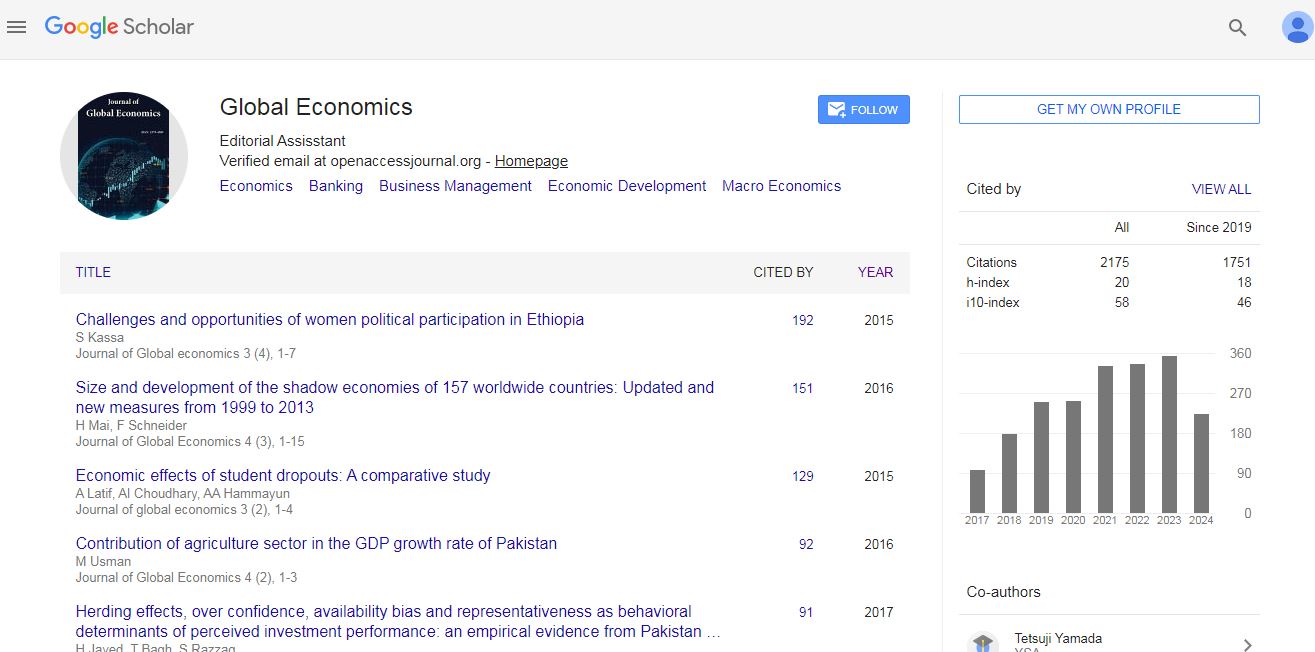
Journal of Global Economics received 2175 citations as per Google Scholar report