Opinion - (2025) Volume 11, Issue 5
Received: 02-Oct-2025, Manuscript No. jpnp-25-175528;
Editor assigned: 06-Oct-2025, Pre QC No. P-175528;
Reviewed: 20-Oct-2025, QC No. Q-175528;
Revised: 23-Oct-2025, Manuscript No. R-175528;
Published:
30-Oct-2025
, DOI: 10.37421/2472-0992.2025.11.386
Citation: Kowalczyk, Mateusz. ”Food’s Future: Health, Sustainability, Innovation.” J Pharmacogn Nat Prod 11 (2025):386.
Copyright: © 2025 Kowalczyk M. This is an open-access article distributed under the terms of the Creative Commons Attribution License, which permits unrestricted use, distribution and reproduction in any medium, provided the original author and source are credited.
Here's the thing, the landscape of food science and nutrition is undergoing profound transformations, driven by evolving consumer needs, sustainability imperatives, and technological advancements. Functional foods, for instance, play an increasingly vital role in health promotion, moving beyond basic nutrition to offer specific health benefits. This shift, from disease prevention to therapeutic applications, highlights the critical bioactive compounds responsible for these positive effects and their underlying mechanisms. What this really means is that including these foods in a diet can significantly contribute to overall well-being, potentially reducing the risk of chronic diseases [1].
As global food demands rise, exploring new plant-based protein sources becomes crucial for sustainable nutrition. This area of research assesses various emerging plant-based proteins, scrutinizing their nutritional quality, functional properties, and potential for large-scale production. It really shows how these alternatives can help address pressing issues of food security and environmental concerns [2].
Meanwhile, food waste isn't just waste; it's a valuable, untapped resource. This perspective explores various strategies for transforming food waste into valuable products, such as biofuels, bioplastics, and functional ingredients. It highlights the importance of circular economy principles in the food industry, turning what was once considered garbage into beneficial commodities [3].
Let's break it down, traditional foods are more than just cultural artifacts; they often hold significant nutritional and medicinal value. This area of study delves into the ethnobotanical and nutritional aspects of various traditional foods, showcasing their inherent potential to promote health and prevent disease. Understanding these indigenous foods can offer new insights for modern dietary recommendations, enriching our approach to wellness [4].
Here's the thing about food additives: while they undeniably extend shelf life and improve taste, their long-term health impact is under constant scrutiny. This comprehensive review examines various food additives, discussing their regulatory status, safety assessments, and potential effects on human health. It underlines the ongoing need for rigorous evaluation to ensure consumer safety and maintain public trust [5].
What this really means is that one-size-fits-all nutrition advice is rapidly becoming outdated in our understanding of human health. This evolving field explores advancements and challenges in personalized nutrition, leveraging 'omics technologies to tailor dietary recommendations based on an individual's unique genetic makeup, microbiome, and lifestyle. This approach promises more effective strategies for health and disease prevention by aligning diet with individual biological needs [6].
Food processing is also evolving rapidly with new technologies aimed at improving safety, quality, and nutritional value. This includes emerging and sustainable food processing methods, like high-pressure processing and pulsed electric fields, which are designed to minimize environmental impact while extending shelf life and preserving sensitive nutrients. It highlights a clear shift towards more eco-friendly and health-conscious food production practices [7].
Our gut microbiome profoundly influences overall health, and diet stands as a primary driver of its composition. This domain explores various dietary interventions, including prebiotics, probiotics, and specific dietary patterns, all designed to modulate the gut microbiome for improved metabolic, immune, and even mental health outcomes. It underscores how specific food choices can actively shape our internal ecosystem, impacting well-being in multifaceted ways [8].
Packaging is more than just a container; it's a critical element in the food supply chain, especially with sustainability in mind. This area highlights recent innovations in sustainable food packaging, ranging from biodegradable materials to active and intelligent packaging systems. It discusses their pivotal role in reducing environmental impact, extending product shelf life, and ensuring food safety, addressing both ecological and practical concerns [9].
Finally, ensuring food safety and authenticity across complex supply chains presents a significant challenge. This is where blockchain technology offers a robust solution for food traceability, providing transparent, immutable records from farm to fork. It covers its practical applications in enhancing consumer trust, preventing fraud, and improving recall efficiency, thereby strengthening the entire food distribution network [10].
The intricate relationship between diet and human health is a cornerstone of ongoing scientific exploration. Functional foods, for instance, are increasingly recognized for their capacity to move beyond basic nutritional provision, offering targeted health benefits that range from disease prevention to therapeutic support. These specific effects are attributed to bioactive compounds whose underlying mechanisms are a focus of intense research, demonstrating how strategic dietary inclusions can significantly bolster overall well-being and potentially mitigate the risk of chronic ailments [1]. Complementing this modern understanding, traditional foods often possess remarkable ethnobotanical and nutritional profiles, serving as a rich, often overlooked, source of health promotion and disease prevention. Studying these ancestral dietary patterns provides invaluable insights that can inform and enrich contemporary dietary recommendations [4]. Here's the thing, the future of nutrition is moving away from generic advice towards personalized strategies. Utilizing advanced 'omics' technologies, personalized nutrition tailors dietary recommendations to an individual's unique genetic makeup, microbiome, and lifestyle, promising far more effective outcomes for health and disease management [6]. The profound influence of the gut microbiome on various aspects of health â?? metabolic, immune, and even mental â?? further underscores the power of diet. Specific dietary interventions, including the strategic use of prebiotics and probiotics, are actively explored to modulate this internal ecosystem, demonstrating how food choices deeply shape our physiological landscape [8].
Addressing global food demands while simultaneously navigating environmental concerns is a critical challenge. What this really means is that exploring and scaling up new plant-based protein sources is not just an option but a necessity for achieving sustainable nutrition. Research in this area rigorously assesses the nutritional quality, functional properties, and feasibility of large-scale production for these alternatives, highlighting their crucial role in enhancing food security and mitigating ecological footprints [2]. Furthermore, the concept of food waste is being radically redefined; it is no longer simply refuse but a valuable resource awaiting transformation. Various innovative strategies are being developed to valorize food waste, turning it into beneficial products such as biofuels, bioplastics, and novel functional ingredients. This approach firmly aligns with circular economy principles, converting what was once discarded into valuable commodities and reducing overall environmental burden [3].
Innovations in food processing and packaging are equally pivotal in shaping the future of our food system. Let's break it down, emerging and sustainable food processing technologies, such as high-pressure processing and pulsed electric fields, are revolutionizing how food is prepared. These methods are designed not only to improve safety, quality, and nutritional value but also to minimize environmental impact, extend shelf life, and carefully preserve sensitive nutrients. This signifies a pronounced shift towards more eco-friendly and health-conscious food production paradigms [7]. Concurrently, food packaging transcends its basic function as a mere container, becoming a critical component in the supply chain, particularly through the lens of sustainability. Recent advances in sustainable food packaging, encompassing biodegradable materials and sophisticated active and intelligent systems, are paramount. These innovations play a dual role: significantly reducing environmental impact while simultaneously extending product shelf life and ensuring robust food safety throughout the distribution network [9].
Here's the thing about food additives: while undeniably beneficial for extending shelf life and enhancing sensory attributes, their long-term health implications are under continuous and rigorous scrutiny. Comprehensive reviews are essential to examine their regulatory status, safety assessments, and potential effects on human health, emphasizing an ongoing need for vigilant evaluation to safeguard consumer well-being [5]. In the complex global food supply chains, ensuring food safety and authenticity remains a substantial hurdle. What this really means is that blockchain technology is emerging as a powerful, robust solution for achieving comprehensive food traceability. By providing transparent, immutable records from the point of origin to the final consumer, blockchain applications are enhancing consumer trust, actively preventing fraud, and drastically improving the efficiency of product recalls, thereby fortifying the integrity of the entire food system [10].
Collectively, these advancements across diet, sustainability, processing, packaging, and traceability underscore a dynamic and evolving food industry. The focus is increasingly on not just feeding the population, but nourishing it sustainably, safely, and in ways that are deeply responsive to individual needs and planetary health.
Functional foods are crucial for health promotion, extending beyond basic nutrition to offer specific benefits, potentially reducing chronic disease risks. Here's the thing, global food demands necessitate exploring new plant-based protein sources, which are vital for sustainable nutrition and addressing food security. What this really means is that food waste is a valuable resource, transformed into products like biofuels and bioplastics, highlighting circular economy principles. Traditional foods, often overlooked, hold significant nutritional and medicinal value, offering new insights for modern dietary recommendations. Meanwhile, food additives are under constant scrutiny for their long-term health impact, requiring continuous rigorous evaluation for consumer safety. The field of nutrition is evolving towards personalized approaches, using 'omics' technologies to tailor dietary advice based on individual genetics and lifestyle, promising more effective health strategies. Let's break it down, emerging and sustainable food processing methods are improving safety and quality while minimizing environmental impact. Our gut microbiome, heavily influenced by diet, can be modulated through interventions like prebiotics and probiotics for better metabolic and immune health. Furthermore, sustainable food packaging innovations, from biodegradable materials to intelligent systems, are crucial for reducing environmental impact and ensuring product safety. Finally, ensuring food safety and authenticity in complex supply chains is being addressed by blockchain technology, providing transparent, immutable records from farm to fork, enhancing consumer trust and recall efficiency.
None
None
Diana CP, Susana MC, Sónia CA. "Functional Foods and Their Impact on Human Health: From Prevention to Therapy".Foods 13 (2024):864.
Indexed at, Google Scholar, Crossref
Muhammad T, Muhammad A, Muhammad S. "Emerging plant-based protein sources for human consumption: A review".J Food Sci Technol 60 (2023):1269-1282.
Indexed at, Google Scholar, Crossref
Mohit S, Nitin S, Garima S. "Food Waste Valorization for the Production of Value-Added Products: A Review".Sustainability 14 (2022):8556.
Indexed at, Google Scholar, Crossref
Anna K, Agnieszka S, Anna MK. "Traditional Foods and Their Potential for Health Promotion: A Review of Ethnobotanical and Nutritional Aspects".Nutrients 13 (2021):4026.
Indexed at, Google Scholar, Crossref
Sanjeev KS, Anil K, Ravi SS. "Food additives and their impact on health: A comprehensive review".Food Sci Nutr 8 (2020):3-12.
Indexed at, Google Scholar, Crossref
Ana LFMNA, Catarina FNSP, Joana PNDS. "Personalized Nutrition: Promises and Challenges in the Era of Omics Technologies".Nutrients 15 (2023):343.
Indexed at, Google Scholar, Crossref
Aakash C, Neelesh K, Rajan S. "Emerging and Sustainable Food Processing Technologies: A Review".J Food Process Preserv 48 (2024):e18318.
Indexed at, Google Scholar, Crossref
Sarah KPS, Rajni S, Amit K. "Dietary Interventions to Modulate the Gut Microbiome for Health Benefits".Front Microbiol 13 (2022):864556.
Indexed at, Google Scholar, Crossref
Muhammad I, Muhammad S, Saima G. "Sustainable Food Packaging: Recent Advances and Future Perspectives".Packag Technol Sci 34 (2021):1201-1216.
Indexed at, Google Scholar, Crossref
Ruifeng Z, Yong W, Jin H. "Blockchain Technology in Food Traceability: A Review of Recent Advances and Applications".Foods 9 (2020):1245.
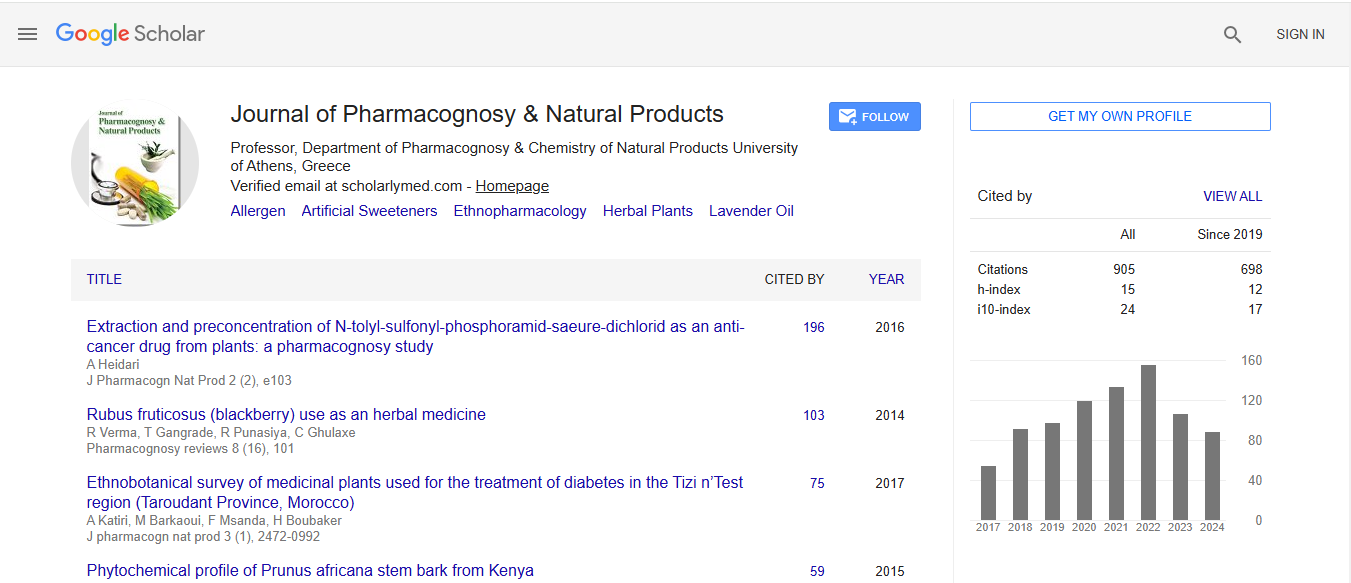
Journal of Pharmacognosy & Natural Products received 606 citations as per Google Scholar report