Commentary - (2025) Volume 16, Issue 2
Received: 03-Mar-2025, Manuscript No. jch-26-178745;
Editor assigned: 05-Mar-2025, Pre QC No. P-178745;
Reviewed: 19-Mar-2025, QC No. Q-178745;
Revised: 24-Mar-2025, Manuscript No. R-178745;
Published:
31-Mar-2025
, DOI: 10.37421/2157-7099.2025.16.783
Citation: Bianchi, Marco L.. ”FNAC: Minimally Invasive Diagnostic Cornerstone For Lesions.” J Cytol Histol 16 (2025):783.
Copyright: © 2025 Bianchi L. Marco This is an open-access article distributed under the terms of the Creative Commons Attribution License, which permits unrestricted use, distribution and reproduction in any medium, provided the original author and source are credited.
Fine Needle Aspiration Cytology (FNAC) has undergone considerable advancement, solidifying its position as a vital instrument in contemporary medical practice. Its minimally invasive nature, affordability, and swift diagnostic capabilities enable timely patient care, particularly for superficial lumps and accessible organs. FNAC is instrumental in distinguishing between benign and malignant lesions, guiding subsequent investigations, and informing treatment strategies across diverse specialties such as endocrinology, breast pathology, and head and neck oncology. The integration of FNAC with ancillary techniques further refines its diagnostic precision and therapeutic efficacy [1].
The utility of FNAC is also evident in the assessment of thyroid nodules, providing a rapid and effective initial evaluation method. It facilitates the categorization of nodules as benign or suspicious for malignancy, thereby preventing unnecessary surgeries for benign conditions and ensuring prompt treatment for malignant ones. The synergy of FNAC with imaging modalities like ultrasound enhances lesion targeting accuracy and diagnostic yield. Current research efforts are focused on improving sample quality and incorporating molecular markers for more definitive diagnoses [2].
In breast pathology, FNAC of palpable breast masses remains a cornerstone diagnostic procedure. It offers a quick, cost-effective, and minimally invasive approach for differentiating benign conditions from malignant neoplasms. The procedure can often be performed in an outpatient setting, optimizing the diagnostic pathway and alleviating patient anxiety. Enhancements in technique and cytological interpretation have further improved its accuracy in breast lesion evaluation [3].
The role of FNAC in diagnosing pancreatic lesions, especially in differentiating cystic from solid tumors and identifying malignancy, is gaining increasing recognition. While core needle biopsy is often preferred for definitive tissue architecture, FNAC yields rapid cytological material for initial assessment, particularly in patients who are poor surgical candidates. Its application in conjunction with imaging is crucial for accurate sample acquisition [4].
Lymph node assessment via FNAC is a fundamental diagnostic procedure for a spectrum of conditions, including infections, inflammatory disorders, and metastatic cancers. It provides a minimally invasive method for obtaining material for cytological examination, aiding in disease diagnosis and staging. This procedure is generally well-tolerated by patients and yields rapid results compared to excisional biopsy [5].
The integration of FNAC with immunohistochemistry and molecular testing has substantially augmented its diagnostic power. These supplementary techniques enable more precise tumor classification, identification of prognostic markers, and prediction of treatment response. This combined approach is particularly beneficial in differentiating tumor subtypes and guiding personalized medicine strategies [6].
In the management of salivary gland lesions, FNAC plays a pivotal role by offering a reliable method for differentiating benign from malignant tumors. This initial cytological assessment informs subsequent diagnostic and therapeutic decisions, potentially averting unnecessary extensive surgical interventions for benign conditions. The accuracy of the technique is enhanced by correlating cytological findings with imaging results [7].
While less common than biopsies in gynecological practice, FNAC of the cervix and endometrium can be valuable in specific scenarios. It assists in detecting malignancy and precancerous lesions, particularly in patients for whom other methods are contraindicated or insufficient. Its minimally invasive nature makes it a viable option for screening and initial diagnosis [8].
The application of FNAC in diagnosing bone and soft tissue lesions, though occasionally challenging, serves as a valuable initial step. It can aid in differentiating between benign and malignant masses, guide further imaging, and inform the necessity of a biopsy. Accuracy is improved through image guidance and correlation with clinical and radiological findings [9].
FNAC is critical in the initial diagnosis of lung nodules and masses, especially when combined with imaging techniques like CT. It allows for the sampling of suspicious lesions without resorting to more invasive procedures, providing cytological material for diagnosis that subsequently guides further management. Its cost-effectiveness and accessibility render it a valuable tool in thoracic oncology [10].
Fine Needle Aspiration Cytology (FNAC) has evolved into an indispensable tool in modern clinical practice, characterized by its minimally invasive nature, cost-effectiveness, and rapid diagnostic capabilities. This allows for timely patient management, especially in the diagnosis of superficial lumps and accessible organs. FNAC plays a crucial role in differentiating benign from malignant lesions, guiding further investigations, and aiding in treatment planning across various specialties like endocrinology, breast pathology, and head and neck oncology. Its increasing integration with ancillary techniques further enhances its diagnostic accuracy and therapeutic impact [1].
The utility of FNAC extends significantly to thyroid nodules, providing a rapid and effective method for their initial assessment. It aids in categorizing nodules as benign or suspicious for malignancy, thereby preventing unnecessary surgeries for benign lesions and facilitating prompt treatment for malignant ones. The integration of FNAC with imaging modalities such as ultrasound improves the accuracy of lesion targeting and overall diagnostic yield. Current trends emphasize improving sample quality and incorporating molecular markers for more definitive diagnoses [2].
Breast FNAC remains a foundational procedure in the diagnosis of palpable breast masses. It offers a quick, cost-effective, and minimally invasive approach to distinguish between benign conditions and malignant neoplasms. This procedure can often be performed in an outpatient setting, streamlining the diagnostic pathway and reducing patient anxiety. Advances in technique and cytological interpretation have further refined its accuracy in breast lesion assessment [3].
The role of FNAC in diagnosing pancreatic lesions, particularly in distinguishing cystic from solid tumors and identifying malignancy, is increasingly recognized. Although core needle biopsy is often preferred for definitive tissue architecture, FNAC provides rapid cytological material for initial assessment, especially in patients who are poor surgical candidates. Its application in conjunction with imaging is crucial for accurate sample acquisition [4].
Lymph node assessment through FNAC is a fundamental diagnostic procedure for a wide array of conditions, including infections, inflammatory disorders, and metastatic cancers. It offers a minimally invasive way to obtain material for cytological examination, aiding in the diagnosis and staging of diseases. The procedure is typically well-tolerated by patients and provides rapid results compared to excisional biopsy [5].
The integration of FNAC with immunohistochemistry and molecular testing has significantly enhanced its diagnostic power. These ancillary techniques permit more precise classification of tumors, identification of prognostic markers, and prediction of treatment response. This combined approach is particularly valuable in differentiating tumor subtypes and guiding personalized medicine approaches [6].
FNAC is pivotal in the management of salivary gland lesions, offering a reliable method for differentiating benign from malignant tumors. This initial cytological assessment guides subsequent diagnostic and therapeutic decisions, potentially avoiding unnecessary extensive surgical interventions for benign conditions. The technique's accuracy is enhanced by correlating cytological findings with imaging [7].
In gynecological practice, FNAC of the cervix and endometrium, while less common than biopsies, can be useful in specific situations. It aids in the detection of malignancy and precancerous lesions, particularly in patients where other methods are contraindicated or insufficient. The minimal invasiveness makes it a viable option for screening and initial diagnosis [8].
The application of FNAC in diagnosing bone and soft tissue lesions, while sometimes challenging, offers a valuable initial step. It can help differentiate between benign and malignant masses, guide further imaging, and inform the need for a biopsy. Accuracy is improved with image guidance and correlation with clinical and radiological findings [9].
FNAC plays a critical role in the initial diagnosis of lung nodules and masses, particularly when combined with imaging techniques like CT. It allows for sampling of suspicious lesions without the need for more invasive procedures, providing cytological material for diagnosis, which can then guide further management. Its cost-effectiveness and accessibility make it a valuable tool in thoracic oncology [10].
Fine Needle Aspiration Cytology (FNAC) is a minimally invasive, cost-effective, and rapid diagnostic technique widely used in clinical practice. It is crucial for differentiating benign from malignant lesions and guiding treatment across various specialties including endocrinology, breast pathology, head and neck oncology, and thoracic oncology. FNAC is particularly useful for assessing superficial lumps, accessible organs, thyroid nodules, pancreatic lesions, and lymph nodes. Its accuracy is enhanced by integration with imaging modalities and ancillary techniques like immunohistochemistry and molecular testing. While core needle biopsy is sometimes preferred for definitive tissue architecture, FNAC provides valuable initial cytological material. The procedure is well-tolerated, offers rapid results, and can help avoid unnecessary surgeries. Advances in techniques and interpretation continue to refine its diagnostic capabilities, making it a cornerstone in modern diagnostic pathways.
None
None
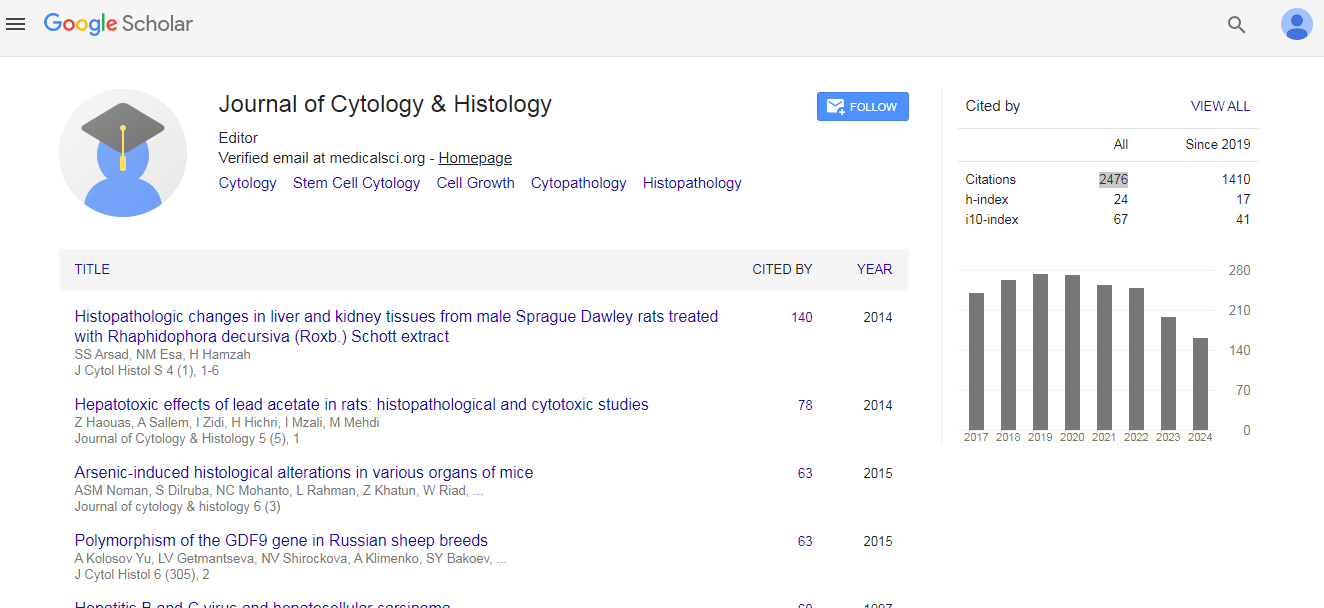
Journal of Cytology & Histology received 2476 citations as per Google Scholar report