Opinion - (2025) Volume 11, Issue 3
Received: 02-Jun-2025, Manuscript No. icoa-25-173587;
Editor assigned: 04-Jun-2025, Pre QC No. P-173587;
Reviewed: 18-Jun-2025, QC No. Q-173587;
Revised: 23-Jun-2025, Manuscript No. R-173587;
Published:
30-Jun-2025
, DOI: 10.37421/2469-9756.2025.11.302
Citation: Novak, Angela R.. ”Flow Cytometry’s Transformation: AI, Imaging, Deeper Insights.” Immunochem Immunopathol 11 (2025):302.
Copyright: © 2025 Novak R. Angela This is an open-access article distributed under the terms of the Creative Commons Attribution License, which permits unrestricted use,
distribution and reproduction in any medium, provided the original author and source are credited.
Flow cytometry stands as a cornerstone technology in biological and medical research, providing unparalleled insights into cellular populations. However, its capabilities are continually evolving, driven by the integration of cutting-edge computational methods and novel instrumental advancements. One significant leap involves how deep learning is fundamentally changing flow cytometry data analysis, providing powerful tools to identify and classify complex cellular populations, moving beyond traditional manual gating methods to enable more accurate disease diagnosis, therapeutic monitoring, and the discovery of novel biomarkers [1] . Beyond general data analysis, specific clinical applications have seen critical developments. For instance, crucial international consensus recommendations now exist for the immunophenotypic diagnosis and monitoring of paroxysmal nocturnal hemoglobinuria (PNH) using flow cytometry. This includes a specific proposal for evaluating residual disease, which ensures standardized and high-quality assessment across different laboratories and clinical settings [2] . New technologies are also expanding the horizon of what's possible. Here's the thing, spectral flow cytometry is really making waves in clinical research. This approach outlines its emerging applications, specifically its enhanced ability to resolve fluorochromes and enable high-parameter single-cell analysis, vital for understanding complex disease mechanisms [3] . This capability complements the significant progress made in utilizing flow cytometry for cancer research, where the technology aids in identifying malignant cells, monitoring treatment efficacy, characterizing the tumor microenvironment, and discovering new biomarkers, all contributing to the advancement of personalized cancer therapies [4] . Ensuring consistency and reliability across these diverse applications is paramount. The EuroFlow consortium presents an innovative, automated quality control system for flow cytometry, ensuring consistency and comparability of results across diverse instrument platforms [5] . This standardization is critical for reliable data in multi-center studies and diagnostic applications, bringing much-needed uniformity to the field. Another advancement in visualization and data acquisition is imaging flow cytometry, which offers a unique blend of high-throughput analysis and detailed cellular morphology, function, and cell-cell interaction insights. This technology provides spatial context to single-cell data, overcoming limitations of traditional flow cytometry by capturing images of individual cells [6] . What this really means is that machine learning and automation are becoming indispensable in flow cytometry, especially for managing and interpreting high-dimensional datasets. This paper explores how these advanced computational approaches streamline data analysis, improve accuracy in cell population identification, and accelerate biomarker discovery [7] . The importance of standardized protocols cannot be overstated, particularly for reproducible research. A rigorously standardized protocol for immunophenotyping human peripheral blood cells via flow cytometry has been detailed and validated across multiple centers. Such a protocol is fundamental for ensuring reliable and reproducible immune monitoring, which is absolutely essential for both clinical research and diagnostics [8] . Let's break it down: The FlowCAP challenges provided a crucial, community-wide evaluation of automated methods for analyzing complex flow cytometry data. This assessment offers valuable insights into the performance, strengths, and limitations of various computational approaches, helping researchers choose the best tools for their specific needs in cell population identification and biomarker discovery [9] . All these advancements contribute to a clear picture of high-dimensional flow cytometry, detailing its current capabilities and exciting future prospects. By simultaneously measuring an unprecedented number of cellular parameters, this technology is unlocking deeper biological insights, moving us toward a more comprehensive understanding of cellular systems and disease [10] .
The landscape of flow cytometry is rapidly transforming, moving beyond conventional techniques to embrace sophisticated computational and technological innovations. Here's the thing, deep learning is fundamentally reshaping how we analyze flow cytometry data, offering robust tools for identifying and classifying intricate cellular populations. This shift enables more precise disease diagnosis, effective therapeutic monitoring, and the discovery of novel biomarkers, significantly advancing capabilities beyond older, manual gating methods [1]. These computational strategies are crucial for handling the increasing complexity of data generated by modern flow cytometry platforms.
Alongside these analytical improvements, the field is seeing the emergence of specialized flow cytometry modalities that offer enhanced data richness. Spectral flow cytometry, for instance, is garnering significant attention in clinical research due to its superior ability to resolve fluorochromes. This allows for high-parameter single-cell analysis, which is vital for dissecting complex disease mechanisms with unprecedented detail [3]. Complementing this, imaging flow cytometry provides a unique blend of high-throughput analysis with the added benefit of detailed cellular morphology, functional insights, and observations of cell-cell interactions. This technology captures actual images of individual cells, thereby providing spatial context to single-cell data and overcoming some inherent limitations of traditional, image-less flow cytometry [6].
What this really means is that these advancements are directly translating into improved clinical applications. In cancer research, flow cytometry continues to be an indispensable tool, aiding in the identification of malignant cells, the monitoring of treatment efficacy, the characterization of the tumor microenvironment, and the discovery of new biomarkers. These applications collectively contribute to the development of more personalized and effective cancer therapies [4]. Similarly, for specific conditions like paroxysmal nocturnal hemoglobinuria (PNH), international consensus recommendations have been established for immunophenotypic diagnosis and monitoring using flow cytometry. This includes a detailed proposal for evaluating residual disease, ensuring a consistent and high-quality assessment standard across diverse clinical and laboratory settings [2].
To ensure the reliability and comparability of these advanced analyses, particularly in multi-center studies and diagnostic applications, standardization and quality control are paramount. The EuroFlow consortium has developed an innovative, automated quality control system for flow cytometry. This system ensures consistency and comparability of results across various instrument platforms, bringing much-needed standardization to the field and bolstering data integrity [5]. Furthermore, the importance of rigorously standardized protocols is underscored by efforts to establish common methods, such as a multi-center validated protocol for immunophenotyping human peripheral blood cells via flow cytometry. Such standardization is fundamental for ensuring reliable and reproducible immune monitoring, a critical aspect of both clinical research and diagnostics [8].
Let's break it down: The sheer volume and dimensionality of data generated by modern flow cytometry necessitate sophisticated computational solutions. Machine learning and automation are becoming indispensable for managing and interpreting these high-dimensional datasets. These advanced computational approaches streamline data analysis, significantly improve accuracy in identifying cell populations, and accelerate the discovery of novel biomarkers [7]. The efficacy of various automated analysis methods for complex flow cytometry data has even been subject to community-wide evaluation through initiatives like the FlowCAP challenges. These assessments have offered valuable insights into the performance, strengths, and limitations of different computational tools, thereby guiding researchers in selecting the most appropriate methods for their specific needs in cell population identification and biomarker discovery [9]. All these developments culminate in high-dimensional flow cytometry, which, by simultaneously measuring an unprecedented number of cellular parameters, is unlocking deeper biological insights. This progressive understanding moves us towards a more comprehensive grasp of cellular systems and disease, representing the exciting current status and future perspectives of the technology [10].
Flow cytometry is undergoing a significant transformation, driven by innovative technologies and advanced computational methods. Deep Learning is fundamentally changing how data from flow cytometry gets analyzed, offering powerful tools to identify and classify complex cellular populations, which helps in more accurate disease diagnosis and the discovery of new biomarkers. What this really means is that we are moving beyond traditional manual gating methods. Imaging Flow Cytometry, for example, combines high-throughput analysis with detailed cellular morphology, function, and insights into cell-cell interactions. It provides spatial context to single-cell data, capturing images of individual cells to overcome the limitations of older techniques. Similarly, spectral flow cytometry is making waves in clinical research with its enhanced ability to resolve fluorochromes and enable high-parameter single-cell analysis, which is vital for understanding complex disease mechanisms. The field is also seeing major advancements in specific applications. In cancer research, flow cytometry significantly aids in identifying malignant cells, monitoring treatment efficacy, characterizing the tumor microenvironment, and discovering new biomarkers, all essential for personalized therapies. Furthermore, international consensus recommendations now guide the immunophenotypic diagnosis and monitoring of conditions like paroxysmal nocturnal hemoglobinuria, ensuring standardized and high-quality assessment across different laboratories. To maintain this consistency, the EuroFlow consortium introduced an innovative, automated quality control system for flow cytometry, ensuring comparable results across diverse instrument platforms. Here's the thing, managing and interpreting the ever-growing, high-dimensional datasets from flow cytometry demands advanced computational approaches. Machine Learning and automation are becoming indispensable, streamlining data analysis, improving accuracy in cell population identification, and accelerating biomarker discovery. Community-wide assessments, like the FlowCAP challenges, have evaluated automated methods, offering valuable insights into their performance. All these developments point towards high-dimensional flow cytometry unlocking deeper biological insights by measuring an unprecedented number of cellular parameters, pushing towards a more comprehensive understanding of cellular systems and disease.
None
None
1. Sean CB, Kevin LD, Brice G. "Deep learning for cytometry: a review of methods, applications, and opportunities".Curr Opin Immunol 85 (2023):102379.
Indexed at, Google Scholar, Crossref
2. Brent LW, Dima A, Maria A. "International consensus recommendations on the immunophenotypic diagnosis and monitoring of paroxysmal nocturnal hemoglobinuria, including a proposal for evaluation of residual disease".Cytometry B Clin Cytom 98 (2020):99-119.
Indexed at, Google Scholar, Crossref
3. Heejeong P, Byung KO, Yeong C. "Emerging applications of spectral flow cytometry in clinical research".Front Immunol 12 (2021):794356.
Indexed at, Google Scholar, Crossref
4. Yang Z, Pei W, Xinyu L. "Advances in applications of flow cytometry for cancer research".Front Oncol 13 (2023):1184394.
Indexed at, Google Scholar, Crossref
5. Tomas K, Marc B, Claire C. "EuroFlow quality control for flow cytometry: An extensive automated toolbox applicable across instrument platforms".Cytometry A 99 (2021):1083-1094.
Indexed at, Google Scholar, Crossref
6. Sarah MB, Carlo DC, Martin H. "Imaging flow cytometry for characterization of cellular morphology, function, and cellâ??cell interactions".Cytometry A 97 (2020):1083-1095.
Indexed at, Google Scholar, Crossref
7. Johannes D, Maren H, Christian F. "Advancing Flow Cytometry: Machine Learning and Automation in Data Analysis".Curr Protoc 3 (2023):e855.
Indexed at, Google Scholar, Crossref
8. Roberta S, Daniela M, Marco M. "The Use of Flow Cytometry for the Immunophenotyping of Human Peripheral Blood Cells: A Standardized Protocol for a Multicenter Study".Methods Mol Biol 2271 (2021):47-68.
Indexed at, Google Scholar, Crossref
9. Nima A, Pratip KC, Narmada G. "The FlowCAP-I and FlowCAP-II challenges: a community-wide assessment of automated analysis methods for flow cytometry data".Cytometry A 99 (2021):21-33.
Indexed at, Google Scholar, Crossref
10. Stephen PP, Pratip KC, Margaret K. "High-dimensional flow cytometry: current status and future perspectives".Curr Opin Syst Biol 31 (2022):100412.
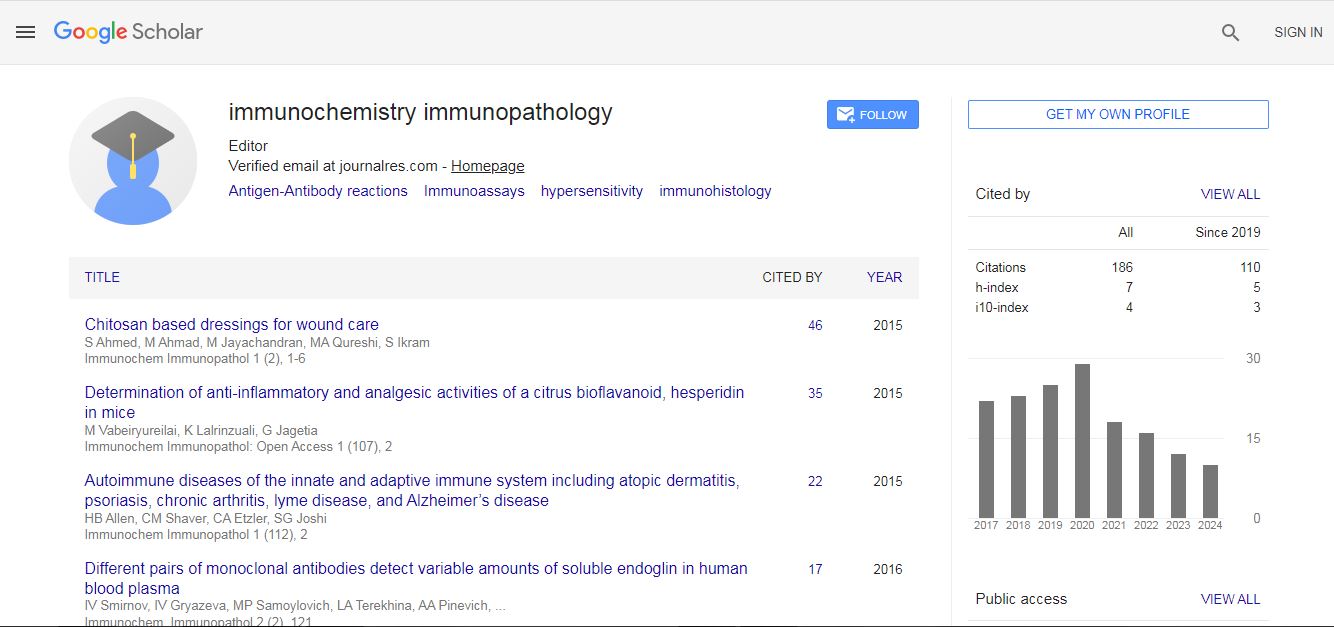
Immunochemistry & Immunopathology received 174 citations as per Google Scholar report