Brief Report - (2025) Volume 14, Issue 5
Received: 01-Sep-2025, Manuscript No. iem-26-179824;
Editor assigned: 03-Sep-2025, Pre QC No. P-179824;
Reviewed: 14-Sep-2025, QC No. Q-179824;
Revised: 22-Sep-2025, Manuscript No. R-179824;
Published:
29-Sep-2025
, DOI: 10.37421/2169- 0316.2025.14.318
Citation: Novak, Anna. âFlexible Manufacturing Systems: Adapting Industry 4.0.â J Ind Eng Manag 14 (2025):318.
Copyright: © 2025 Novak A. This is an open-access article distributed under the terms of the Creative Commons Attribution License, which permits unrestricted use, distribution and reproduction in any medium, provided the original author and source are credited.
Flexible Manufacturing Systems (FMS) are fundamental to modern industrial operations, offering the capacity for rapid adaptation to evolving market demands, diverse product portfolios, and personalized production needs. These systems amalgamate cutting-edge technologies such as automation, robotics, and real-time data processing to achieve remarkable agility and efficiency. The central tenet of FMS is the ability of production lines to reconfigure swiftly for different products without incurring substantial downtime or extensive retooling processes. This strategic approach significantly bolsters competitiveness by reducing lead times and optimizing the utilization of resources, marking a paradigm shift in manufacturing efficiency [1].
The integration of sophisticated technologies like Artificial Intelligence (AI) and the Internet of Things (IoT) serves as a pivotal facilitator for the advancement of FMS. AI algorithms are instrumental in optimizing critical functions, including production scheduling, resource allocation, and predictive maintenance, while IoT sensors continuously provide real-time data streams on machine performance and the overall flow of products. This intricate network of interconnectedness empowers intelligent decision-making and enables autonomous adjustments, thereby further amplifying system flexibility and responsiveness to dynamic market fluctuations [2].
Agile production strategies, which are frequently underpinned by the robust framework of FMS, are indispensable for businesses aiming to thrive amidst the prevailing volatile market conditions. This necessitates not only technological adaptability but also a profound sense of organizational flexibility. The inherent ability to swiftly pivot production strategies, effectively manage a wide array of product portfolios, and meticulously respond to the unique requirements of individual customers are definitive hallmarks of success in contemporary manufacturing landscapes [3].
Despite their significant advantages, the implementation of FMS is not without its challenges. These hurdles typically include substantial initial investment costs, the imperative need for a highly skilled workforce, and the inherent complexity associated with integrating disparate system components. Nevertheless, the long-term benefits, which encompass increased throughput, enhanced product quality, and significantly improved operational flexibility, often demonstrably outweigh these initial challenges, solidifying FMS as a strategic imperative for numerous industries [4].
The advent of digital twins is heralding a revolutionary era for FMS, by offering precise virtual replicas of physical manufacturing systems. This technological leap facilitates real-time monitoring, sophisticated simulation capabilities, and advanced optimization of production processes, all without causing any disruption to ongoing actual operations. The strategic application of digital twins notably enhances predictive maintenance protocols, streamlines process improvement initiatives, and greatly improves the capacity to rigorously test new system configurations in a virtual environment before their physical deployment [5].
The discernible shift towards mass customization, largely propelled by the ever-evolving expectations of consumers, critically necessitates the adoption of highly flexible manufacturing capabilities. FMS are unequivocally instrumental in facilitating this transformative transition, enabling the efficient production of small batches and highly individualized products while steadfastly maintaining cost-effectiveness and operational speed. This crucial flexibility emerges as a key determinant in preserving a competitive edge within the current market [6].
Human-robot collaboration (HRC) is progressively emerging as an increasingly vital aspect of sophisticated FMS, contributing significantly to improvements in both flexibility and overall efficiency. Robots are adeptly performing repetitive or hazardous tasks, thereby freeing human workers to leverage their dexterity, sophisticated problem-solving skills, and inherent adaptability for more complex and nuanced operations. This synergistic partnership optimizes workflows and demonstrably enhances safety within diverse manufacturing environments [7].
The widespread adoption of FMS is intrinsically intertwined with the broader conceptual framework of Industry 4.0, a paradigm that champions intelligent automation, seamless connectivity, and robust data-driven decision-making. FMS serve as a foundational cornerstone for the creation of smart factories, facilitating real-time communication networks among machines, products, and overarching systems, consequently fostering unprecedented levels of agility and operational efficiency [8].
Supply chain resilience is substantially fortified through the inherent flexibility that FMS provide. The capacity to rapidly reconfigure production lines and adeptly adapt to unforeseen disruptions empowers manufacturers to sustain optimal output levels and consistently meet demand, even in the face of unexpected events, thereby reinforcing the robustness and reliability of the entire supply chain [9].
The economic viability of implementing FMS is increasingly being bolstered by the strategic application of modular design principles. This approach facilitates more straightforward reconfiguration and expansion of existing manufacturing capabilities. Such modularity effectively reduces both the cost and the time required for adapting to new product lines or fluctuating production volumes, ultimately rendering FMS a more accessible and adaptable solution for an increasingly diverse spectrum of industries [10].
Flexible Manufacturing Systems (FMS) are indispensable for modern industries, enabling swift adaptation to dynamic market demands, a wide array of product varieties, and the intricacies of customized production. They achieve this by integrating advanced technologies like automation, robotics, and real-time data processing, leading to enhanced agility and efficiency. The fundamental principle of FMS lies in its ability to quickly reconfigure production lines for diverse products without significant downtime or extensive retooling, thereby boosting competitiveness through reduced lead times and improved resource utilization [1].
The synergistic integration of Artificial Intelligence (AI) and the Internet of Things (IoT) is a paramount enabler for developing sophisticated FMS. AI algorithms are crucial for optimizing production scheduling, efficient resource allocation, and implementing predictive maintenance strategies. Concurrently, IoT sensors furnish real-time performance data from machinery and track the flow of products. This interconnected ecosystem fosters intelligent decision-making and autonomous adjustments, significantly increasing system flexibility and responsiveness to market shifts [2].
Agile production strategies, often facilitated by the inherent capabilities of FMS, are vital for businesses navigating volatile market conditions. Success in this domain requires not only technological adaptability but also organizational flexibility. Key characteristics of successful modern manufacturing include the capacity for rapid production pivots, effective management of diverse product portfolios, and responsiveness to specific customer demands [3].
The implementation of FMS, while offering substantial benefits, also presents notable challenges. These include significant initial capital investment, the necessity of highly skilled personnel, and the inherent complexity of integrating various system components. Despite these obstacles, the long-term advantages, such as increased throughput, superior product quality, and heightened operational flexibility, frequently justify the investment, making FMS a strategic necessity for many industrial sectors [4].
Digital twins are revolutionizing FMS by creating precise virtual replicas of physical systems. This technology allows for real-time monitoring, simulation, and optimization of production processes without interrupting ongoing operations. The utilization of digital twins enhances predictive maintenance, facilitates process improvements, and enables the virtual testing of new configurations prior to physical implementation [5].
The growing trend towards mass customization, driven by evolving consumer expectations, demands highly flexible manufacturing capabilities. FMS are crucial in enabling this transition by allowing for the cost-effective and swift production of small batches and individually tailored products. This level of flexibility is a critical factor in maintaining a competitive advantage in today's market landscape [6].
Human-robot collaboration (HRC) is becoming an increasingly important element within FMS, augmenting both flexibility and efficiency. Robots excel at performing repetitive or dangerous tasks, while humans contribute essential dexterity, problem-solving skills, and adaptability for complex operations. This collaborative synergy leads to optimized workflows and improved safety within manufacturing environments [7].
The adoption of FMS aligns closely with the principles of Industry 4.0, emphasizing intelligent automation, pervasive connectivity, and data-driven decision-making. FMS serve as a core component in building smart factories, enabling seamless real-time communication between machines, products, and systems, thereby fostering unparalleled levels of agility and efficiency [8].
Supply chain resilience is significantly bolstered by the flexibility inherent in FMS. The ability to rapidly reconfigure production lines and adapt to disruptions allows manufacturers to maintain output and meet demand even under unexpected circumstances, thereby strengthening the overall supply chain's robustness [9].
The economic feasibility of FMS is increasingly supported by the adoption of modular design principles, which simplify reconfiguration and expansion of manufacturing capacities. Modularity reduces the cost and time associated with adapting to new product lines or varying production volumes, making FMS a more accessible and adaptable solution for a broader range of industries [10].
Flexible Manufacturing Systems (FMS) are crucial for modern industries, enabling rapid adaptation to changing demands, product variety, and customization through the integration of automation, robotics, and real-time data processing. They allow for quick production line reconfiguration without significant downtime, enhancing competitiveness by reducing lead times and improving resource utilization. The integration of AI and IoT further optimizes production scheduling, resource allocation, and predictive maintenance, while digital twins provide virtual replicas for monitoring and simulation. Agile production strategies supported by FMS are essential for navigating volatile markets, and human-robot collaboration enhances efficiency and flexibility. FMS are a cornerstone of Industry 4.0 and smart factories, contributing to supply chain resilience and economic viability through modular design principles. While challenges like high initial costs exist, the long-term benefits of increased throughput, improved quality, and operational flexibility make FMS a strategic imperative.
None
None
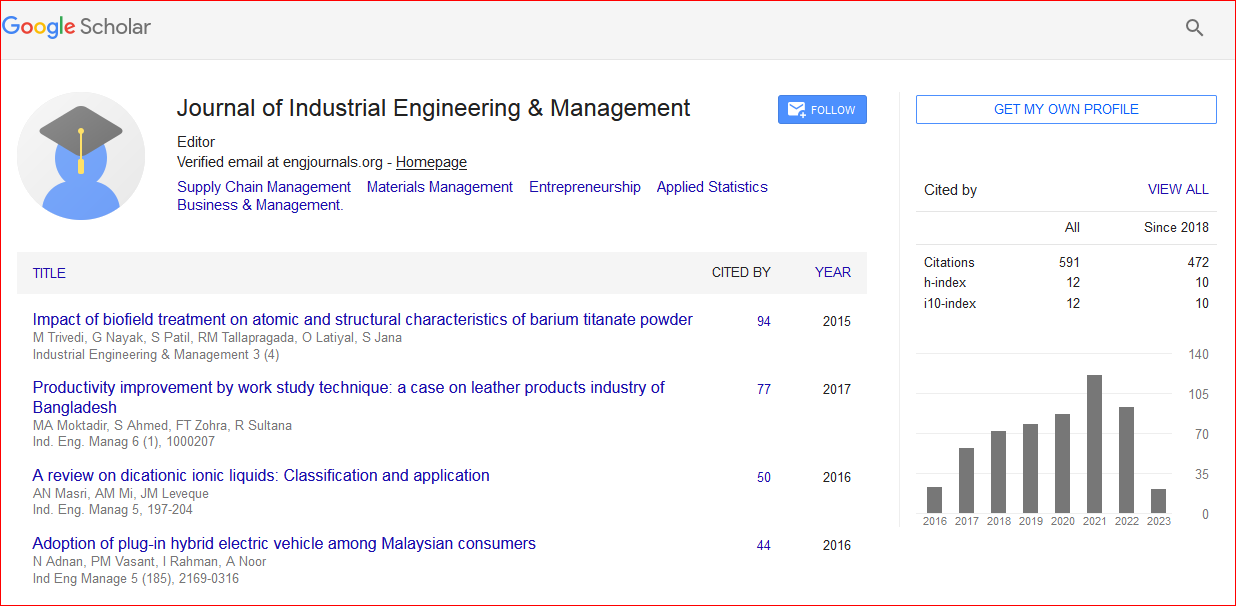
Industrial Engineering & Management received 739 citations as per Google Scholar report