Brief Report - (2025) Volume 13, Issue 3
Received: 01-May-2025, Manuscript No. economics-26-186046;
Editor assigned: 05-May-2025, Pre QC No. P-186046;
Reviewed: 19-May-2025, QC No. Q-186046;
Revised: 22-May-2025, Manuscript No. R-186046;
Published:
29-May-2025
, DOI: 10.37421/2375-4389.2025.13.522
Citation: Lefebvre, Manon. ”Fiscal Stimulus: Balancing Growth,
Stability, and Debt.” J Glob Econ 13 (2025):522.
Copyright: © 2025 Lefebvre M. This is an open-access article distributed under the terms of the Creative Commons Attribution License, which permits unrestricted use,
distribution and reproduction in any medium, provided the original author and source are credited.
The multifaceted role of fiscal stimulus during periods of economic instability has become a critical area of academic and policy inquiry. Targeted government spending and tax relief are recognized as powerful tools to mitigate recessions, stimulate aggregate demand, and provide essential support to vulnerable populations, underscoring the importance of well-designed interventions [1].
In times of global economic uncertainty, governments are increasingly exploring unconventional fiscal policy measures beyond traditional spending and tax adjustments. These can include forward guidance on fiscal policy, significant public investment in green technologies, and direct income support programs, demonstrating a broader toolkit for economic management [2].
Assessing the macroeconomic consequences of sustained fiscal stimulus in advanced economies facing persistent uncertainty is crucial. Different stimulus designs, whether consumption-based or investment-focused, can significantly impact inflation, employment levels, and sovereign debt, necessitating careful consideration of their potential effects [3].
The distributional effects of fiscal stimulus measures during economic downturns are also a significant concern. Analyzing how various policy instruments, such as direct cash transfers and tax credits, affect different income groups is vital for ensuring equitable outcomes and mitigating inequality [4].
The interplay between fiscal stimulus and monetary policy in managing economic uncertainty warrants close examination. Coordinated actions by fiscal and monetary authorities are often crucial for influencing macroeconomic outcomes effectively, especially during periods of high uncertainty [5].
Public investment, particularly in areas like infrastructure, green energy, and digital technologies, can serve as a potent fiscal stimulus for fostering long-term economic growth during uncertain times. Such investments have the potential to create jobs, enhance productivity, and build resilience [6].
The impact of fiscal stimulus on inflation expectations and actual inflation during periods of economic volatility is a key consideration. The perceived permanence and financing of stimulus measures can significantly influence price dynamics, making careful design and communication essential [7].
The effectiveness of automatic fiscal stabilizers in mitigating economic downturns characterized by high uncertainty is another important aspect. Built-in mechanisms like progressive taxation and unemployment benefits can provide automatic cushioning, reducing the need for complex discretionary adjustments [8].
In emerging market economies, the impact of fiscal stimulus on sovereign debt sustainability is a significant concern, especially when facing heightened global uncertainty. Balancing short-term stabilization needs with long-term fiscal health requires a cautious approach and credible fiscal frameworks [9].
Addressing supply-side shocks during periods of economic uncertainty through fiscal stimulus is increasingly relevant. Government measures aimed at supporting critical industries, enhancing supply chain resilience, and assisting labor market adjustments can help alleviate inflationary pressures and restore stability [10].
This article investigates the multifaceted role of fiscal stimulus during periods of economic instability, highlighting how targeted government spending and tax relief can mitigate recessions, stimulate demand, and support vulnerable populations. The authors emphasize the importance of timely and appropriate policy design, considering factors like the size of the stimulus, its composition, and the prevailing economic conditions to maximize effectiveness and minimize unintended consequences such as inflation or increased debt [1].
Examining the impact of unconventional fiscal policies, this paper delves into how governments can deploy stimulus measures beyond traditional spending and tax cuts during uncertain economic times. It explores tools like forward guidance on fiscal policy, public investment in green technologies, and direct income support. The study underscores that the effectiveness of these policies is contingent on institutional capacity, public trust, and international coordination [2].
This research assesses the macroeconomic consequences of sustained fiscal stimulus in advanced economies facing persistent uncertainty. It models how different stimulus designsâ??whether consumption-based or investment-focusedâ??affect inflation, employment, and sovereign debt levels. The findings suggest that while stimulus can prevent deeper downturns, a careful balance is needed to avoid overheating the economy and creating long-term fiscal vulnerabilities [3].
The paper explores the distributional effects of fiscal stimulus measures during economic downturns. It analyzes how different policy instruments, such as direct cash transfers, tax credits, and unemployment benefits, impact various income groups. The study emphasizes that well-designed stimulus packages can not only stabilize the economy but also reduce income inequality, particularly in times of heightened economic uncertainty where lower-income households are disproportionately affected [4].
This article examines the interplay between fiscal stimulus and monetary policy in managing economic uncertainty. It investigates how coordinated or uncoordinated actions by fiscal and monetary authorities can influence macroeconomic outcomes. The authors suggest that a clear communication strategy and alignment of policy objectives are crucial for an effective response to economic shocks, especially when uncertainty is high [5].
The study analyzes the role of public investment as a fiscal stimulus in fostering long-term economic growth during periods of uncertainty. It focuses on infrastructure, green energy, and digital technologies, arguing that such investments can create jobs, enhance productivity, and build resilience against future shocks. The paper emphasizes the importance of project selection, efficient execution, and a stable policy framework to maximize the multiplier effects of public investment [6].
This research investigates the impact of fiscal stimulus on inflation expectations and actual inflation during times of economic volatility. It examines how the perceived permanence and financing of stimulus measures influence price dynamics. The authors highlight that while stimulus can be necessary, its design and communication are critical to anchoring inflation expectations and avoiding runaway price increases [7].
The paper examines the effectiveness of automatic fiscal stabilizers in mitigating economic downturns characterized by high uncertainty. It analyzes how built-in mechanisms like progressive taxation and unemployment benefits automatically cushion the impact of recessions. The study emphasizes that while discretionary stimulus is often necessary, robust automatic stabilizers can provide a more immediate and efficient response, reducing the need for complex policy adjustments during crises [8].
This article analyzes the impact of fiscal stimulus on sovereign debt sustainability in emerging market economies facing heightened global uncertainty. It explores the trade-offs between short-term stabilization and long-term fiscal health. The authors recommend a cautious approach, emphasizing the need for credible fiscal frameworks, clear debt management strategies, and international support to manage the financial risks associated with stimulus measures [9].
The paper examines the role of fiscal stimulus in addressing supply-side shocks during economic uncertainty. It analyzes how government measures, such as subsidies for critical industries, investments in supply chain resilience, and support for labor market adjustments, can help alleviate inflationary pressures and restore economic stability. The authors stress the importance of targeted interventions that address the root causes of supply disruptions [10].
Fiscal stimulus plays a crucial role in economic instability, with targeted government spending and tax relief mitigating recessions and supporting vulnerable populations. Unconventional policies, including green technology investments and direct income support, are also explored. The impact on inflation, employment, and sovereign debt requires careful balancing to avoid economic overheating and fiscal vulnerabilities. Stimulus packages can reduce income inequality when well-designed. Coordination between fiscal and monetary policies is vital for effective responses. Public investment in infrastructure and technology can foster long-term growth. Managing inflation expectations through stimulus design and communication is essential. Automatic stabilizers offer an efficient response to downturns. Emerging markets must balance stimulus with sovereign debt sustainability. Addressing supply-side shocks through targeted fiscal measures is key to restoring stability.
None
None
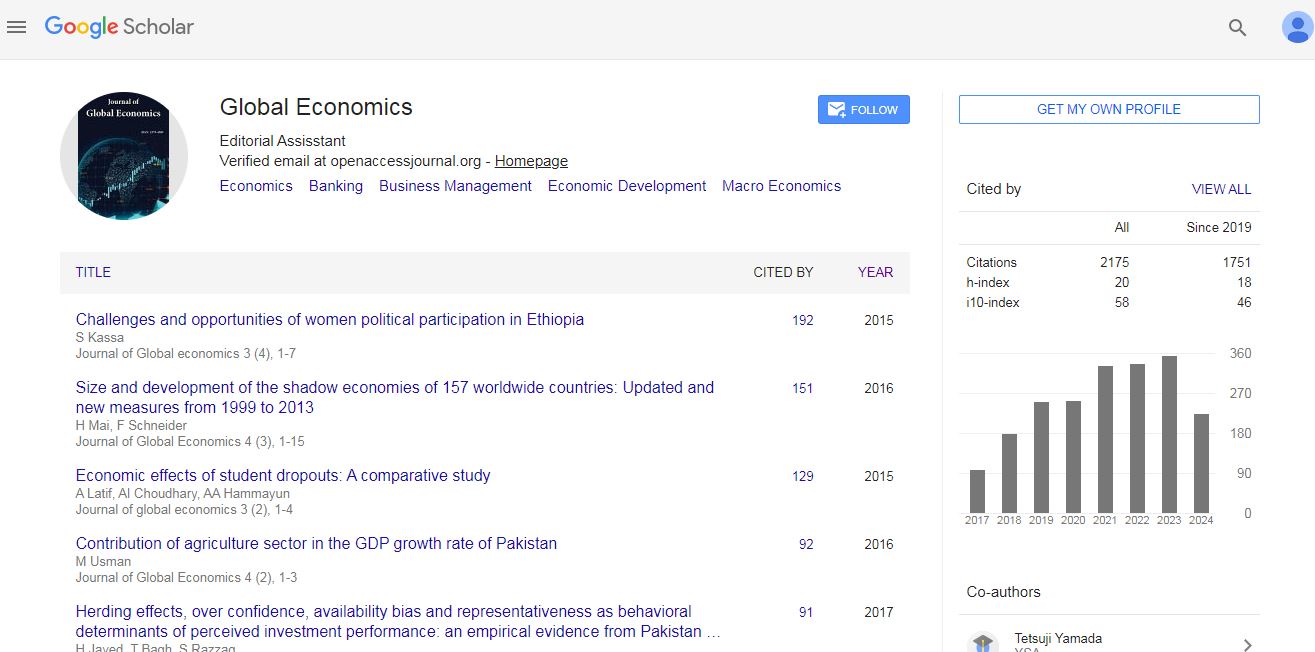
Journal of Global Economics received 2175 citations as per Google Scholar report