Perspective - (2025) Volume 14, Issue 6
Received: 01-Dec-2025, Manuscript No. jbfa-25-176853;
Editor assigned: 03-Dec-2025, Pre QC No. P-176853;
Reviewed: 17-Dec-2025, QC No. Q-176853;
Revised: 22-Dec-2025, Manuscript No. R-176853;
Published:
29-Dec-2025
, DOI: 10.37421/2161-0673.2025.14.566
Citation: Kurian, Anita. ”FinTech’s Evolving Landscape: Innovation, Regulation, Risks.” J Bus Fin Aff 14 (2025):566.
Copyright: © 2025 Kurian A. This is an open-access article distributed under the terms of the Creative Commons Attribution License, which permits unrestricted use, distribution and reproduction in any medium, provided the original author and source are credited.
The financial services sector is currently experiencing an unprecedented wave of technological innovation, profoundly altering its operational paradigms and regulatory requirements. This article explores how blockchain technology is transforming financial services, necessitating a fresh look at regulatory frameworks. It highlights the challenges of fitting decentralized, transparent ledger systems into existing legal structures and proposes a more adaptive, innovation-focused regulatory approach to foster growth while managing risks in the evolving FinTech landscape [1] This paper provides a comprehensive overview of the application of Artificial Intelligence (AI) across various financial services. It identifies key trends like personalized banking, fraud detection, and algorithmic trading, discussing how AI is reshaping customer interactions and operational efficiencies. The authors also consider ethical implications and future prospects for AI integration, emphasizing its potential to drive significant innovation [2] This research examines the emergence and growth of neobanks, digital-only financial institutions that challenge traditional banking models. It analyzes their disruptive capabilities, customer-centric approaches, and technological advantages, while also addressing the regulatory hurdles and competitive pressures they face. The article suggests neobanks are driving a significant shift in consumer expectations and the competitive landscape of the financial sector [3] This paper explores the transformative potential of RegTech in revolutionizing financial regulation and compliance. It discusses how technologies like Artificial Intelligence (AI), machine learning, and blockchain can enhance supervisory efficiency, reduce compliance costs, and improve risk management. The authors emphasize that effective adoption of RegTech requires collaboration between regulators, financial institutions, and technology providers to navigate complex challenges and secure a more resilient financial system [4] This review offers an in-depth analysis of open banking, a paradigm where third-party providers gain access to customer data (with consent) from banks to offer new services. It outlines the opportunities for innovation, enhanced competition, and personalized financial products, alongside significant challenges related to data privacy, security, and interoperability. The article concludes that successful open banking implementation hinges on robust regulatory frameworks and strong consumer trust [5] This study investigates the impact of InsurTech, the application of technology to the insurance sector, on traditional business models. It highlights how innovations like Artificial Intelligence (AI)-driven underwriting, telematics, and personalized risk assessment are reshaping product development, distribution, and claims processing. The authors discuss the strategic implications for incumbents and new entrants, stressing the need for adaptability and collaboration to thrive in this evolving industry [6] This paper delves into the potential effects of Central Bank Digital Currencies (CBDCs) on financial stability. It analyzes how CBDCs could alter bank funding, liquidity management, and monetary policy transmission mechanisms. The authors caution that while CBDCs offer benefits like increased financial inclusion and payment efficiency, their design must carefully consider potential risks to the banking system and the broader financial ecosystem to prevent unintended consequences [7] This article explores the nexus between FinTech and green finance, examining how technological innovations can facilitate sustainable investment and environmental protection. It discusses applications such as blockchain for green bond issuance, Artificial Intelligence (AI) for Environmental, Social, and Governance (ESG) data analysis, and crowdfunding for eco-friendly projects. The authors highlight the potential for FinTech to enhance transparency, efficiency, and accessibility in green finance, driving capital towards environmentally responsible initiatives globally [8] This paper provides a thorough examination of the complex landscape of cryptocurrency regulation. It reviews various regulatory approaches adopted globally, from outright bans to comprehensive licensing frameworks, addressing challenges like market volatility, consumer protection, and illicit activities. The authors argue for harmonized international efforts and flexible regulatory tools to effectively manage the risks and harness the innovation potential of digital assets [9] This research analyzes the critical cybersecurity challenges confronting the rapidly evolving FinTech sector. It identifies vulnerabilities stemming from digital transformation, data aggregation, and interconnected systems, proposing various technological and organizational solutions. The authors emphasize the importance of robust security protocols, threat intelligence sharing, and regulatory oversight to protect financial data, maintain trust, and ensure the resilience of FinTech innovations [10]
The transformation of financial services is largely driven by advancements in technology, creating both opportunities and complex challenges. At the core, blockchain technology is fundamentally reshaping financial service delivery, requiring a reevaluation of current regulatory approaches. The task involves integrating decentralized ledger systems into existing legal structures, calling for flexible, innovation-focused regulations that foster growth while effectively managing associated risks [1]. Complementing this, Artificial Intelligence (AI) plays a pervasive role across the financial sector, manifest in personalized banking experiences, advanced fraud detection systems, and sophisticated algorithmic trading strategies. These applications are not only redefining customer interactions but also significantly enhancing operational efficiencies, with ongoing considerations for ethical implications and future integration potential [2].
New models of financial institutions, such as neobanks, are challenging traditional banking paradigms. These digital-only entities leverage customer-centric approaches and technological superiority to disrupt the market. Their growth, however, is met with substantial regulatory hurdles and intense competition, yet they continue to drive shifts in consumer expectations within the financial landscape [3]. Correspondingly, RegTech is emerging as a powerful force in financial regulation and compliance. By utilizing technologies like AI, machine learning, and blockchain, RegTech solutions promise greater supervisory efficiency, reduced compliance costs, and improved risk management. Successful adoption relies heavily on collaboration among regulators, financial institutions, and technology providers to navigate complexities and build a more resilient financial system [4].
Open banking represents a paradigm shift, enabling third-party providers to access customer dataâ??with explicit consentâ??from banks to deliver novel services. This framework unlocks innovation, intensifies competition, and facilitates the creation of personalized financial products. However, it also introduces considerable challenges related to data privacy, security, and interoperability. Effective open banking implementation hinges on robust regulatory frameworks and strong consumer trust [5]. The insurance sector, too, is undergoing a similar evolution through InsurTech, which applies technology to revolutionize traditional business models. Innovations like AI-driven underwriting, telematics, and personalized risk assessment are transforming product development, distribution, and claims processing. This shift demands adaptability and strategic partnerships for both established players and new entrants to thrive [6].
Beyond established financial domains, technological innovation is extending into new areas like Central Bank Digital Currencies (CBDCs) and green finance. Research delves into the potential effects of CBDCs on financial stability, analyzing their capacity to alter bank funding, liquidity management, and monetary policy. While CBDCs offer benefits like enhanced financial inclusion and payment efficiency, their design requires careful consideration of potential risks to the banking system and the broader financial ecosystem to avoid unintended consequences [7]. Furthermore, FinTech is increasingly instrumental in green finance, leveraging technology to promote sustainable investment and environmental protection. Examples include using blockchain for issuing green bonds, AI for Environmental, Social, and Governance (ESG) data analysis, and crowdfunding for eco-friendly initiatives, ultimately enhancing transparency and accessibility in responsible finance globally [8].
Despite these advancements, the FinTech sector faces significant challenges, particularly in regulation and security. The complex landscape of cryptocurrency regulation, for instance, involves diverse global approaches from outright bans to comprehensive licensing. Regulators grapple with market volatility, consumer protection, and illicit activities, underscoring the need for harmonized international efforts and flexible tools to manage risks while fostering innovation [9]. Simultaneously, the rapid digital transformation within FinTech creates critical cybersecurity challenges. Vulnerabilities arise from data aggregation and interconnected systems, demanding robust security protocols, active threat intelligence sharing, and comprehensive regulatory oversight to protect financial data, maintain trust, and ensure the resilience of FinTech innovations [10].
The financial services landscape is experiencing a profound shift driven by FinTech innovations. Blockchain technology is reshaping financial services and necessitates new regulatory frameworks to integrate decentralized systems while managing risks. Artificial Intelligence (AI) applications are widespread, enhancing personalized banking, fraud detection, and algorithmic trading, thereby improving customer interactions and operational efficiencies. Digital-only neobanks are disrupting traditional models through customer-centric approaches and technological advantages, though they face regulatory and competitive pressures. The regulatory space itself is evolving with RegTech, leveraging AI and machine learning to boost supervisory efficiency and reduce compliance costs. Open banking creates opportunities for third-party providers to offer new services by accessing customer data, fostering innovation but also raising concerns about data privacy and security. The insurance sector is also transforming through InsurTech, utilizing AI for underwriting and personalized risk assessment. Beyond these, the potential impact of Central Bank Digital Currencies (CBDCs) on financial stability is a key area of study, with their design requiring careful consideration of risks to the banking system. Furthermore, FinTech is playing a crucial role in green finance, promoting sustainable investment through tools like blockchain for green bonds and AI for Environmental, Social, and Governance (ESG) data analysis. However, navigating the complex world of cryptocurrency regulation, with its market volatility and consumer protection issues, remains a challenge. Finally, the rapid digital transformation in FinTech brings significant cybersecurity challenges, demanding strong security protocols and regulatory oversight to maintain trust and resilience.
None
None
Indexed at, Google Scholar, Crossref
Indexed at, Google Scholar, Crossref
Indexed at, Google Scholar, Crossref
Indexed at, Google Scholar, Crossref
Indexed at, Google Scholar, Crossref
Indexed at, Google Scholar, Crossref
Indexed at, Google Scholar, Crossref
Indexed at, Google Scholar, Crossref
Indexed at, Google Scholar, Crossref
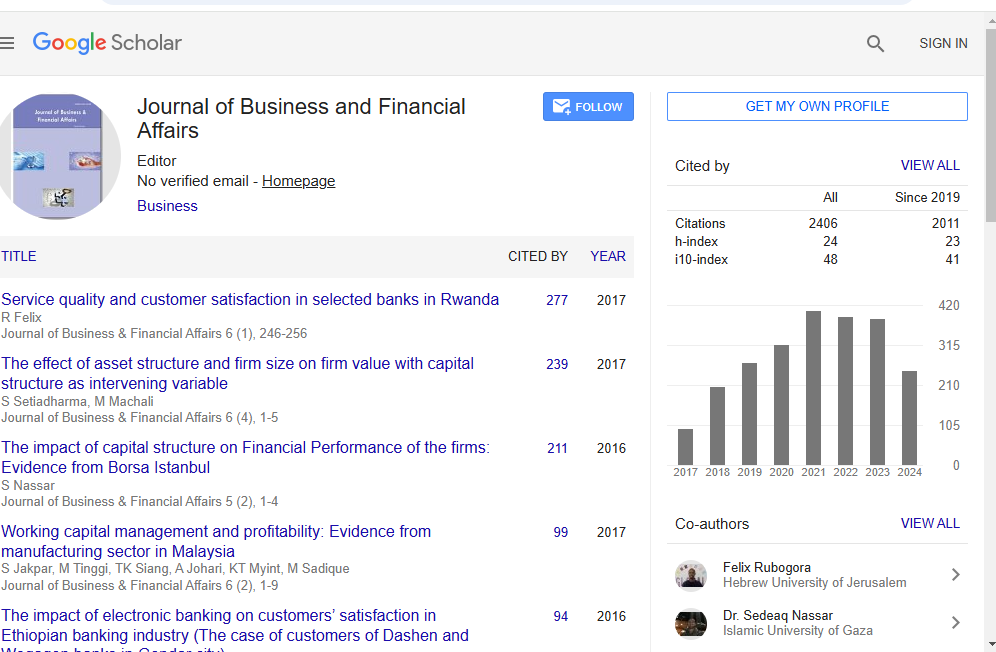
Journal of Business & Financial Affairs received 1726 citations as per Google Scholar report