Perspective - (2025) Volume 14, Issue 5
Received: 01-Oct-2025, Manuscript No. jbfa-25-176831;
Editor assigned: 03-Oct-2025, Pre QC No. P-176831;
Reviewed: 17-Oct-2025, QC No. Q-176831;
Revised: 22-Oct-2025, Manuscript No. R-176831;
Published:
29-Oct-2025
, DOI: 10.37421/2161-0673.2025.14.556
Citation: Al-Majid, Nour. ”Financial Reporting: Governance, Technology, Sustainability Factors.” J Bus Fin Aff 14 (2025):556.
Copyright: © 2025 Al-Majid N. This is an open-access article distributed under the terms of the Creative Commons Attribution License, which permits unrestricted use, distribution and reproduction in any medium, provided the original author and source are credited.
Financial reporting is a foundational element for business transparency and stakeholder decision-making, continuously evolving with new standards, technologies, and societal expectations. One significant area of focus revolves around Environmental, Social, and Governance (ESG) reporting, which has moved beyond a mere compliance exercise to a strategic imperative. This study delves into how ESG reporting concretely influences a firm's financial performance and elevates the quality of its disclosures. What's evident is that robust ESG practices, when accurately and comprehensively reported, do more than just enhance a company's public image; they tangibly improve financial outcomes and contribute to more transparent and reliable financial reporting. This suggests that a strategic focus on ESG factors is no longer a fleeting trend but a critical component for safeguarding both reputational standing and long-term financial health [1].
The advent of digital transformation is fundamentally reshaping how businesses approach financial reporting. Research from an emerging market powerfully illustrates that embracing a suite of digital tools can significantly boost the overall quality of financial reporting. This improvement isn't solely about achieving operational efficiency; it encompasses enhanced accuracy, a notable reduction in reporting errors, and a substantial increase in transparency. These elements are, of course, absolutely crucial for cultivating and maintaining stakeholder trust in a company's financial representations [2].
Beyond technological shifts, the adoption of harmonized standards like International Financial Reporting Standards (IFRS) represents a major structural change in global financial landscapes. This study, specifically examining the context of Egypt, demonstrates that the transition to IFRS generally leads to a marked enhancement in the quality of financial reporting and an increase in transparency. What this really means is that consistent, globally accepted accounting standards pave the way for more comparable and understandable financial statements across different jurisdictions, ultimately providing significant benefits for investors and other financial statement users who operate internationally [3].
Delving deeper into specific technological innovations, blockchain technology is proving to be far more than just the underlying infrastructure for cryptocurrencies; it holds profound implications for the future of financial reporting. A systematic review outlines how blockchain can revolutionize financial transactions by significantly improving data integrity, enhancing security protocols, and offering unparalleled traceability. This suggests a future where financial reporting processes could become considerably less susceptible to manipulation and far more auditable, owing to the inherent, immutable features of distributed ledger technology [4].
Similarly, Artificial Intelligence (AI) is rapidly emerging as a transformative force in the domain of financial reporting. A comprehensive review highlights the diverse ways AI tools can automate routine data processing tasks, dramatically enhance fraud detection capabilities, and significantly improve predictive analytics within the broader financial reporting framework. It's clear that AI has the potential to make reporting not only quicker and more efficient but also profoundly more insightful, moving beyond simple data aggregation to enable deeper, more sophisticated analytical capabilities [5].
Let's further break down the impact of big data analytics on financial reporting. This research concretely demonstrates that publicly listed companies that effectively leverage big data can achieve substantial improvements in their financial reporting quality. This translates into more precise estimations, better informed risk assessments, and consequently, a much clearer and more comprehensive picture of a company's true financial standing. Ultimately, these advancements lead to stakeholders being able to make more informed and robust decisions based on superior financial intelligence [6].
Integrated Reporting (IR) represents a strategic approach aimed at holistically connecting a company's financial performance with its social, environmental, and governance information. A study from South Africa indicates that the adoption of IR positively influences a firm's financial performance and contributes to its overall value. It's fundamentally about presenting a complete, integrated view of how a company creates value, enabling investors to grasp not only the raw financial numbers but also the underlying business model and its long-term sustainability prospects [7].
Meanwhile, narrative reporting, which encompasses the qualitative disclosures found in annual reports and goes beyond mere quantitative figures, plays an increasingly significant role. This research reveals that the manner in which companies articulate their strategic story and future prospects can substantially impact financial analyst forecasts and directly influence how investors make critical investment decisions. It underscores a crucial point: the 'soft' side of reporting, embodied by qualitative disclosures, is just as vital as the hard financial figures in shaping market perceptions and investor confidence [8].
Another pressing global concern, climate change, necessitates robust and transparent financial disclosures regarding related risks and opportunities. A systematic review synthesizes the current landscape of climate change financial disclosures, identifying both progress and ongoing challenges. It points out that the development of standardized, comprehensive reporting in this complex area is still evolving but is absolutely crucial for investors. Accurate and consistent information allows them to properly assess future risks and opportunities, thereby guiding capital allocation towards genuinely sustainable endeavors [9].
Finally, the bedrock of credible financial reporting rests significantly on the quality of corporate governance. This study, with a specific focus on developing countries, reaffirms that strong corporate governance mechanisms are indispensable for materially enhancing the quality of financial reports. This means that factors such as effective and independent boards, diligent external auditors, and ethical leadership collectively contribute to producing more credible and reliable financial information. Such information is truly fundamental for fostering investor confidence and ensuring broader market stability [10].
The landscape of financial reporting is undergoing a profound transformation, driven by an array of factors ranging from evolving global standards to revolutionary technological advancements and increasing demands for non-financial disclosures. A core theme emerging from recent research is the pervasive impact of various influences on the quality, transparency, and utility of financial reports. For instance, the adoption of International Financial Reporting Standards (IFRS) has been shown to generally enhance reporting quality and transparency, creating more comparable and understandable financial statements for international users, as evidenced by studies from regions like Egypt [3]. Similarly, strong corporate governance mechanisms, including effective boards and independent auditors, are consistently identified as essential for improving the credibility and reliability of financial information, particularly in developing economies where such structures are crucial for investor confidence [10]. These foundational elements provide the framework for robust financial disclosure.
Beyond regulatory and structural components, technological innovations are rapidly reshaping the capabilities and efficiency of financial reporting. Digital transformation fundamentally alters how businesses manage their financial records, leading to significant improvements in accuracy, error reduction, and overall transparency [2]. This broader digital shift is further empowered by specific technologies that offer specialized benefits. Blockchain technology, for example, is not merely a tool for cryptocurrencies but offers profound implications for financial reporting by enhancing data integrity, bolstering security, and enabling unprecedented traceability in transactions. This suggests a future where financial reporting could be inherently more auditable and less susceptible to manipulation due to the distributed ledger's characteristics [4]. Artificial Intelligence (AI) also plays a transformative role, automating data processing, significantly improving fraud detection capabilities, and refining predictive analytics. AI makes reporting faster, more efficient, and crucially, more insightful, moving beyond simple data aggregation to offer deeper analytical perspectives [5].
The strategic use of data, particularly big data analytics, provides another powerful lever for enhancing financial reporting quality. Publicly listed companies leveraging big data can achieve more precise estimations, conduct better risk assessments, and ultimately present a clearer, more comprehensive picture of their financial standing. This leads to more informed decision-making for all stakeholders [6]. These technological advancements together signify a move towards a more sophisticated, data-driven approach to financial disclosure, promising greater accuracy and deeper insights.
Moreover, the scope of what constitutes "financial reporting" is expanding to include vital non-financial information, reflecting a growing appreciation for integrated value creation. Environmental, Social, and Governance (ESG) reporting, for instance, is increasingly recognized for its tangible impact on financial performance and disclosure quality. Strong ESG practices, when effectively communicated, do more than just improve a company's image; they directly enhance financial outcomes and foster greater transparency, signifying its critical role for both reputational and financial health [1]. This broader perspective is further captured by Integrated Reporting (IR), which aims to holistically connect financial with social, environmental, and governance information. Studies, such as those from South Africa, suggest that IR positively influences a firm's financial performance and overall value by providing a comprehensive view of how a company creates value and sustains itself [7].
A parallel development in non-financial reporting involves the increasing importance of qualitative disclosures. Narrative reporting, the story and prospects articulated in annual reports, significantly influences financial analyst forecasts and investor decisions. It highlights that the qualitative aspects are just as crucial as the hard figures in shaping market perceptions [8]. Furthermore, the pressing global challenge of climate change necessitates standardized and comprehensive financial disclosures related to its risks and opportunities. While still evolving, clear climate change financial disclosures are becoming indispensable for investors to accurately assess future risks, guide capital allocation, and support sustainable endeavors [9]. Collectively, these trends underscore a shift towards more comprehensive, technologically advanced, and ethically grounded financial reporting that seeks to provide a more holistic and accurate representation of an organization's performance and prospects.
Financial reporting quality and transparency are profoundly influenced by a diverse range of interconnected factors, spanning from established governance structures to cutting-edge technologies and evolving disclosure standards. Foundational improvements stem from robust corporate governance mechanisms and the widespread adoption of International Financial Reporting Standards (IFRS), both of which significantly enhance the credibility, comparability, and reliability of financial reports across various markets. Simultaneously, a wave of technological advancements is revolutionizing reporting processes. Digital transformation, alongside specific innovations like blockchain technology, Artificial Intelligence (AI), and big data analytics, is leading to remarkable improvements in accuracy, operational efficiency, fraud detection capabilities, and the generation of deeper, more nuanced insights into a company's true financial standing. Beyond traditional financial metrics, the scope of reporting is broadening to encompass critical non-financial information. Environmental, Social, and Governance (ESG) practices, when properly reported, are shown to tangibly improve not just a firm's reputation but also its financial performance and the quality of its overall disclosures. Similarly, Integrated Reporting (IR) plays a vital role by presenting a holistic view of how a company creates value, incorporating social, environmental, and governance information, which positively affects firm value. Furthermore, the qualitative aspects of financial communication, such as narrative reporting, significantly impact financial analyst forecasts and investor decision-making. As global concerns mount, comprehensive climate change financial disclosures are also becoming crucial for investors to accurately assess future risks and guide capital allocation towards sustainable endeavors. These developments collectively underscore a dynamic evolution towards more transparent, reliable, insightful, and holistically integrated financial communication, crucial for stakeholder trust and informed decision-making in a complex global economy.
None
None
Indexed at, Google Scholar, Crossref
Indexed at, Google Scholar, Crossref
Indexed at, Google Scholar, Crossref
Indexed at, Google Scholar, Crossref
Indexed at, Google Scholar, Crossref
Indexed at, Google Scholar, Crossref
Indexed at, Google Scholar, Crossref
Indexed at, Google Scholar, Crossref
Indexed at, Google Scholar, Crossref
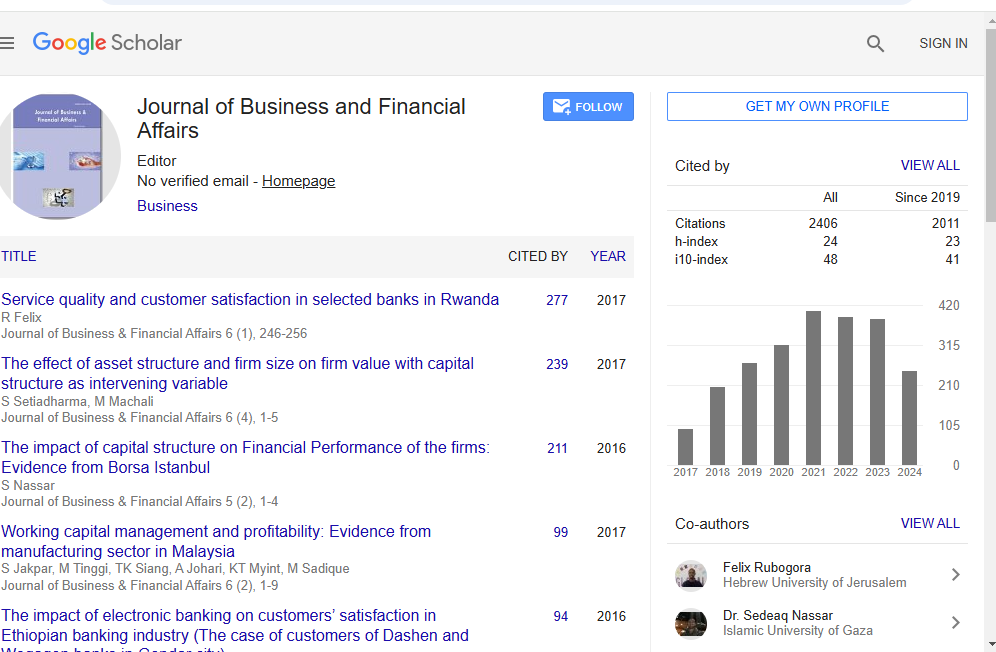
Journal of Business & Financial Affairs received 1726 citations as per Google Scholar report