Perspective - (2025) Volume 14, Issue 3
Received: 01-Jun-2025, Manuscript No. idse-26-182815;
Editor assigned: 03-Jun-2025, Pre QC No. P-182815;
Reviewed: 17-Jun-2025, QC No. Q-182815;
Revised: 23-Jun-2025, Manuscript No. R-182815;
Published:
30-Jun-2025
, DOI: 10.37421/2168-9768.2025.14.494
Citation: Al-Harbi, Mohammed. ”Farm Irrigation And Drainage:
Efficiency, Sustainability, Productivity.” Irrigat Drainage Sys Eng 14 (2025):494
Copyright: © 2025 Al-Harbi M. This is an open-access article distributed under the terms of the Creative Commons Attribution License, which permits unrestricted use,
distribution and reproduction in any medium, provided the original author and source are credited.
The imperative for efficient and sustainable agricultural practices has never been more pronounced, with water management standing as a cornerstone of global food security. Engineering design principles for farm-level irrigation and drainage systems are pivotal in addressing these challenges, emphasizing optimized water use and resource conservation. The development of sophisticated systems aims to enhance crop yields while mitigating environmental impacts, laying the groundwork for resilient agricultural landscapes. This field of study is continuously evolving, driven by the need to adapt to varying climatic conditions and increasing demands on water resources.
Irrigation scheduling represents a critical aspect of water management, particularly in arid and semi-arid regions where water scarcity is a significant constraint. Tailoring irrigation to specific crop requirements and environmental factors, leveraging modern technologies, can dramatically improve water productivity. Such adaptive strategies are essential for maintaining and even increasing crop yields under water-limited scenarios. The integration of real-time data and intelligent decision-making processes is becoming increasingly vital. Addressing the pervasive issue of soil salinity and water table fluctuations in irrigated lands necessitates innovative drainage solutions. Subsurface drainage systems, when properly designed and implemented, play a crucial role in managing these detrimental conditions. Research into novel designs that are both hydraulically efficient and cost-effective offers promising avenues for improving soil health and supporting sustainable crop production. The careful consideration of material selection and system layout is paramount. The integration of smart technologies, including the Internet of Things (IoT), automated control systems, and data analytics, is revolutionizing farm-level irrigation. These advancements enable real-time monitoring of soil conditions, weather patterns, and crop water needs, facilitating precise irrigation applications. Such smart systems are instrumental in achieving significant water savings and boosting agricultural productivity, particularly in the face of growing water scarcity. On-farm rainwater harvesting presents a viable and sustainable approach to supplement irrigation water requirements, especially in areas prone to erratic rainfall. By effectively capturing, storing, and managing rainwater, farmers can reduce their dependence on conventional water sources. Comprehensive guidelines for system sizing, collection efficiency, and storage are essential for maximizing the benefits of this practice. The performance and longevity of drip irrigation emitters are critical factors in the success of micro-irrigation systems. Evaluating emitter performance under diverse water quality conditions highlights the importance of appropriate selection and diligent maintenance to prevent clogging and ensure uniform water application. This is particularly relevant in environments where water quality may pose challenges to system functionality. In flood-prone agricultural regions, the effective design and management of drainage systems are essential for mitigating crop damage and improving soil conditions. A variety of drainage techniques, from open ditches to subsurface systems, can be employed. An integrated approach that combines drainage strategies with other water control measures is often necessary for comprehensive flood mitigation. Micro-irrigation systems, such as drip and micro-sprinkler systems, offer substantial water-saving potential when compared to conventional irrigation methods. Quantifying water use, crop yields, and economic returns demonstrates the tangible benefits of adopting these technologies. Their widespread implementation can lead to considerable improvements in agricultural sustainability. Energy efficiency in farm irrigation pumping systems is a key consideration for reducing operational costs and minimizing the environmental footprint of agriculture. Analyzing different pump types, including solar-powered options, and employing system optimization techniques are crucial. The selection of appropriate pumping technology based on specific farm needs and available energy sources is vital for efficient operation. The environmental consequences of agricultural drainage water discharge, including elevated salinity, nutrient loads, and pesticide contamination, require careful attention. Developing and implementing effective mitigation strategies, such as drainage water treatment and improved management practices at the farm level, are essential for protecting receiving water bodies and preserving ecosystem health. A holistic approach to drainage water management is necessary.The engineering principles guiding farm-level irrigation and drainage systems are fundamental to achieving both efficiency and sustainability in agricultural water management. These systems encompass a range of critical components and operational strategies, from initial system selection to the precise application of water. A key objective is to optimize water usage through advanced techniques, thereby preventing issues like waterlogging and soil salinization, ultimately leading to improved crop yields and better conservation of precious water resources. The design of these systems must consider the specific needs of different crops and the prevailing environmental conditions.
Research into irrigation scheduling strategies has revealed significant impacts on water productivity and crop performance, particularly in arid regions. By meticulously aligning irrigation application with the specific needs of crops and by utilizing environmental data, such as that provided by soil moisture sensors and weather forecasts, it is possible to substantially reduce water consumption. This adaptive management approach is crucial for ensuring that irrigation systems are both effective and economical, thereby enhancing overall agricultural output. A novel design for subsurface drainage systems has been presented, specifically engineered to tackle the persistent problems of salinity and high water tables in irrigated agricultural lands. This innovative approach focuses on optimizing the hydraulic performance and cost-effectiveness of the system. By incorporating advanced materials and thoughtful layout considerations, the design aims to maximize drainage efficiency, leading to improved soil conditions and fostering more sustainable crop production methods. The incorporation of smart technologies into farm irrigation systems is a transformative development aimed at enhancing water use efficiency. The use of IoT sensors for real-time data collection, coupled with automated control systems and sophisticated data analytics, enables informed decision-making. This integration allows for dynamic adjustments to irrigation schedules and volumes, leading to substantial water savings and increased agricultural productivity, particularly in areas facing water scarcity. On-farm rainwater harvesting, when integrated with supplementary irrigation systems, offers a promising strategy to lessen reliance on traditional water sources. This is especially pertinent in regions characterized by unpredictable rainfall patterns. The study provides essential guidelines for the proper sizing of harvesting systems, ensuring optimal collection efficiency and effective storage management, thereby maximizing its contribution to meeting crop irrigation needs. The evaluation of different drip irrigation emitter types under varying water quality conditions is crucial for ensuring system reliability and efficiency. The research underscores the importance of selecting appropriate emitters and implementing consistent maintenance routines to prevent blockages. This diligence is necessary to guarantee uniform water distribution, which is a prerequisite for effective drip irrigation, especially in challenging water quality environments. Efficient drainage systems are vital for managing agricultural lands susceptible to flooding. The paper explores various drainage techniques, including both open ditches and subsurface drainage, assessing their effectiveness in improving soil aeration and protecting crops from flood damage. The findings highlight the necessity of employing integrated water management approaches that synergistically combine drainage with other water control mechanisms for optimal results. Micro-irrigation systems have demonstrated significant water-saving potential when contrasted with more traditional irrigation methods, particularly in vegetable cultivation. Quantitative assessments of water usage, crop yields, and economic benefits associated with micro-irrigation strongly support its adoption. These systems are instrumental in promoting water conservation and enhancing the overall sustainability of agricultural practices. Designing energy-efficient pumping systems for farm irrigation is critical for reducing both operational expenditures and the environmental impact of agricultural activities. The analysis considers various pump types, including the potential of solar-powered solutions, and explores system optimization techniques. Selecting the most suitable pump technology, based on factors such as water demand, required head, and available energy sources, is paramount for achieving efficiency. The environmental implications of discharging agricultural drainage water are thoroughly assessed, along with the proposal of effective mitigation strategies. The study examines the detrimental effects of salinity, nutrient enrichment, and pesticide contamination on aquatic ecosystems. It emphasizes the critical need for robust drainage water treatment and management practices at the farm level to minimize environmental degradation and safeguard natural resources.This collection of research addresses critical aspects of farm-level irrigation and drainage systems. It covers engineering design principles for efficiency and sustainability, emphasizing water management, system selection, and operational strategies. Key insights include optimizing water use through precise application and designing effective drainage to prevent waterlogging and salinization, thereby enhancing crop yields and resource conservation. The studies explore the impact of irrigation scheduling strategies on water productivity in arid regions, highlighting adaptive management using sensor technology. Novel designs for subsurface drainage systems aim to manage salinity and water tables effectively. The integration of smart technologies like IoT and data analytics is discussed for real-time monitoring and water savings. Rainwater harvesting, drip irrigation emitter performance, flood mitigation through drainage, micro-irrigation benefits, energy-efficient pumping systems, and environmental impacts of drainage water discharge are also examined. The overall focus is on improving water use efficiency, crop productivity, and environmental sustainability in agriculture.
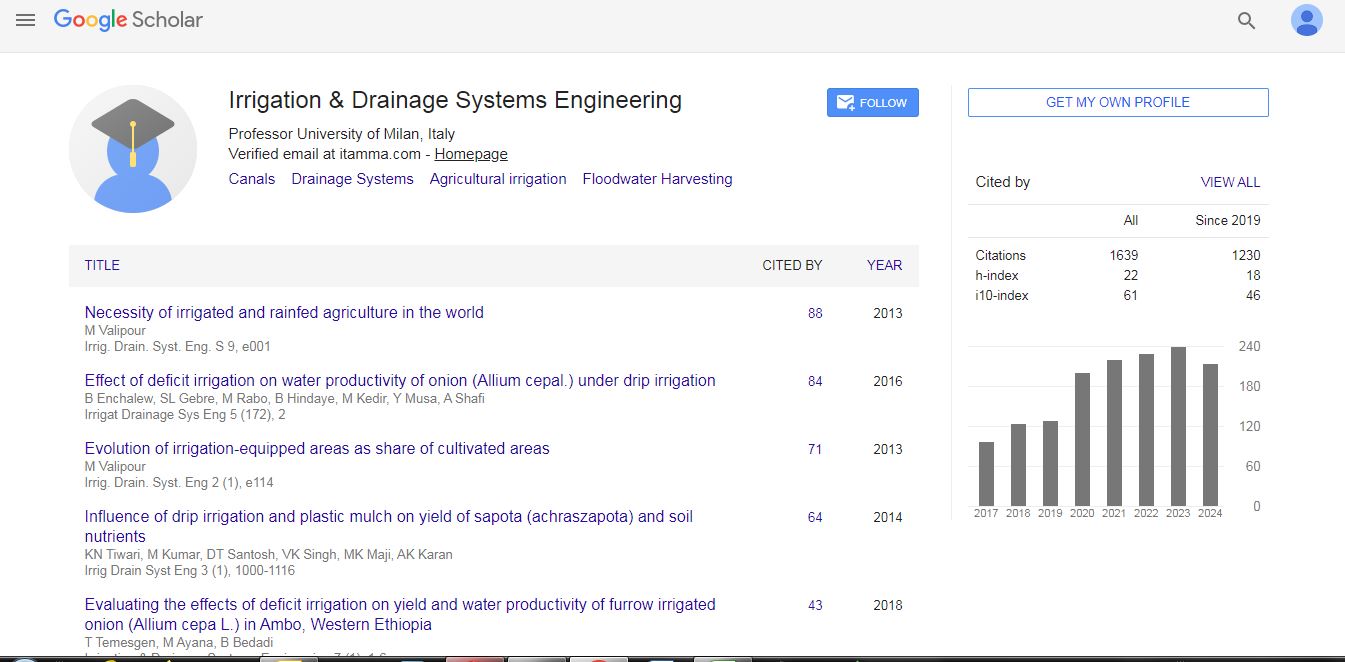
Irrigation & Drainage Systems Engineering received 835 citations as per Google Scholar report