Perspective - (2025) Volume 11, Issue 3
Received: 01-Aug-2025, Manuscript No. jmt-25-175192;
Editor assigned: 04-Aug-2025, Pre QC No. P-175192;
Reviewed: 18-Aug-2025, QC No. Q-175192;
Revised: 22-Aug-2025, Manuscript No. R-175192;
Published:
29-Aug-2025
, DOI: 10.37421/2471-271X.2025.11.353
Citation: Santos, Gabriela. ”Family-Based Interventions: Versatile, Effective Healing.” J Ment Disord Treat 11 (2025):353.
Copyright: © 2025 Santos G. This is an open-access article distributed under the terms of the Creative Commons Attribution License, which permits unrestricted use, distribution and reproduction in any medium, provided the original author and source are credited.
A comprehensive systematic review and meta-analysis has brought to light the substantial efficacy of family-based interventions specifically designed for treating adolescent depression. The research strongly indicates that when families are actively involved in the therapeutic process, there is a significant and measurable improvement in outcomes for young individuals who are struggling with depressive symptoms. This body of work distinctly emphasizes the critical and pivotal role that healthy family dynamics and effective communication play in facilitating a successful recovery journey[1].
Here, a compelling review presents robust evidence for the undeniable effectiveness of family-based treatment when addressing adolescent anorexia nervosa. This approach profoundly underscores how actively engaging the entire family system is not just helpful, but absolutely crucial for a successful recovery, aiding young people in normalizing their eating patterns and significantly enhancing their overall psychological well-being[2].
This particular meta-analysis clearly demonstrates that systemic family therapy offers substantial and wide-ranging benefits for individuals confronting severe mental illness. It keenly emphasizes how directly addressing complex family interactions and established communication patterns can lead to markedly improved symptom management and ultimately better functional outcomes for both the patients and their supporting families[3].
The findings here highlight the proven effectiveness of family-based interventions in the challenging arena of treating substance use disorders. This research points out that involving family members as key participants in the recovery process actively strengthens vital support systems, significantly improves communication within the family unit, and ultimately contributes to superior long-term outcomes for individuals striving to overcome addiction[4].
We see a valuable narrative review exploring the nuances of trauma-informed family therapy, drawing attention to specialized approaches that consciously acknowledge the pervasive and often profound impact of trauma on entire family systems. This perspective suggests that by thoughtfully integrating trauma-sensitive practices, therapists are better equipped to foster deep healing, improve complex relational dynamics, and build lasting resilience within families[5].
This pilot study delves into the promising potential of Emotionally Focused Family Therapy for adolescents experiencing anxiety. The preliminary findings strongly suggest that by intentionally focusing on fundamental attachment issues and enhancing emotional regulation skills within the family context, this therapeutic approach can lead to a significant reduction in anxiety symptoms and a noticeable improvement in overall family functioning[6].
Furthermore, a systematic review underscores the absolutely crucial and multifaceted role of family-based interventions in providing comprehensive support for children and adolescents navigating chronic illness. The evidence clearly shows how these interventions are instrumental in improving essential coping strategies, actively reducing psychological distress, and ultimately enhancing the overall quality of life for the entire family unit, not just the patient[7].
Another important meta-analysis powerfully underscores the clear efficacy of family-based interventions specifically tailored for managing conduct disorder in children and adolescents. It highlights that by directly engaging families in the treatment process, there can be a significant reduction in problematic behaviors and a marked improvement in overall family functioning, presenting a more holistic and effective approach to these complex behavioral challenges[8].
This systematic review and meta-analysis thoroughly evaluates Brief Strategic Family Therapy as an intervention for various adolescent problem behaviors. It convincingly demonstrates that this focused intervention effectively reduces a wide spectrum of adolescent issues by skillfully targeting dysfunctional family interactions and actively fostering improved communication and problem-solving skills within the family unit[9].
Finally, a systematic review and meta-analysis rigorously evaluates the profound impact of family interventions on individuals who are experiencing psychosis. The accumulating evidence firmly indicates that involving families as active partners in treatment substantially reduces relapse rates, markedly improves social functioning, and genuinely enhances the overall well-being of both the patients and their dedicated caregivers[10].
Family-based interventions represent a cornerstone of modern therapeutic practice, demonstrating profound efficacy across a diverse array of psychological, behavioral, and physical health conditions affecting individuals of all ages. This therapeutic modality, which actively integrates the family unit into the treatment process, consistently yields improved outcomes by addressing underlying family dynamics, enhancing communication, and strengthening support systems. For instance, the treatment of adolescent depression has seen significant advancements through family-based approaches, where the involvement of family members has been shown to critically improve outcomes for young people struggling with depressive symptoms, underscoring the vital role of family dynamics and communication in their recovery journey [1]. Similarly, in cases of adolescent anorexia nervosa, engaging the entire family system is deemed crucial, not just for normalizing eating patterns but also for significantly improving the overall psychological well-being of the young individual [2].
The utility of family-based therapy extends robustly into more severe and complex mental health challenges. Systemic family therapy, for example, offers substantial benefits for individuals facing severe mental illness. By diligently addressing family interactions and communication patterns, this approach has been linked to improved symptom management and better functional outcomes for patients and their families, highlighting its comprehensive impact [3]. When considering psychosis, evidence clearly indicates that actively involving families in treatment significantly reduces relapse rates, improves social functioning, and genuinely enhances the overall well-being of patients and their caregivers, cementing its role as an indispensable component of care [10]. These findings underscore the systemic influence of family dynamics on the trajectory of recovery for severe conditions.
Furthermore, family-based interventions are highly effective in addressing challenging behavioral issues and addictions. For individuals grappling with substance use disorders, involving family members in the recovery process actively strengthens support systems, notably improves communication, and ultimately contributes to superior outcomes for those striving to overcome addiction [4]. Likewise, for children and adolescents managing conduct disorder, engaging families directly in treatment can lead to a significant reduction in problematic behaviors and a marked improvement in overall family functioning, offering a more holistic and effective approach to behavioral challenges [8]. This illustrates how a family-centric focus can interrupt detrimental cycles and foster healthier coping mechanisms.
Beyond specific diagnoses, specialized family therapy models cater to unique needs. Trauma-informed family therapy, for example, explores approaches that explicitly acknowledge the pervasive impact of trauma on family systems. By integrating trauma-sensitive practices, therapists are empowered to foster deep healing, improve relational dynamics, and build lasting resilience within families grappling with the aftermath of traumatic experiences [5]. In another area, Emotionally Focused Family Therapy (EFFT) shows promising potential for adolescents experiencing anxiety. A pilot study suggests that by intentionally focusing on fundamental attachment issues and enhancing emotional regulation skills within the family context, EFFT can significantly reduce anxiety symptoms and improve overall family functioning [6].
Moreover, family-based interventions play a crucial supportive role for children and adolescents navigating chronic illness. These interventions are instrumental in improving essential coping strategies, actively reducing psychological distress, and ultimately enhancing the overall quality of life for the entire family unit, extending care beyond just the patient to encompass the well-being of the whole system [7]. Additionally, for a broader spectrum of adolescent problem behaviors, Brief Strategic Family Therapy (BSFT) has been evaluated, demonstrating its effectiveness in reducing various issues by skillfully targeting dysfunctional family interactions and fostering improved communication and problem-solving skills within the family unit [9]. These diverse applications underscore the adaptability and comprehensive reach of family-focused therapeutic strategies in fostering health and resilience.
Family-based interventions consistently emerge as a highly effective and versatile therapeutic approach across a broad spectrum of mental health, behavioral, and chronic health challenges affecting children, adolescents, and adults. These interventions demonstrate significant efficacy in treating adolescent depression, where involving families critically improves outcomes by addressing dynamics and communication. Similarly, for adolescent anorexia nervosa, engaging the family system is crucial for recovery, facilitating normalized eating patterns and enhancing psychological well-being. Systemic family therapy extends its benefits to severe mental illness and psychosis, leading to improved symptom management, reduced relapse rates, and better functional outcomes for patients and caregivers alike. Beyond mental health, family-based strategies prove vital for substance use disorders, strengthening support systems and communication for better recovery. Specialized approaches like trauma-informed family therapy foster healing and resilience by acknowledging trauma's impact, while Emotionally Focused Family Therapy for anxiety improves family functioning and reduces symptoms through focusing on attachment. Furthermore, for children and adolescents with chronic illnesses, these interventions enhance coping and quality of life. Even for complex issues like conduct disorder and general adolescent problem behaviors, family engagement significantly reduces problematic conduct by targeting dysfunctional interactions and improving communication. The overarching theme is the indispensable role of the family unit in fostering recovery, managing symptoms, and improving the overall well-being across diverse clinical populations.
None
None
Miao R, Qingchun W, Peng W. "Family-based interventions for adolescent depression: A systematic review and meta-analysis.".J Consult Clin Psychol 91 (2023):697-710.
Indexed at, Google Scholar, Crossref
Harriet JW, Anthea F, Tracey DW. "Family-based treatment for adolescent anorexia nervosa: A systematic review and meta-analysis of individual patient data.".J Am Acad Child Adolesc Psychiatry 60 (2021):1374-1389.
Indexed at, Google Scholar, Crossref
Xiaoxia Z, Hongmei Z, Lin H. "Systemic family therapy for severe mental illness: A systematic review and meta-analysis of randomized controlled trials.".J Psychiatr Res 137 (2021):596-607.
Indexed at, Google Scholar, Crossref
Yi-Wen C, Wen-Ching Y, Li-Cheng P. "Family-based interventions for substance use disorders: A systematic review and meta-analysis.".J Subst Abuse Treat 137 (2022):108779.
Indexed at, Google Scholar, Crossref
Julian DF, Joseph S, Bessel AVdK. "Trauma-informed family therapy: A narrative review of evidence-based approaches.".J Marital Fam Ther 46 (2020):23-40.
Indexed at, Google Scholar, Crossref
Jay LL, Susan MJ, Heidi BM. "Emotionally Focused Family Therapy for adolescents with anxiety: A pilot study.".J Marital Fam Ther 48 (2022):407-422.
Indexed at, Google Scholar, Crossref
Anne EK, Melissa AA, Janet AD. "Family-based interventions for chronic illness in childhood and adolescence: A systematic review.".J Pediatr Psychol 45 (2020):1159-1172.
Indexed at, Google Scholar, Crossref
Alina M, Matthew RS, Vanessa EC. "Family-based interventions for conduct disorder: A systematic review and meta-analysis.".J Clin Child Adolesc Psychol 50 (2021):358-372.
Indexed at, Google Scholar, Crossref
Howard AL, Cynthia LR, Aaron H. "Brief Strategic Family Therapy for adolescent problem behaviors: A systematic review and meta-analysis.".J Adolesc Health 66 (2020):15-28.
Indexed at, Google Scholar, Crossref
Fiona P, John R, Jose JM. "Family interventions for psychosis: A systematic review and meta-analysis of randomized controlled trials.".Schizophr Bull 47 (2021):1344-1355.
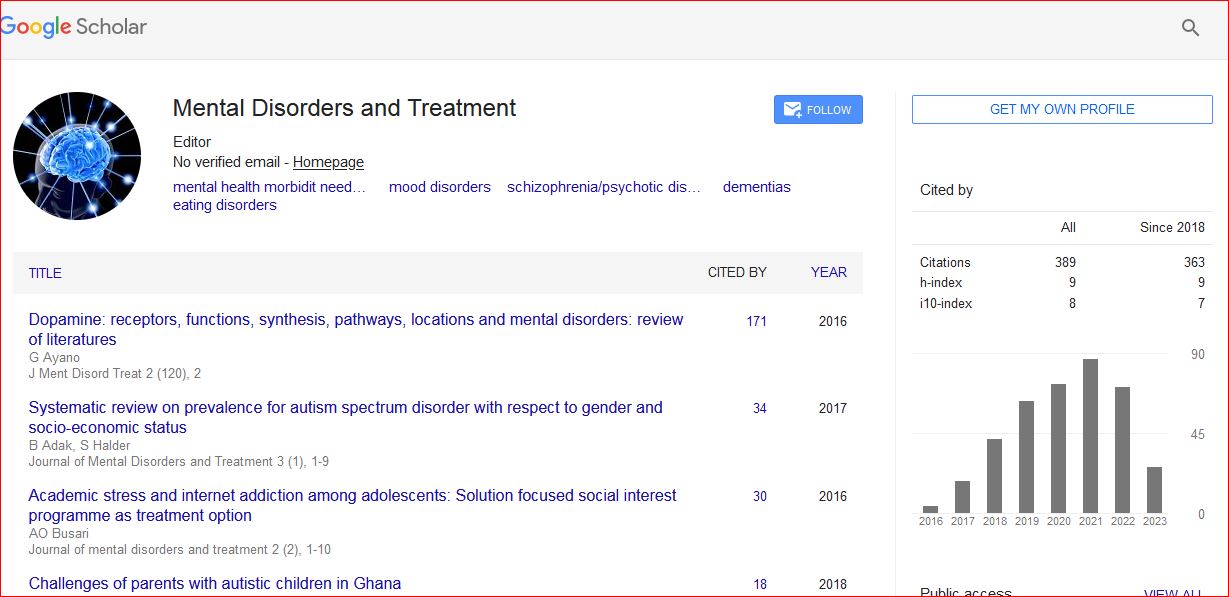
Mental Disorders and Treatment received 556 citations as per Google Scholar report