Short Communication - (2025) Volume 14, Issue 5
Received: 02-Oct-2025, Manuscript No. jeom-26-188193;
Editor assigned: 06-Oct-2025, Pre QC No. P-188193;
Reviewed: 20-Oct-2025, QC No. Q-188193;
Revised: 23-Oct-2025, Manuscript No. R-188193;
Published:
30-Oct-2025
, DOI: 10.37421/2169-026X.2025.14.554
Citation: Walker, Emily. ”Family Business Growth: Governance, Succession, and Wealth Management.” J Entrepren Organiz Manag 14 (2025):554.
Copyright: © 2025 Walker E. This is an open-access article distributed under the terms of the Creative Commons Attribution License, which permits unrestricted use, distribution and reproduction in any medium, provided the original author and source are credited.
The intricate dynamics of family businesses present a unique set of challenges and opportunities that significantly influence their trajectory and long-term success. As these enterprises mature, they often encounter hurdles in the process of professionalization, which can impede their capacity for adaptation and innovation. Implementing formal governance structures and professional management practices has been identified as a crucial strategy to enhance organizational growth, improve decision-making, and mitigate risks like succession issues and nepotism. The transition of leadership within family firms represents a pivotal moment, directly impacting the potential for sustained growth and organizational continuity. Successful succession planning hinges on early preparation, transparent communication, and the cultivation of successor capabilities to ensure seamless operations and future expansion. Integrating external talent into the fabric of family businesses, though sometimes met with resistance, can serve as a potent catalyst for growth. Hiring non-family managers with specialized expertise introduces novel perspectives, drives operational professionalization, and fosters greater innovation and organizational expansion. The ownership structure of a family business plays a considerable role in shaping its strategic decision-making processes and overall adaptability. Different ownership configurations can influence a firm's capacity for strategic renewal and its ability to thrive in evolving market landscapes. Beyond financial considerations, the emotional fabric of a family profoundly impacts organizational management and growth. Effectively managing socioemotional wealth alongside financial wealth is essential for navigating complex decisions and ensuring the enduring development of family firms. Family firm culture acts as a fundamental determinant in how innovation and growth are approached and implemented. A robust and adaptable family culture can cultivate an entrepreneurial spirit and facilitate the adoption of new technologies, thereby accelerating organizational growth. The unwavering commitment of family members to the enterprise serves as a distinct and valuable resource that can propel organizational growth. Intergenerational commitment and the preservation of shared values within a family business are integral to its long-term strategic decision-making and sustained performance. Venturing into international markets presents a dual landscape of opportunities and challenges for family businesses aiming for expansion. Understanding the strategic approaches family firms employ to enter global markets and the influence of family involvement in managing these ventures is key to achieving sustained growth. Tailoring governance mechanisms to support strategic growth objectives is a critical aspect of family firm management. Unique governance structures, such as family councils and advisory boards, can significantly bolster a family firm's capacity to pursue ambitious growth targets. The financial policies adopted by family businesses have a profound impact on their growth trajectories and overall success. Strategic decisions regarding capital structure, dividend distribution, and investment patterns directly influence a firm's ability to reinvest and achieve long-term expansion. Navigating the complexities of growth in family businesses requires a multifaceted approach that addresses governance, leadership, talent, culture, and financial strategy to ensure sustained success and adaptability in dynamic environments.
Family businesses often confront significant challenges in their journey toward professionalization as they scale, which can detrimentally affect their inherent ability to adapt to changing market conditions and to foster innovation. Research indicates that the formal implementation of robust governance frameworks and the adoption of professional management methodologies can markedly enhance organizational expansion by refining decision-making protocols and mitigating inherent risks associated with leadership succession and potential nepotism. In the context of family firms, the process of leadership transition is undeniably a critical juncture, holding substantial implications for the achievement of sustained growth and the preservation of organizational continuity. Achieving successful succession planning is predicated on several key factors, including meticulous early preparation, the establishment of clear and consistent communication channels, and the dedicated development of successor capabilities to ensure the firm's ongoing viability and future growth. Although the integration of external talent into established family businesses can sometimes encounter resistance, it possesses the potential to serve as a powerful engine for driving organizational growth. By strategically hiring non-family managers who bring diverse expertise and perspectives, family firms can professionalize their operations and ultimately stimulate greater organizational innovation and expansion. The specific ownership structures adopted by family businesses can have a direct and considerable influence on their strategic decision-making processes and their inherent adaptability to market fluctuations. Investigating how various ownership configurations impact a firm's capacity for strategic renewal is crucial for understanding its ability to achieve sustained growth in increasingly dynamic market environments. Beyond the tangible aspects of business, the intrinsic emotional dynamics that characterize family relationships can significantly shape organizational management practices and influence the pace of growth. For family firms, the skillful management of socioemotional wealth, in conjunction with financial wealth, is indispensable for navigating intricate business decisions and ensuring the long-term developmental trajectory of the organization. The prevailing culture within a family firm plays a pivotal role in defining its approach to innovation and its overall pursuit of growth. A strong and adaptable family culture can effectively nurture an entrepreneurial orientation among its members and significantly facilitate the adoption of novel technologies, leading to augmented organizational growth. The inherent commitment demonstrated by family members towards their business stands as a unique and valuable asset that can powerfully drive organizational growth. This commitment, often manifested through intergenerational dedication and the adherence to shared values, contributes substantially to the firm's long-term strategic decision-making capabilities and its sustained performance. Embarking on internationalization presents family businesses with a landscape rich in both opportunities for expansion and inherent challenges that must be carefully navigated. This involves exploring the strategic methodologies family firms adopt for global market entry and understanding the critical role of family involvement in effectively managing these international ventures to secure sustained growth. Effective governance mechanisms within family firms can be strategically designed and implemented to provide robust support for the pursuit of growth objectives. This research explores how the distinctive governance structures characteristic of family firms, including the active involvement of family councils and advisory boards, can enhance their capacity to achieve ambitious growth targets. Financial policies are a cornerstone of a family business's growth strategy, significantly influencing its developmental trajectory. This study analyzes how critical capital structure decisions, dividend distribution policies, and overarching investment strategies within family firms directly impact their potential for reinvestment and their ability to achieve long-term organizational expansion. Collectively, these factors underscore the complex interplay of internal and external influences that shape the growth and sustainability of family businesses, highlighting the need for strategic adaptation and thoughtful management.
Family businesses face challenges in professionalization that impact their adaptability and innovation. Implementing formal governance and professional management enhances growth by improving decision-making and mitigating risks such as succession and nepotism. Successful leadership transition requires early planning, clear communication, and successor development. Integrating external talent brings new perspectives and drives innovation. Ownership structures influence strategic decision-making and adaptability. Managing socioemotional and financial wealth is crucial for development. A strong family culture fosters entrepreneurship and technology adoption. Intergenerational commitment and shared values support long-term strategy and performance. Internationalization offers opportunities and challenges, requiring strategic approaches and family involvement. Tailored governance mechanisms and sound financial policies are vital for pursuing growth objectives and achieving long-term expansion.
None
None
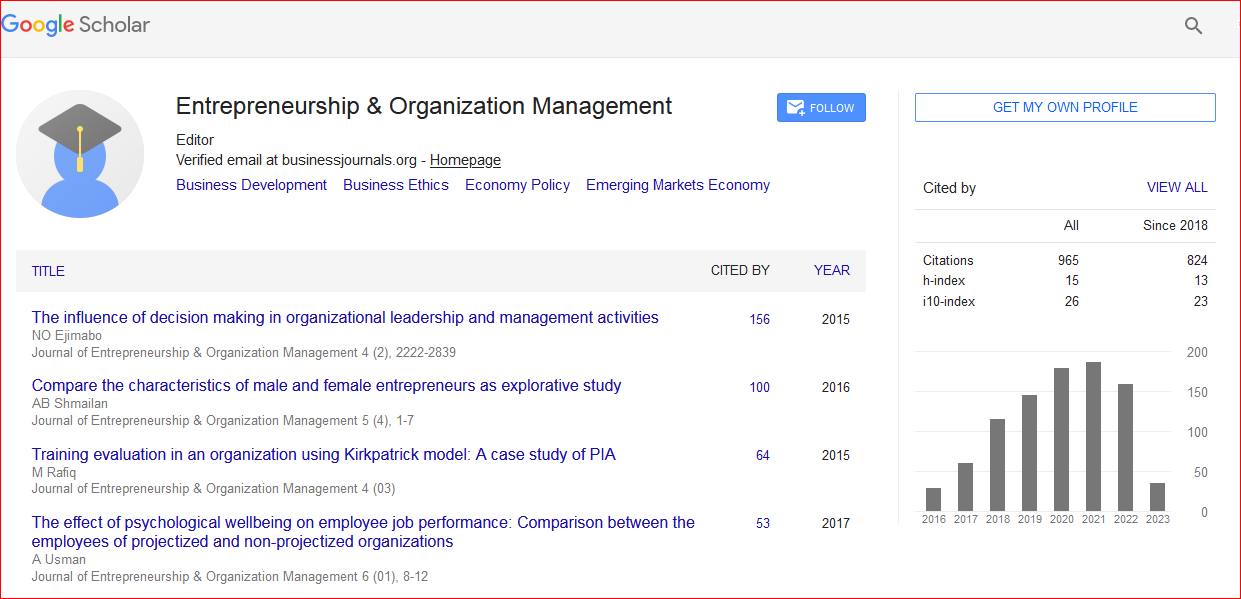
Entrepreneurship & Organization Management received 1115 citations as per Google Scholar report