Commentary - (2025) Volume 21, Issue 6
Received: 01-Nov-2025, Manuscript No. jos-26-185183;
Editor assigned: 03-Nov-2025, Pre QC No. P-185183;
Reviewed: 17-Nov-2025, QC No. Q-185183;
Revised: 24-Nov-2025, Manuscript No. R-185183;
Published:
01-Dec-2025
, DOI: 10.37421/1584-9341.2024.20.232
Citation: Diallo, Mohamed. ”Factors Influencing Laparoscopic
Colorectal Conversion Rates.” J Surg 21 (2025):232.
Copyright: © 2025 Diallo M. This is an open-access article distributed under the terms of the Creative Commons Attribution License, which permits unrestricted use, distribution
and reproduction in any medium, provided the original author and source are credited.
Laparoscopic colorectal surgery has revolutionized patient care, offering numerous benefits over traditional open procedures, including reduced pain, shorter hospital stays, and faster recovery times. However, a critical aspect of this minimally invasive approach is the potential for conversion to an open procedure, which can occur due to various intraoperative challenges. Understanding the factors that predict conversion is crucial for optimizing surgical planning and patient outcomes. This study investigates the conversion rates and factors influencing them in laparoscopic colorectal surgery, aiming to improve surgical outcomes and patient care. It identifies key predictors for conversion to open surgery, highlighting their significance in preoperative planning and intraoperative decision-making [1].
Analyzing conversion rates in a large cohort of patients undergoing laparoscopic sigmoid colectomy, this research pinpoints surgeon experience, operative time, and specific anatomical challenges as crucial determinants for conversion. The findings suggest a learning curve effect for laparoscopic colorectal procedures [2].
This systematic review focuses on the impact of patient-related factors, such as body mass index and previous abdominal surgery, on conversion rates in laparoscopic colorectal surgery. It emphasizes the importance of careful preoperative assessment to anticipate potential difficulties [3].
The study explores the learning curve associated with total mesorectal excision (TME) performed laparoscopically, specifically examining how conversion rates decrease with increasing surgeon experience. It provides insights into training pathways for complex laparoscopic colorectal procedures [4].
This article examines the evolving role of single-port laparoscopic surgery for colorectal procedures and its impact on conversion rates. It compares conversion rates between single-port and multi-port approaches, suggesting that patient selection is critical for successful single-port surgery [5].
Focusing on emergency laparoscopic colorectal surgery, this study identifies factors that significantly increase the risk of conversion to an open procedure. It highlights the challenges posed by acute conditions and the need for rapid decision-making in these scenarios [6].
This research analyzes the impact of intraoperative findings, such as extensive adhesions or severe inflammation, on conversion rates in laparoscopic colorectal surgery. It underscores the dynamic nature of surgical decision-making and the importance of adapting to intraoperative realities [7].
The study investigates the oncological outcomes of patients who undergo conversion from laparoscopic to open surgery for colorectal cancer. It compares recurrence rates and survival between converted and purely laparoscopic cases, providing evidence-based insights into the implications of conversion [8].
This paper examines the use of augmented reality (AR) and artificial intelligence (AI) in reducing conversion rates during complex laparoscopic colorectal surgeries. It explores how these advanced technologies can assist surgeons in real-time decision-making and improve surgical precision [9].
This multicenter study evaluates the impact of surgeon's training background (e.g., general surgery vs. colorectal surgery fellowship) on conversion rates in laparoscopic colorectal procedures. It aims to identify optimal training pathways for minimizing conversions and enhancing surgical proficiency [10].
The conversion of laparoscopic colorectal surgery to an open procedure remains a critical consideration, influenced by a multitude of factors ranging from patient characteristics to surgeon experience and the specific nature of the pathology. Comprehensive understanding and prediction of these conversions are paramount for enhancing surgical planning and ultimately improving patient outcomes. This study investigates the conversion rates and factors influencing them in laparoscopic colorectal surgery, aiming to improve surgical outcomes and patient care. It identifies key predictors for conversion to open surgery, highlighting their significance in preoperative planning and intraoperative decision-making [1].
Analyzing conversion rates in a large cohort of patients undergoing laparoscopic sigmoid colectomy, this research pinpoints surgeon experience, operative time, and specific anatomical challenges as crucial determinants for conversion. The findings suggest a learning curve effect for laparoscopic colorectal procedures [2].
This systematic review focuses on the impact of patient-related factors, such as body mass index and previous abdominal surgery, on conversion rates in laparoscopic colorectal surgery. It emphasizes the importance of careful preoperative assessment to anticipate potential difficulties [3].
The study explores the learning curve associated with total mesorectal excision (TME) performed laparoscopically, specifically examining how conversion rates decrease with increasing surgeon experience. It provides insights into training pathways for complex laparoscopic colorectal procedures [4].
This article examines the evolving role of single-port laparoscopic surgery for colorectal procedures and its impact on conversion rates. It compares conversion rates between single-port and multi-port approaches, suggesting that patient selection is critical for successful single-port surgery [5].
Focusing on emergency laparoscopic colorectal surgery, this study identifies factors that significantly increase the risk of conversion to an open procedure. It highlights the challenges posed by acute conditions and the need for rapid decision-making in these scenarios [6].
This research analyzes the impact of intraoperative findings, such as extensive adhesions or severe inflammation, on conversion rates in laparoscopic colorectal surgery. It underscores the dynamic nature of surgical decision-making and the importance of adapting to intraoperative realities [7].
The study investigates the oncological outcomes of patients who undergo conversion from laparoscopic to open surgery for colorectal cancer. It compares recurrence rates and survival between converted and purely laparoscopic cases, providing evidence-based insights into the implications of conversion [8].
This paper examines the use of augmented reality (AR) and artificial intelligence (AI) in reducing conversion rates during complex laparoscopic colorectal surgeries. It explores how these advanced technologies can assist surgeons in real-time decision-making and improve surgical precision [9].
This multicenter study evaluates the impact of surgeon's training background (e.g., general surgery vs. colorectal surgery fellowship) on conversion rates in laparoscopic colorectal procedures. It aims to identify optimal training pathways for minimizing conversions and enhancing surgical proficiency [10].
Conversion to open surgery in laparoscopic colorectal procedures is influenced by numerous factors. Studies highlight surgeon experience, operative time, and anatomical challenges as key determinants, suggesting a learning curve effect. Patient-related factors like BMI and prior abdominal surgery also play a role, emphasizing the need for thorough preoperative assessment. Specific procedures like total mesorectal excision show improvement in conversion rates with surgeon experience. Advances in surgical techniques, such as single-port surgery, are being evaluated for their impact on conversion rates. Emergency settings present unique challenges, increasing the risk of conversion. Intraoperative findings, such as adhesions and inflammation, dynamically affect decision-making. While conversion can impact oncological outcomes, the use of emerging technologies like augmented reality and artificial intelligence shows promise in reducing conversion rates. Surgeon training background is also identified as a significant factor influencing conversion rates.
None
None
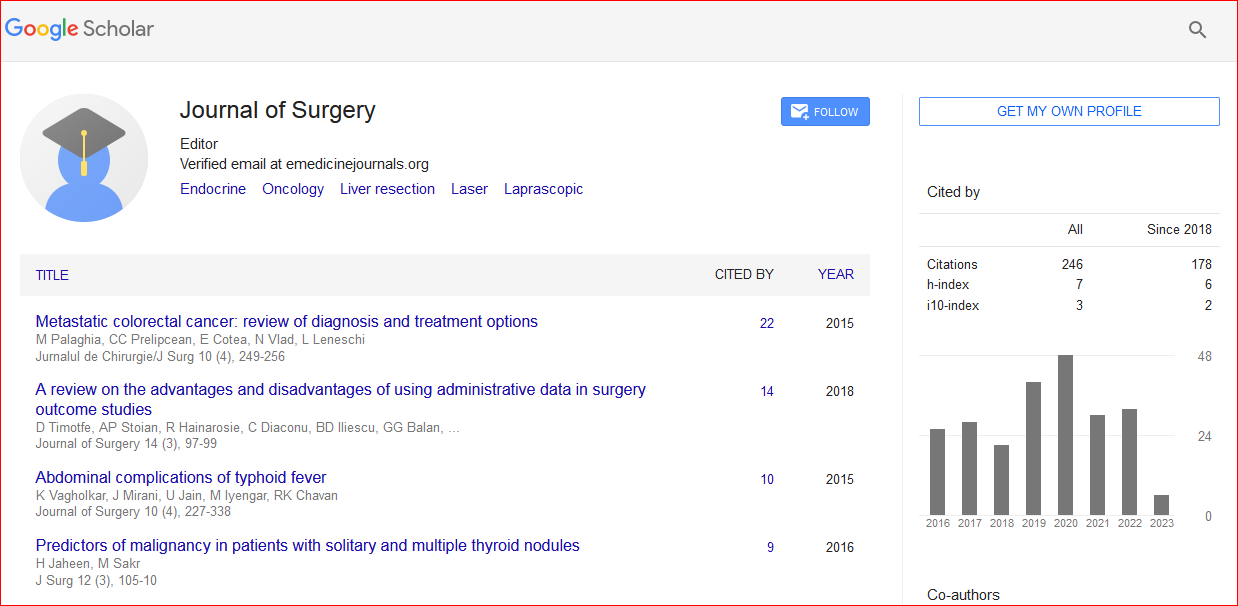
Journal of Surgery received 288 citations as per Google Scholar report