Opinion - (2025) Volume 14, Issue 6
Received: 01-Dec-2025, Manuscript No. jeom-26-188202;
Editor assigned: 01-Feb-2025, Pre QC No. P-188202;
Reviewed: 17-Dec-2025, QC No. Q-188202;
Revised: 22-Dec-2025, Manuscript No. R-188202;
Published:
29-Dec-2025
, DOI: 10.37421/2169-026X.2025.14.562
Citation: Kuznetsova, Daria. ”Factors For Business Sustainability: Resilience and Innovation.” J Entrepren Organiz Manag 14 (2025):562.
Copyright: © 2025 Kuznetsova D. This is an open-access article distributed under the terms of the Creative Commons Attribution License, which permits unrestricted use, distribution and reproduction in any medium, provided the original author and source are credited.
Entrepreneurial resilience is a cornerstone for navigating the volatile landscape of business, equipping organizations to effectively manage disruptions and sustain operational continuity. This inherent adaptability is fundamental for achieving long-term business sustainability, cultivating an organizational capacity to rebound and flourish amidst adversity [1].
Organizational ambidexterity, defined as the capacity to simultaneously leverage current strengths while exploring novel avenues, emerges as a significant contributor to enduring business success. Firms adept at balancing these dual demands are demonstrably better positioned to adapt and thrive within dynamic market environments [2].
Entrepreneurial leadership critically underpins the development of resilience by championing an organizational culture that embraces innovation, flexibility, and proactive issue resolution. Visionary leaders are instrumental in guiding their enterprises through challenging periods and fostering a deep-seated commitment to overarching sustainability objectives [3].
Digital transformation presents a complex duality for business sustainability. While it unlocks opportunities for enhanced operational efficiency and broader market penetration, it concurrently introduces significant challenges related to adaptation and cybersecurity. Strategic implementation is thus paramount for maximizing its benefits while mitigating associated risks [4].
Supply chain resilience is of paramount importance for business continuity, particularly in light of escalating global disruptions. Strategies such as supplier diversification, sophisticated inventory management, and agile logistical frameworks are crucial for effectively reducing vulnerabilities within the supply chain [5].
Financial resilience empowers businesses to weather economic downturns and allocate resources towards long-term strategic initiatives. Access to a variety of funding streams, meticulous cash flow management, and prudent financial planning are indispensable for ensuring sustained operational viability [6].
Human capital, encompassing a skilled workforce and effective leadership, forms the bedrock of entrepreneurial resilience. Organizations that prioritize talent development and cultivate a supportive workplace environment are inherently better equipped to innovate and adapt to changing circumstances [7].
Organizational learning capabilities are directly correlated with resilience, enabling firms to glean insights from both setbacks and achievements, refine strategies, and enhance operational effectiveness. A culture that actively promotes continuous learning serves as a fundamental element of lasting business sustainability [8].
Innovation capability stands as a critical determinant for maintaining market competitiveness and ensuring business sustainability in evolving sectors. Businesses that consistently foster innovation are more capable of responding to shifting consumer demands and technological advancements [9].
Stakeholder engagement plays a pivotal role in fostering business sustainability by cultivating trust, promoting collaboration, and generating shared value. Proactive interaction with a diverse array of stakeholders assists organizations in effectively identifying and addressing both risks and emergent opportunities [10].
The capability of entrepreneurial resilience is recognized as essential for navigating the inherent uncertainties present in the business world, empowering firms to effectively adapt to disruptions and maintain their operational functions. This adaptive capacity contributes significantly to the long-term sustainability of businesses by strengthening their ability to recover from and grow in the face of challenges [1].
Organizational ambidexterity, which refers to a firm's dual capacity to exploit its existing competencies while simultaneously exploring new opportunities, is identified as a key determinant of sustained success over the long term. Companies that successfully manage this delicate balance are more robust in their ability to adapt and thrive within rapidly changing environments [2].
Entrepreneurial leadership is highlighted as a vital force in nurturing resilience, primarily through the cultivation of an organizational ethos that values innovation, adaptability, and proactive problem-solving. Effective leaders are crucial for guiding their organizations through periods of crisis and inspiring dedication towards achieving sustainability goals [3].
Digital transformation presents a dual-edged scenario for business sustainability. While offering avenues for improved efficiency and expanded market access, it also introduces complexities related to adaptation and the imperative of robust cybersecurity. Strategic and thoughtful implementation is key to harnessing its advantages and mitigating its inherent risks [4].
Resilience within the supply chain is of paramount importance for ensuring business continuity, particularly given the increasing frequency of global disruptions. Strategies such as diversifying suppliers, implementing rigorous inventory control, and establishing agile logistics systems are vital for minimizing operational vulnerabilities [5].
Financial resilience equips businesses with the fortitude to withstand economic shocks and to make strategic investments aimed at long-term growth. Securing diverse funding sources, maintaining effective cash flow management, and engaging in diligent financial planning are critical prerequisites for sustained business operations [6].
Human capital, encompassing a skilled and motivated workforce alongside capable leadership, forms the fundamental basis for entrepreneurial resilience. Organizations that actively invest in the development of their personnel and foster a supportive work atmosphere are demonstrably better prepared to adapt and innovate [7].
Organizational learning capabilities are intrinsically linked to a firm's resilience, allowing it to learn from past experiences, both positive and negative, to adjust its strategies and enhance operational efficiency. An organizational culture that embraces and encourages continuous learning is a foundational element for achieving enduring sustainability [8].
The capacity for innovation is identified as a crucial factor in maintaining a competitive edge and ensuring business sustainability within evolving market landscapes. Enterprises that consistently engage in innovation are better positioned to meet changing customer needs and to embrace technological advancements [9].
Engagement with stakeholders contributes positively to business sustainability by building trust, facilitating collaboration, and creating shared value. A proactive approach to engaging with a wide range of stakeholders enables organizations to more effectively identify and respond to both potential risks and emerging opportunities [10].
Business sustainability hinges on several interconnected factors. Entrepreneurial resilience, enabled by adaptability, allows firms to navigate uncertainties and recover from disruptions. Organizational ambidexterity, balancing exploitation and exploration, fosters long-term thriving. Effective entrepreneurial leadership cultivates innovation and guides through crises. Digital transformation offers efficiency gains but requires strategic management of adaptation and cybersecurity risks. Supply chain resilience, through diversification and agile logistics, mitigates global disruption impacts. Financial resilience, supported by diverse funding and prudent management, weathers economic shocks. Strong human capital and investment in talent development are crucial for adaptability. Organizational learning from experiences enhances strategic adjustments and operational efficiency. Innovation capability ensures competitiveness by meeting evolving demands. Finally, stakeholder engagement builds trust and fosters collaboration, aiding in risk and opportunity management.
None
None
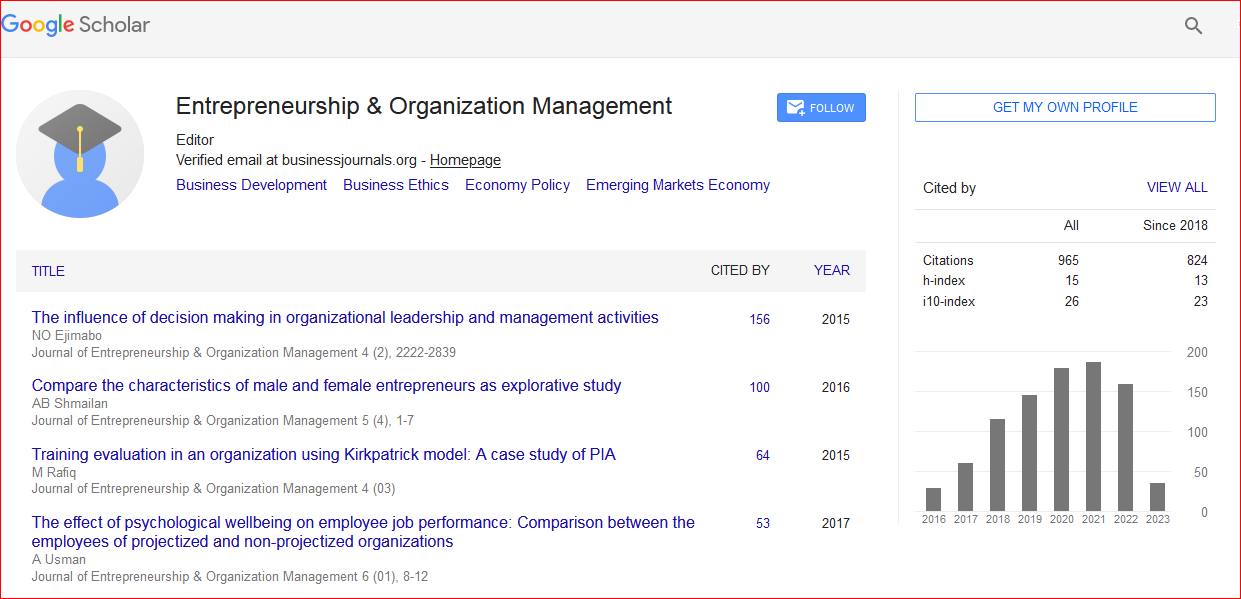
Entrepreneurship & Organization Management received 1115 citations as per Google Scholar report