Short Communication - (2025) Volume 16, Issue 6
Received: 01-Dec-2025, Manuscript No. jfr-26-184137;
Editor assigned: 03-Dec-2025, Pre QC No. P-184137;
Reviewed: 17-Dec-2025, QC No. Q-184137;
Revised: 22-Dec-2025, Manuscript No. R-184137;
Published:
29-Dec-2025
, DOI: 10.37421/2157-7145.2025.16.698
Citation: Lan, Nguyen Thi. ”Eyewitness Unreliability: Cognitive
Biases and Justice.” J Forensic Res 16 (2025):698.
Copyright: © 2025 Lan T. Nguyen This is an open-access article distributed under the terms of the Creative Commons Attribution License, which permits unrestricted use,
distribution and reproduction in any medium, provided the original author and source are credited.
Eyewitness testimony, a cornerstone of many legal proceedings, is frequently lauded for its compelling nature. However, its inherent unreliability is a significant concern, stemming from the malleability of memory, the susceptibility to suggestion, and the distorting effects of stress [1].
Research meticulously details how numerous factors can compromise the accuracy of eyewitness recollections. Among these are the phenomenon of weapon focus, where attention is diverted to a weapon, and the challenges associated with cross-racial identification, often referred to as the own-race effect [1].
Furthermore, the introduction of post-event information, whether through leading questions or subsequent discussions, can lead to memory contamination, altering an eyewitness's original perception of events [1].
The impact of stress on eyewitness memory recall is a critical area of study. High levels of stress during an event can result in fragmented memories, particularly affecting the recall of peripheral details, thereby introducing distortions into testimony [2].
Empirical evidence strongly supports the existence of weapon focus, demonstrating that the presence of a weapon during a crime significantly impairs an eyewitness's ability to accurately recall the perpetrator's facial features, diminishing identification accuracy [3].
The cross-racial identification bias, or the own-race effect, is well-documented, indicating that individuals possess a reduced capacity to accurately identify persons of a different race compared to their own race [4].
Memory contamination, a direct consequence of post-event information and leading questions, reveals how subtle suggestions can significantly alter an eyewitness's recollection of an event, underscoring the need for careful interview protocols [5].
Investigating different lineup procedures, such as sequential versus simultaneous lineups, has shown that sequential lineups, where suspects are viewed one at a time, generally lead to lower rates of misidentification compared to their simultaneous counterparts [6].
The relationship between eyewitness confidence and memory accuracy is complex and often weak. High confidence should not be indiscriminately equated with reliability, especially when influenced by external factors or repeated questioning [7].
To mitigate these issues, cognitive interviewing techniques have been developed. These methods, including context reinstatement and open-ended questioning, aim to enhance recall and reduce suggestibility, thereby improving the quality of eyewitness accounts [8].
Eyewitness testimony, while seemingly straightforward, is subject to a myriad of cognitive and external influences that significantly undermine its reliability. Research consistently highlights that memory is not a perfect recording device but a reconstructive process, vulnerable to distortion and manipulation [1].
Key to understanding these limitations are factors such as memory malleability, the inherent suggestibility of individuals, and the physiological and psychological effects of stress experienced during a traumatic event [1].
The phenomenon of weapon focus, where attention is disproportionately directed towards a weapon, is a prime example of how the circumstances of an event can impair an eyewitness's ability to recall crucial details, such as the perpetrator's face [1].
Similarly, the cross-racial identification bias, also known as the own-race effect, presents a substantial challenge, as individuals are generally less accurate in identifying faces of individuals from different racial groups than their own [1].
Post-event information, whether unintentionally or intentionally introduced, can contaminate an eyewitness's memory. This can occur through leading questions during interviews or information shared after the event, leading to the incorporation of false details into the witness's recollection [1].
Studies on the impact of stress on memory recall reveal that high stress levels during an incident can lead to fragmented and less accurate memories, particularly affecting the recall of peripheral details, thus introducing significant distortions [2].
Empirical investigations into weapon focus provide concrete evidence that the presence of a weapon detrimentally affects an eyewitness's capacity to remember facial characteristics, resulting in decreased identification accuracy in subsequent investigations [3].
The cross-racial identification problem is a well-established bias where the accuracy of identification is significantly lower when the witness and the perpetrator belong to different racial groups, with distinct psychological underpinnings [4].
Research on memory contamination demonstrates how the introduction of post-event information, even through subtle suggestions, can alter an eyewitness's account. This underscores the critical need for carefully designed interviewing protocols to prevent the corruption of witness testimony [5].
Examining the effectiveness of police lineup procedures, studies indicate that sequential lineups, which present suspects one by one, are generally more reliable in minimizing misidentifications compared to simultaneous lineups where all suspects are presented at once [6].
Eyewitness testimony, while compelling, is notoriously unreliable due to memory malleability, suggestibility, and stress. Factors like weapon focus, cross-racial identification bias, and post-event information significantly impair accuracy. High stress levels during an event can lead to fragmented memories, and the presence of a weapon distracts from facial recall. The own-race effect reduces accuracy in identifying individuals of different races. Post-event information can contaminate memory, altering recollections. Sequential police lineups are more effective than simultaneous ones in reducing misidentifications. Witness confidence often has a weak correlation with accuracy. Cognitive interviewing techniques enhance recall while minimizing suggestibility. Juror perception can be influenced by expert testimony and jury instructions regarding memory fallibility. False memories can be implanted through suggestion, leading to inaccurate accounts. Understanding these cognitive biases is crucial for the justice system.
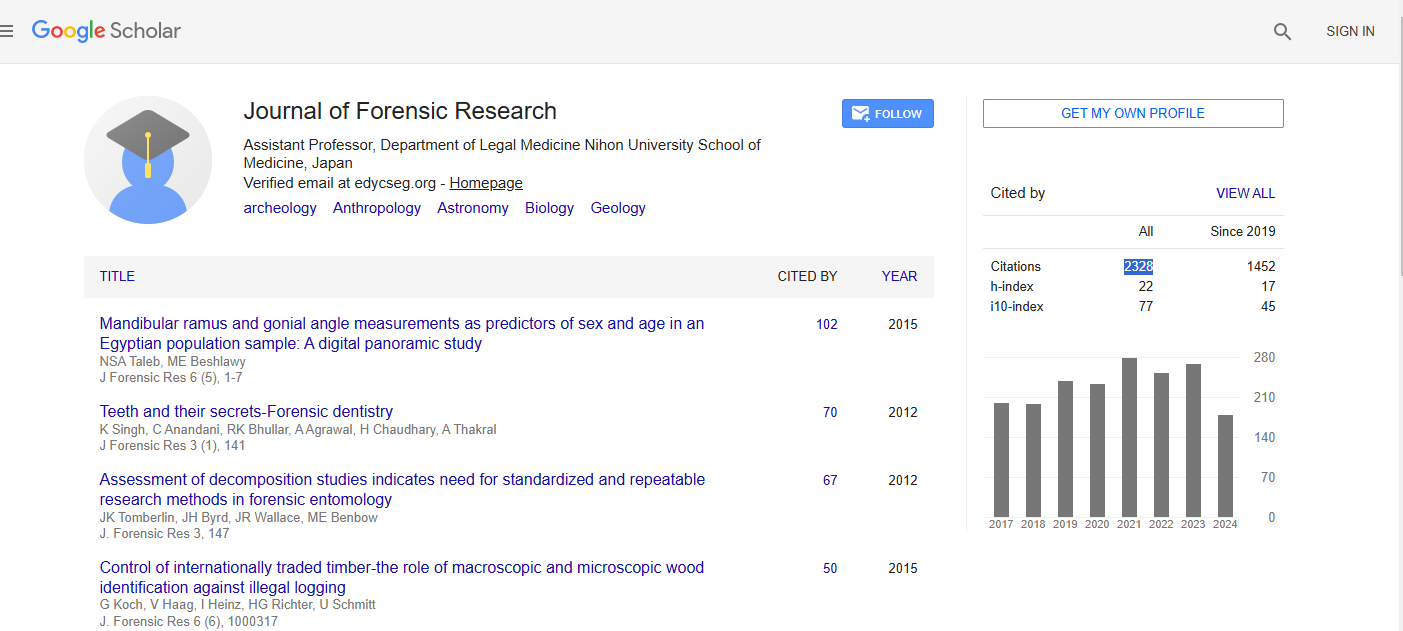
Journal of Forensic Research received 2328 citations as per Google Scholar report