Commentary - (2026) Volume 12, Issue 1
Received: 08-Nov-2024, Manuscript No. ABP-24-152091;
Editor assigned: 11-Nov-2024, Pre QC No. ABP-24-152091 (PQ);
Reviewed: 25-Nov-2024, QC No. ABP-24-152091;
Revised: 02-Feb-2026, Manuscript No. ABP-24-152091 (R);
Published:
09-Feb-2026
Citation: Poshtmashhadi, Marjan. "Evaluation Validity and Reliability of a CATS-2 in Iran." Abnorm Behav Psychol 12 (2026): 360.
Copyright: © 2026 Poshtmashhadi M. This is an open-access article distributed under the terms of the creative commons attribution license which permits unrestricted use, distribution and reproduction in any medium, provided the original author and source are credited.
Childhood and adolescence is one of the most sensitive periods of life, and it is very important to pay attention to the health of children and adolescents in these stages. In fact, children and teenagers are the future builders of the society and maintaining the health of these groups can lead to the development of a healthy society [1]. Children and adolescents make up almost a quarter of the world's population, 85% of whom live in low and middle-income countries, so attention and actions related to their physical and mental health should be among the priorities of societies. On the other hand, mental disorders are among the main causes of inefficiency and disability in the population under the age of 18, therefore, timely identification, diagnosis and intervention are very important for the treatment of mental disorders in children and adolescents [2]. Unfortunately, exposure to traumatic events and trauma (defined as "exposure to an extremely threatening or terrifying event or series of events" [3] is a common reality for many children and adolescents. and those who have been exposed to traumatic events are at risk of suffering from various mental illnesses, including Post-Traumatic Stress Disorder (PTSD) and a wide range of other disorders. In fact, traumas provide a very wide field of psychopathology that challenges diagnostic boundaries. On the other hand, the majority of children and adolescents with trauma-related psychopathology do not have access to health services, so they cannot benefit from medical services [4]. Immediately following multiple traumatic events, a high percentage of children experience symptoms of Post-traumatic Stress Disorder (PTSD), with approximately 20–30% developing full-blown PTSD within the first 6 months. become If this disorder is not treated, it can continue for years, which not only causes severe suffering to children and adolescents, but also increases the risk of other disorders in them, and with the adverse effects on biological development, it has psychological and social problems, it will disturb their psychosocial performance in the future life as well. Therefore, PTSD is increasingly considered a potentially serious disorder in children and adolescents that can have severe and lasting effects on children and adolescents, thus clinicians are increasingly less sensitive to the psychological needs of survivors. The age of traumatic events has become sensitive [5].
The CATS-2 (Childhood Autism Spectrum Test-2) is a diagnostic tool used to identify children at risk for Autism Spectrum Disorder (ASD). Evaluating the validity and reliability of this instrument in Iran is crucial to understanding how well the test performs within a specific cultural and socio-economic context.
Validity refers to the accuracy of the test in measuring what it claims to measure. In the context of the CATS-2, validity evaluation involves determining whether the test accurately identifies children with ASD, considering Iran's unique linguistic, cultural, and developmental factors. This could include conducting criterion validity studies, where the CATS-2 scores are compared with other established ASD diagnostic methods, and content validity, where experts review whether the items on the test adequately cover the symptoms of ASD as understood within the Iranian context.
Reliability, on the other hand, assesses the consistency of the test results over time and across different raters or observers. For the CATS-2, reliability testing in Iran would involve examining whether the instrument produces stable results when used by different clinicians in various settings. The internal consistency of the test items can be evaluated using measures such as Cronbach's alpha, while inter-rater reliability could be tested by having different professionals apply the test to the same group of children and comparing their results.
Given the diversity of Iranian society, the assessment of cultural relevance becomes a pivotal aspect of both validity and reliability. For instance, it’s necessary to ensure that the test items are sensitive to the local language and that the behaviors or symptoms associated with ASD are interpreted correctly within the cultural framework. This adaptation process can highlight potential issues with the generalizability of the CATS-2 across different populations.
Ultimately, establishing the validity and reliability of the CATS-2 in Iran will provide critical insights into its effectiveness as a tool for early ASD detection in Iranian children, offering a foundation for widespread use in clinical settings.
[Crossref] [Google Scholar] [PubMed]
[Crossref] [Google Scholar] [PubMed]
[Crossref] [Google Scholar] [PubMed]
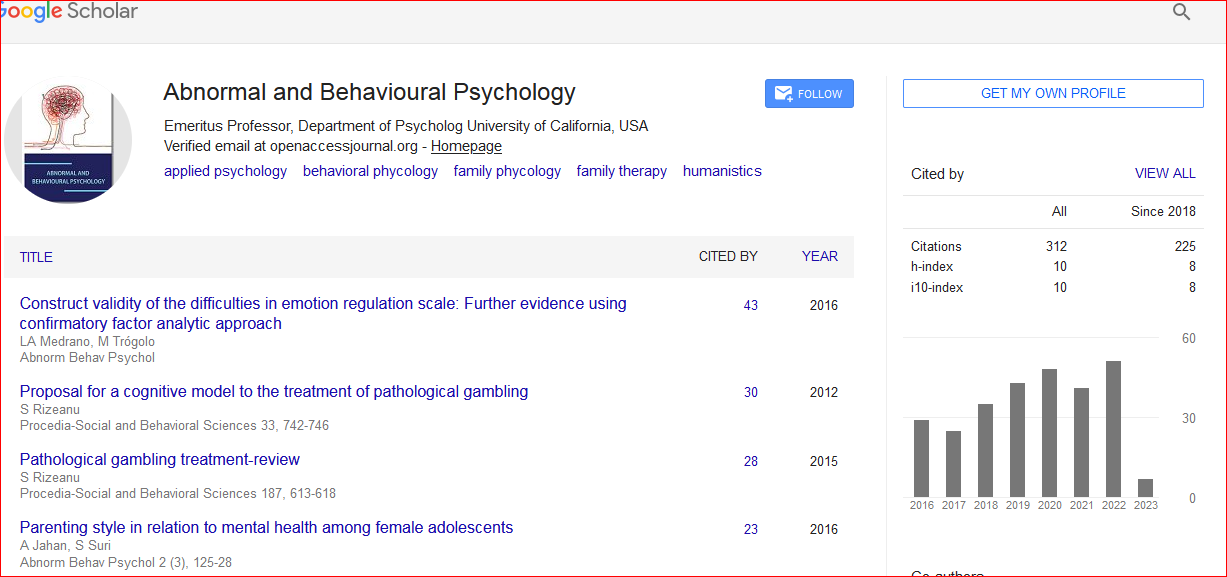
Abnormal and Behavioural Psychology received 361 citations as per Google Scholar report