Commentary - (2025) Volume 11, Issue 2
Received: 02-May-2025, Manuscript No. jotr-25-175577;
Editor assigned: 05-May-2025, Pre QC No. P-175577;
Reviewed: 19-May-2025, QC No. Q-175577;
Revised: 23-May-2025, Manuscript No. R-175577;
Published:
30-May-2025
, DOI: 10.37421/2476-2261. 2025.11.307
Citation: Obermann, Felix. ”Exploiting Tumor Heterogeneity for Adaptive Cancer Therapies.” J Oncol Transl Res 11 (2025):307.
Copyright: © 2025 Obermann F. This is an open-access article distributed under the terms of the Creative Commons Attribution License, which permits unrestricted use, distribution and reproduction in any medium, provided the original author and source are credited.
Tumor heterogeneity represents a significant and multifaceted challenge in contemporary cancer research and clinical practice. It describes the vast array of differences observed within a single tumor, not only among individual cancer cells but also within the tumor microenvironment. These variations can stem from diverse genetic changes, epigenetic modifications, and dynamic interactions with the surrounding stromal cells, immune cells, and extracellular matrix. Understanding the different ways tumor heterogeneity manifests, its underlying causes, and its profound impact on patient treatment is paramount for advancing oncology. The intricate layers of complexity introduced by these heterogeneous elements make treating cancer exceptionally challenging, often leading to varied drug responses and eventual resistance. Therefore, there is a clear and urgent emphasis on developing personalized approaches that can account for this inherent diversity, tailoring therapies to the specific characteristics of each patient's tumor[1].
A particularly crucial aspect of this complexity is spatial heterogeneity, which refers to the distinct characteristics found in different anatomical regions of a single tumor. This phenomenon means that a biopsy from one part of a tumor might reveal different molecular profiles or cellular behaviors compared to a biopsy from another area. Recognizing and thoroughly understanding these spatial differences is critically important for developing truly effective personalized cancer therapies. The long-standing practice of treating a tumor as a uniformly homogenous entity has proven to be a major obstacle, frequently resulting in the selection of resistant cell clones and ultimately treatment failure. By acknowledging and addressing spatial variations, clinicians and researchers can design more targeted interventions that account for the entire tumor landscape, improving the chances of successful eradication and preventing relapse[2].
The influence of tumor heterogeneity extends beyond the cancer cells themselves, actively shaping and interacting with the tumor microenvironment. This dynamic interplay has profound implications, particularly for the tumor's ability to evade detection and destruction by the host immune system. The diverse populations of cancer cells, alongside their varied interactions with surrounding immune cells, fibroblasts, and vasculature, create an immunosuppressive environment. This intricate relationship is a key factor in understanding why immunotherapies, despite their revolutionary potential, do not achieve universal success across all patients and cancer types. Unraveling the mechanisms by which heterogeneous cancer cells conspire with their surroundings to foster immune escape is thus a vital area of research, offering pathways to enhance the efficacy of current immunotherapeutic strategies and develop new ones[3].
For the pharmaceutical industry and drug developers, tumor heterogeneity poses significant and persistent challenges in the discovery and development of novel cancer drugs. The diverse nature of cancer cells within a single tumor means that a drug effective against one subpopulation might be entirely ineffective against another, leading to partial responses or rapid development of resistance. This inherent variability necessitates a fundamental shift in drug discovery strategies. Instead of seeking a 'magic bullet' for a seemingly uniform disease, the focus must move towards developing more adaptable therapeutic approaches. These new strategies should ideally target multiple pathways, employ combination therapies, or be designed to evolve with the tumor's dynamic landscape, thereby accounting for its intrinsic complexity and preventing the emergence of resistant clones[4].
To comprehensively dissect and understand tumor heterogeneity, advanced analytical tools are becoming indispensable. Here's the thing: combining various 'omics' dataâ??such as genomics, proteomics, transcriptomics, and metabolomicsâ??with sophisticated computational methods offers a powerful strategy. This multi-omics approach allows researchers to integrate vast amounts of biological information from different molecular layers, providing a more holistic view of tumor complexity than any single omics technique could achieve. Using big data analytics and bioinformatics, this knowledge can then be translated into actionable insights for personalized treatment strategies. This convergence of biological data and computational power is fundamentally driving the move towards truly precise medicine, where treatments are tailored not just to the patient, but to the unique molecular profile of their tumor[5].
The challenges that tumor heterogeneity presents for effective cancer therapy are ongoing and continuously evolving, demanding persistent innovation. This diversity within tumors directly impacts the efficacy of treatments, as different cancer cell populations can respond differently to the same therapeutic agent, leading to incomplete eradication and eventual relapse. What this really means is that traditional, one-size-fits-all treatment paradigms are often insufficient. Researchers are actively exploring and developing emerging strategies aimed at overcoming these hurdles. This includes the development of adaptive treatment plans, which can change based on the tumor's evolving characteristics, and comprehensive therapeutic approaches that consider the myriad cell types and molecular pathways involved. The goal is to create more resilient and effective treatment regimens that can counteract the tumor's inherent ability to adapt and resist[6].
Beyond primary tumor growth and treatment resistance, tumor heterogeneity is also deeply linked to one of cancer's most lethal characteristics: metastasis. The diverse cell populations within a primary tumor are not merely passive bystanders; they are crucial drivers of the tumor's ability to spread to distant parts of the body, forming secondary tumors. Certain highly aggressive or treatment-resistant subclones within a heterogeneous tumor may possess enhanced metastatic potential, allowing them to intravasate, survive in the circulation, and extravasate into new organs. Understanding this critical connection between tumor heterogeneity and the metastatic cascade is absolutely vital for developing effective strategies to prevent and treat metastatic disease, which remains the primary cause of cancer-related mortality. Targeting the specific heterogeneous drivers of metastasis could offer new therapeutic avenues[7].
Revolutionary technological advancements are dramatically enhancing our ability to interrogate tumor heterogeneity with unprecedented resolution. Single-cell multi-omics technologies stand out in this regard. These cutting-edge techniques allow scientists to analyze individual cells within a tumor across multiple molecular layers simultaneously, capturing genomic, transcriptomic, proteomic, and even epigenomic information from each cell. By delving into the unique molecular profiles of single cells, researchers can construct highly detailed maps of tumor complexity, identifying rare cell populations, lineage relationships, and dynamic changes that would be obscured in bulk sequencing approaches. This granular view is paving the way for the development of far more targeted and effective treatments, allowing interventions to be precisely directed at specific, disease-driving subclones[8].
Intriguingly, the perspective on tumor heterogeneity is evolving, moving beyond simply viewing it as an insurmountable hurdle. Researchers are now actively investigating ways to leverage this inherent diversity to our advantage in cancer treatment. Instead of solely focusing on overcoming heterogeneity, the discussion now includes strategies that could exploit the varied nature of cancer cells to develop more effective and perhaps even adaptive therapies. This might involve designing sequential therapies that target different subclones over time, or using combination treatments that create synthetic lethality across diverse cell populations. This shift in perspective opens up innovative avenues for drug development, aiming to turn a biological challenge into a therapeutic opportunity, ultimately leading to more robust and durable patient responses[9].
Finally, the broad principles of tumor heterogeneity find specific and critical applications in understanding particular cancer types. For instance, in esophageal cancer, dissecting the unique complexities and variations found within these tumors is proving invaluable. Esophageal cancer often presents with significant heterogeneity, which can influence disease progression, treatment response, and prognosis. Gaining deep insights into the specific molecular and cellular diversity within esophageal tumors is crucial for developing more effective and targeted diagnostic and therapeutic strategies. Tailoring interventions precisely for this particular type of cancer, based on its unique heterogeneous landscape, promises to improve patient outcomes significantly by moving away from generalized treatments towards highly specific, disease-focused approaches[10].
Tumor heterogeneity presents itself as a fundamental, inherent characteristic of cancer, intricately shaping its progression and response to therapeutic interventions. This diversity spans various levels, including genetic alterations, epigenetic modifications, and dynamic interactions within the tumor microenvironment. The broad overview of tumor heterogeneity reveals its multifaceted nature, explaining how it manifests, its underlying causes, and the significant impact it exerts on patient treatment strategies. These layers of complexity create profound challenges in effectively treating cancer, often leading to therapy resistance and suboptimal outcomes. Therefore, the necessity for personalized approaches, meticulously tailored to each tumor's unique profile, becomes increasingly clear. Overall, the ongoing challenges that tumor heterogeneity poses for cancer therapy are substantial, requiring continuous adaptation and refined strategies. The diversity within tumors directly affects treatment efficacy, highlighting the need for more adaptive and comprehensive treatment plans to overcome these persistent hurdles[1, 6].
A specific and critical dimension of this complexity is spatial heterogeneity, which describes how distinct regions within a single tumor can exhibit different molecular and cellular characteristics. Recognizing and thoroughly understanding these spatial differences is absolutely vital for the development of truly effective personalized cancer therapies. The historical approach of treating a tumor as a uniform entity has often led to the selection of resistant cell clones and, consequently, treatment failure. Beyond the cancer cells themselves, tumor heterogeneity also profoundly influences the tumor microenvironment, which in turn plays a crucial role in enabling cancer to evade the immune system. This complex interplay between diverse cancer cells and their surroundings is a key determinant in understanding why current immunotherapies do not achieve universal success. A deeper insight into how this heterogeneous environment fosters immune escape is essential for optimizing existing immunotherapies and developing novel ones[2, 3].
For those involved in drug discovery, tumor heterogeneity presents substantial obstacles in the quest for new cancer therapeutics. The inherent diversity among cancer cells within a tumor means that a single drug may only target a subset of cells, allowing resistant populations to thrive and lead to treatment failure. This demands a rethinking of traditional drug development, moving towards strategies that account for this intricate complexity and foster more adaptable therapeutic approaches. Furthermore, tumor heterogeneity is intimately linked to the metastatic cascade, one of the most dangerous aspects of cancer. The varied cell populations within a primary tumor are not just a challenge for local control but are crucial drivers of its ability to spread to distant sites in the body. Understanding this connection is paramount for devising effective strategies to prevent and treat metastatic disease, which remains a leading cause of cancer mortality[4, 7].
To accurately characterize and combat tumor heterogeneity, advanced technological and computational methods are revolutionizing the field. The combination of various 'omics' data, such as genomics, proteomics, and transcriptomics, with sophisticated computational analysis is proving highly effective in dissecting tumor complexity. This multi-omics approach, powered by big data, informs personalized treatment strategies, pushing the boundaries towards truly precise medicine. Moreover, single-cell multi-omics technologies are providing an unprecedented view of tumor heterogeneity by enabling the analysis of individual cells across multiple molecular layers. This granular insight into the distinct characteristics of each cell type within a tumor is paving the way for more targeted and ultimately more effective treatments, allowing for the identification and precise targeting of disease-driving subclones[5, 8].
Interestingly, recent research is also exploring innovative ways to exploit tumor heterogeneity to our advantage in cancer therapy. Instead of viewing this diversity solely as an obstacle, scientists are discussing strategies that could leverage the varied nature of cancer cells to develop more potent and adaptive therapeutic interventions. This paradigm shift could involve designing therapies that anticipate and counteract the tumor's evolutionary potential, or combination strategies that target multiple heterogeneous pathways simultaneously. Such approaches aim to turn a biological challenge into a strategic therapeutic opportunity. Furthermore, the principles of tumor heterogeneity are being applied to specific cancer types, such as esophageal cancer. Dissecting the unique complexities and variations within these particular tumors provides crucial insights for developing highly effective and targeted diagnostic and therapeutic strategies, moving beyond generalized treatments to truly tailored approaches based on the unique heterogeneous landscape of that specific cancer[9, 10].
Tumor heterogeneity, a pervasive and fundamental characteristic of cancer, encompasses diverse manifestations driven by factors like genetic mutations and dynamic interactions within the tumor microenvironment. This intricate variability profoundly influences patient treatment responses and overall outcomes. For instance, the spatial heterogeneity, where different regions of a single tumor exhibit distinct biological characteristics, is a critical factor. Failing to account for these spatial differences by treating a tumor as a uniform entity frequently results in therapeutic resistance, highlighting the urgent need for highly personalized cancer therapies. Furthermore, tumor heterogeneity extends beyond the intrinsic properties of cancer cells, actively shaping the surrounding microenvironment and enabling immune evasion. This complex interplay helps explain why immunotherapies, while promising, do not universally succeed, emphasizing the need to understand these interactions. The inherent diversity within tumors also poses significant hurdles for innovative cancer drug discovery, necessitating strategies that are adaptable and account for this complexity to circumvent resistance mechanisms. On a positive note, scientific advancements are providing novel tools to address these challenges. The integration of multi-omics data with sophisticated computational methods is proving instrumental in dissecting tumor complexity, paving the way for truly precise medicine. Moreover, single-cell multi-omics technologies offer an unprecedented, high-resolution view of tumor heterogeneity at the individual cell level, which is crucial for developing highly targeted and effective treatments. A deeper understanding of tumor heterogeneity's role in the metastatic cascade is also vital for both preventing and effectively treating the spread of cancer. Intriguingly, researchers are now exploring how this very diversity, often seen as a barrier, can be strategically exploited to develop more adaptive and effective cancer therapies. Specific investigations into conditions like esophageal cancer underscore the importance of unraveling tumor heterogeneity within particular cancer types to devise tailored diagnostic and therapeutic approaches. Overall, the continuous exploration of tumor heterogeneity remains central to overcoming current limitations in cancer therapy and improving patient prognosis through comprehensive and adaptive treatment paradigms.
None
None
Divya PT, Priyanka S, Muskan B. "The many facets of tumour heterogeneity: a comprehensive overview of its mechanisms, clinical relevance, and therapeutic implications.".Cancer Metastasis Rev 43 (2024):111-140.
Indexed at, Google Scholar, Crossref
Da D, Dong L, Min F. "Deciphering Tumor Heterogeneity: A Focus on Spatial Heterogeneity in Precision Oncology.".Cancer Res 83 (2023):2715-2722.
Indexed at, Google Scholar, Crossref
Tao H, Zhi L, Shan G. "The role of tumor heterogeneity in shaping the tumor microenvironment and immune escape.".Front Immunol 13 (2022):938637.
Indexed at, Google Scholar, Crossref
Jideofor KD, Jan KL, Lan GL. "Addressing tumor heterogeneity in cancer drug discovery.".Nat Rev Drug Discov 19 (2020):133-150.
Indexed at, Google Scholar, Crossref
Ankita P, Vimal K, Dhruti P. "Multi-omics and computational approaches to characterize tumor heterogeneity and guide precision medicine.".Semin Cancer Biol 74 (2021):181-197.
Indexed at, Google Scholar, Crossref
Min W, Zhidong J, Meina W. "Tumor Heterogeneity: Challenges and Perspectives for Cancer Therapy.".Cells 11 (2022):2717.
Indexed at, Google Scholar, Crossref
Suhani S, Abinash S, Shubham P. "Tumor heterogeneity and the metastatic cascade.".Mol Cancer 22 (2023):110.
Indexed at, Google Scholar, Crossref
Junjie Z, Pihui J, Wei L. "Interrogating tumor heterogeneity using single-cell multi-omics technologies.".Wiley Interdiscip Rev RNA 15 (2024):e1816.
Indexed at, Google Scholar, Crossref
Jiannan X, Chunrui Z, Ruize S. "Exploiting tumor heterogeneity in cancer therapy.".Semin Cell Dev Biol 141 (2023):18-27.
Indexed at, Google Scholar, Crossref
Yuling L, Meiling D, Jin Z. "Unraveling the tumor heterogeneity in esophageal cancer.".Front Genet 14 (2023):1109062.
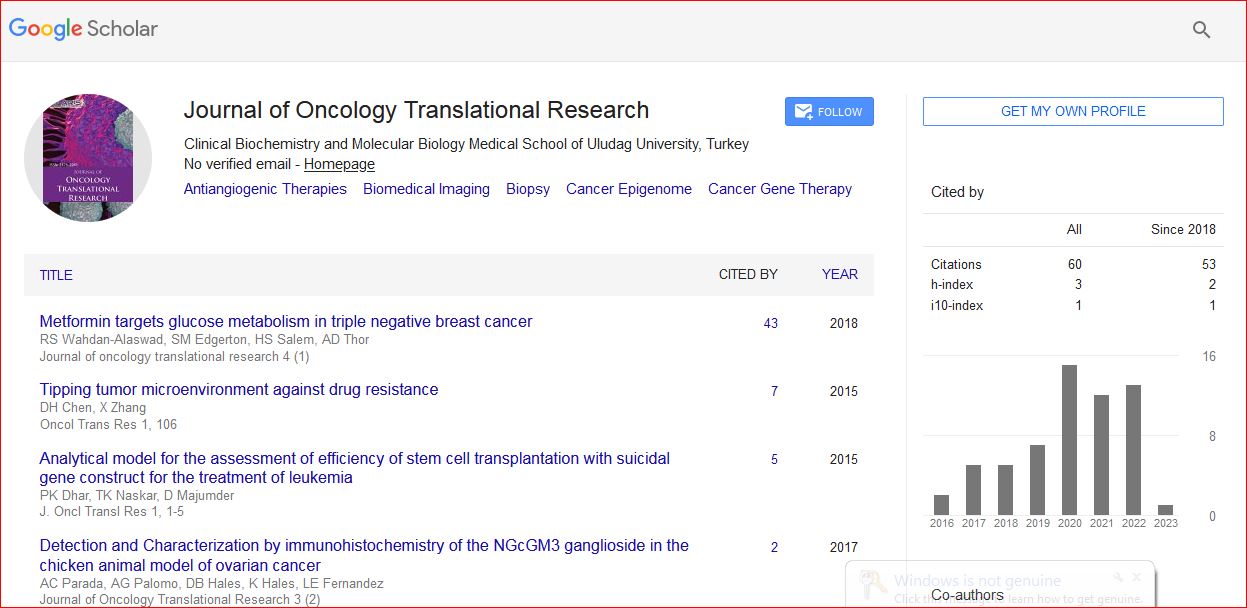
Journal of Oncology Translational Research received 93 citations as per Google Scholar report