Commentary - (2025) Volume 9, Issue 2
Received: 01-Apr-2025, Manuscript No. jcre-26-187167;
Editor assigned: 03-Apr-2025, Pre QC No. P-187167;
Reviewed: 17-Apr-2025, QC No. Q-187167;
Revised: 22-Apr-2025, Manuscript No. R-187167;
Published:
29-Apr-2025
, DOI: 10.37421/2795-6172.2025.9.298
Citation: Al-Mansouri, Noor. ”Exercise for Obese Adults: Fitness And Health.” J Clin Res 09 (2025):28.
Copyright: © 2025 Al-Mansouri N. This is an open-access article distributed under the terms of the Creative Commons Attribution License, which permits unrestricted use, distribution and reproduction in any medium, provided the original author and source are credited.
The growing prevalence of obesity presents a significant public health challenge, necessitating effective strategies to improve health outcomes in affected populations. One crucial area of focus is cardiorespiratory fitness, which is strongly linked to overall cardiovascular health and metabolic well-being. Exercise interventions have emerged as a cornerstone in managing obesity and enhancing fitness levels in this demographic. This article evaluates how exercise programs impact cardiorespiratory fitness in obese adults. The key insight is that structured exercise, particularly aerobic training, consistently leads to significant improvements in VO2max and other fitness markers. The effectiveness is often dose-dependent, meaning longer durations and higher intensities yield better results. Furthermore, combining aerobic and resistance training appears to offer synergistic benefits for both fitness and body composition [1].
Investigating the role of different exercise modalities, this study found that high-intensity interval training (HIIT) can be a time-efficient strategy to improve cardiorespiratory fitness in obese individuals, sometimes even surpassing moderate-intensity continuous training. However, adherence and individual tolerance are important considerations. The findings suggest that personalized exercise prescriptions are crucial for maximizing benefits and ensuring long-term engagement [2].
This research highlights the importance of exercise volume and intensity in eliciting cardiorespiratory adaptations in obese populations. The study demonstrates a clear dose-response relationship, where greater exercise volume and intensity lead to more substantial improvements in VO2max. It also points out that while any exercise is beneficial, exceeding certain thresholds is necessary for significant physiological changes, emphasizing the need for progressive overload [3].
The integration of both aerobic and resistance training is explored for its comprehensive effects on obese adults. This study confirms that combined training is superior to either modality alone for improving cardiorespiratory fitness and also positively impacts body composition and metabolic health. The findings suggest a balanced approach is optimal for addressing the multifaceted challenges of obesity [4].
This paper focuses on the long-term sustainability of exercise interventions for cardiorespiratory fitness in obese individuals. It emphasizes that adherence is a critical factor, and programs that incorporate behavioral strategies, social support, and flexibility tend to have better long-term outcomes. The challenge is not just initiating exercise but maintaining it for sustained health benefits [5].
This study examines the effectiveness of different exercise program structures, including supervised versus unsupervised settings, on cardiorespiratory fitness in obese adults. The findings suggest that while supervised programs often yield greater initial improvements due to accountability and proper technique, well-designed unsupervised programs can also be effective if participants are motivated and educated [6].
The article delves into the specific physiological mechanisms by which exercise improves cardiorespiratory fitness in obese individuals. It discusses improvements in cardiac output, stroke volume, and peripheral vascular function. The key takeaway is that regular exercise leads to structural and functional adaptations in the cardiovascular system, enhancing its efficiency [7].
This research investigates the impact of different exercise frequencies on cardiorespiratory fitness improvements in obese adults. It suggests that exercising most days of the week, rather than just a few, leads to more robust and sustained gains in VO2max. The findings underscore the importance of consistency in exercise programming for achieving optimal results [8].
This study explores the role of motivational interviewing and goal setting in enhancing adherence to exercise programs for cardiorespiratory fitness in obese adults. The key finding is that incorporating these behavioral change techniques significantly improves participant engagement and, consequently, their fitness outcomes. The personalized approach helps address individual barriers to exercise [9].
Finally, this article examines the influence of various exercise program durations on cardiorespiratory fitness gains in obese adults. It suggests that longer-term programs (e.g., 12 weeks or more) are generally more effective for achieving significant and sustainable improvements in VO2max compared to shorter interventions. The findings highlight the necessity of sustained effort for meaningful physiological change [10].
Structured exercise, particularly aerobic training, has been consistently shown to yield significant improvements in cardiorespiratory fitness markers such as VO2max among obese adults. The effectiveness of these programs is often correlated with the exercise dosage, with longer durations and higher intensities leading to more pronounced benefits. The synergistic effects of combining aerobic and resistance training further enhance both fitness and body composition, offering a comprehensive approach to managing obesity-related health concerns [1].
High-intensity interval training (HIIT) presents a time-efficient alternative for improving cardiorespiratory fitness in obese individuals, sometimes proving more effective than moderate-intensity continuous training. However, successful implementation requires careful consideration of individual adherence and tolerance to the training stimulus. Tailored exercise prescriptions are thus essential for maximizing benefits and promoting sustained engagement with physical activity [2].
The volume and intensity of exercise play a critical role in driving cardiorespiratory adaptations in obese populations. A clear dose-response relationship exists, where increased exercise volume and intensity are associated with greater improvements in VO2max. While any form of exercise is beneficial, achieving substantial physiological changes necessitates exceeding specific thresholds and incorporating principles of progressive overload [3].
When considering the multifaceted nature of obesity management, combined aerobic and resistance training emerges as a superior strategy compared to either modality alone. This integrated approach not only enhances cardiorespiratory fitness but also positively influences body composition and metabolic health, suggesting that a balanced exercise regimen is optimal for addressing the complex challenges associated with obesity [4].
The long-term sustainability of exercise interventions for improving cardiorespiratory fitness in obese individuals hinges significantly on adherence. Programs that integrate behavioral strategies, social support mechanisms, and offer flexibility are more likely to achieve better long-term outcomes. The challenge lies not merely in initiating an exercise routine but in maintaining it consistently to realize sustained health benefits [5].
Comparing different exercise program structures, supervised versus unsupervised settings, reveals that supervised programs often lead to greater initial improvements in cardiorespiratory fitness among obese adults. This is largely attributed to enhanced accountability and correct technique execution. Nevertheless, well-designed unsupervised programs can also be effective for motivated and educated participants [6].
The physiological mechanisms underpinning exercise-induced improvements in cardiorespiratory fitness in obese individuals are multifaceted. Regular exercise elicits structural and functional adaptations in the cardiovascular system, leading to enhanced cardiac output, increased stroke volume, and improved peripheral vascular function, thereby boosting overall cardiovascular efficiency [7].
Investigating the frequency of exercise, research suggests that engaging in physical activity most days of the week leads to more robust and sustained gains in VO2max among obese adults compared to exercising only a few times a week. This highlights the crucial role of consistency in exercise programming for achieving optimal and lasting results [8].
Behavioral change techniques, such as motivational interviewing and goal setting, have demonstrated significant efficacy in enhancing adherence to exercise programs for cardiorespiratory fitness in obese adults. The implementation of these personalized approaches helps in addressing individual barriers to exercise, thereby improving participant engagement and ultimately their fitness outcomes [9].
Finally, the duration of exercise programs plays a vital role in achieving meaningful cardiorespiratory fitness improvements in obese adults. Longer-term interventions, typically spanning 12 weeks or more, are generally more effective in yielding significant and sustainable gains in VO2max than shorter programs. This underscores the importance of sustained effort for eliciting lasting physiological adaptations [10].
Exercise programs significantly improve cardiorespiratory fitness in obese adults, with aerobic training being particularly effective. The benefits are dose-dependent, with higher intensity and longer duration yielding better results. Combining aerobic and resistance training offers synergistic advantages for fitness and body composition. High-intensity interval training (HIIT) is a time-efficient option, but adherence and individual tolerance are crucial. Overall, a balanced, consistent, and prolonged exercise approach, supported by behavioral strategies and personalized plans, is key to achieving and sustaining cardiorespiratory health improvements in obese populations.
None
None
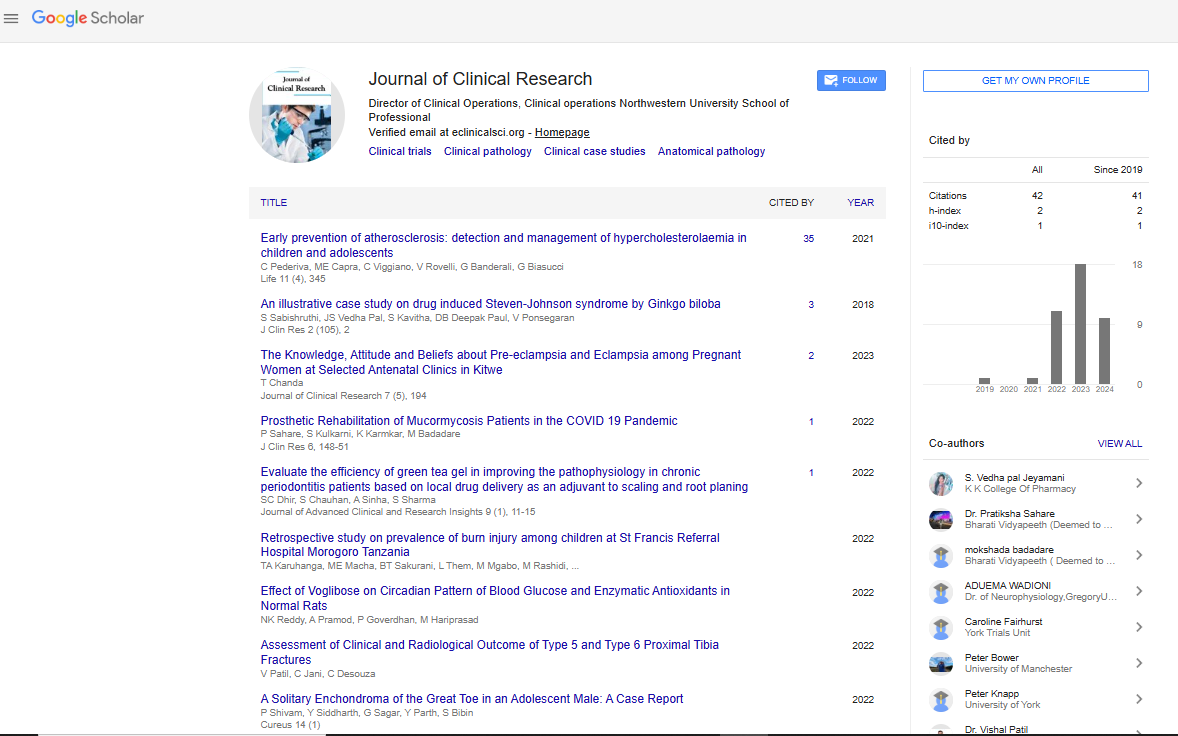
Journal of Clinical Research received 11 citations as per Google Scholar report