Commentary - (2025) Volume 14, Issue 4
Received: 01-Aug-2025, Manuscript No. jhoa-26-187826;
Editor assigned: 04-Aug-2025, Pre QC No. P-187826;
Reviewed: 18-Aug-2025, QC No. Q-187826;
Revised: 22-Aug-2025, Manuscript No. R-187826;
Published:
29-Aug-2025
, DOI: 10.37421/2167-1095.2025.14.528
Citation: Papadopoulos, George. ”Exercise: A Powerful Tool for Hypertension Management.” J Hypertens 14 (2025):528.
Copyright: © 2025 Papadopoulos G. This is an open-access article distributed under the terms of the Creative Commons Attribution License, which permits unrestricted use, distribution and reproduction in any medium, provided the original author and source are credited.
Regular physical activity stands as a cornerstone in the proactive prevention and effective management of hypertension. Its multifaceted benefits extend to enhancing vascular function, a critical element in maintaining healthy blood pressure levels. By reducing the overactivity of the sympathetic nervous system, exercise plays a significant role in alleviating one of the key drivers of elevated blood pressure [1].
Furthermore, exercise is instrumental in promoting and sustaining weight management, which is directly linked to better blood pressure control. Excess weight is a well-established risk factor for hypertension, and exercise aids in calorie expenditure and metabolic improvements, contributing to a healthier body composition [1].
Exercise contributes to lower blood pressure through a variety of sophisticated physiological mechanisms. One such mechanism involves enhanced nitric oxide bioavailability, which promotes vasodilation and improves blood flow. This relaxation of blood vessels is crucial for reducing the pressure within the arterial system [1].
Another significant pathway through which exercise exerts its antihypertensive effects is by reducing arterial stiffness. Stiff arteries are less able to accommodate the pulsatile flow of blood, leading to higher pressure readings. Regular physical activity helps maintain arterial elasticity [1].
Improved insulin sensitivity is another crucial benefit derived from regular exercise that positively impacts blood pressure. Better insulin sensitivity means the body's cells can more effectively use glucose, which is linked to improved metabolic health and reduced hypertension risk [1].
The efficacy of exercise in managing hypertension has been underscored by systematic reviews and meta-analyses, confirming its role in lowering blood pressure among hypertensive individuals. Different exercise modalities have been investigated for their antihypertensive potential [2].
A broad spectrum of exercise types, including aerobic, resistance, and combined training regimens, have demonstrated considerable effectiveness in reducing blood pressure in individuals diagnosed with hypertension. This highlights the versatility of exercise as a therapeutic intervention [2].
The antihypertensive effects of exercise are often observed to be dose-dependent, meaning that the intensity, duration, and frequency of exercise can influence the extent of blood pressure reduction. This suggests a need for tailored exercise prescriptions [2].
Exercise interventions are recognized as valuable complements to pharmacological treatments for hypertension. They can work synergistically with medications to achieve better blood pressure control and reduce the overall cardiovascular risk burden on patients [2].
Physiological mechanisms underlying the antihypertensive effects of exercise are diverse and involve intricate interactions within the cardiovascular system. These mechanisms are critical to understanding how exercise translates into tangible blood pressure benefits [3].
The role of exercise in preventing hypertension is well-documented, with research highlighting its positive impact on vascular health and sympathetic nervous system activity [1].
Regular physical activity also plays a crucial part in effective weight management, a significant factor in controlling blood pressure levels [1].
Exercise actively contributes to reducing blood pressure by enhancing the bioavailability of nitric oxide, a key molecule for vasodilation and improved blood flow. This process helps to relax blood vessels, thereby lowering resistance and pressure [1].
Moreover, exercise helps to mitigate arterial stiffness, a condition where arteries become less flexible and more resistant to blood flow. By maintaining arterial elasticity, exercise ensures that blood vessels can better adapt to the heart's pumping action, leading to reduced pressure [1].
Improved insulin sensitivity, another outcome of regular physical activity, also contributes to better blood pressure regulation. Enhanced insulin sensitivity is associated with improved metabolic health, which in turn can help prevent the development of hypertension [1].
The integration of consistent exercise into one's lifestyle is paramount for sustained hypertension prevention and overall cardiovascular well-being. Long-term adherence to physical activity guidelines has been shown to significantly reduce the risk of cardiovascular diseases [5].
Different types of exercise, including aerobic and resistance training, have been shown to be effective in lowering blood pressure in adults. Combined training, which incorporates elements of both, may offer even greater synergistic benefits for blood pressure control [4].
These findings are supported by systematic reviews and meta-analyses that have investigated the impact of various exercise modalities. Such comprehensive analyses provide strong evidence for the antihypertensive effects of different exercise approaches [4].
The physiological mechanisms by which exercise reduces blood pressure are intricate and involve improvements in endothelial function, a reduction in sympathetic nerve activity, and modulation of the renin-angiotensin-aldosterone system [3].
The effectiveness of exercise interventions in the primary prevention of hypertension has been confirmed through rigorous systematic reviews and meta-analyses of randomized controlled trials. Regular physical activity significantly lowers the incidence of developing hypertension in healthy populations [6].
The study of exercise interventions in the primary prevention of hypertension has yielded significant results, indicating that engaging in regular physical activity is a potent strategy for reducing the likelihood of developing this condition [6].
Regular physical activity is vital for preventing and managing hypertension. Exercise improves vascular function, reduces sympathetic nervous system activity, and aids in weight management. It lowers blood pressure by increasing nitric oxide bioavailability, reducing arterial stiffness, and enhancing insulin sensitivity. Various exercise types, including aerobic, resistance, and combined training, are effective, with effects often being dose-dependent. Exercise interventions can complement medication. Key physiological mechanisms involve improved endothelial function, reduced sympathetic outflow, and modulation of the renin-angiotensin-aldosterone system. Consistent exercise is crucial for long-term cardiovascular health and prevention of hypertension. High-intensity interval training and exercise's impact on inflammation also contribute to blood pressure control.
None
None
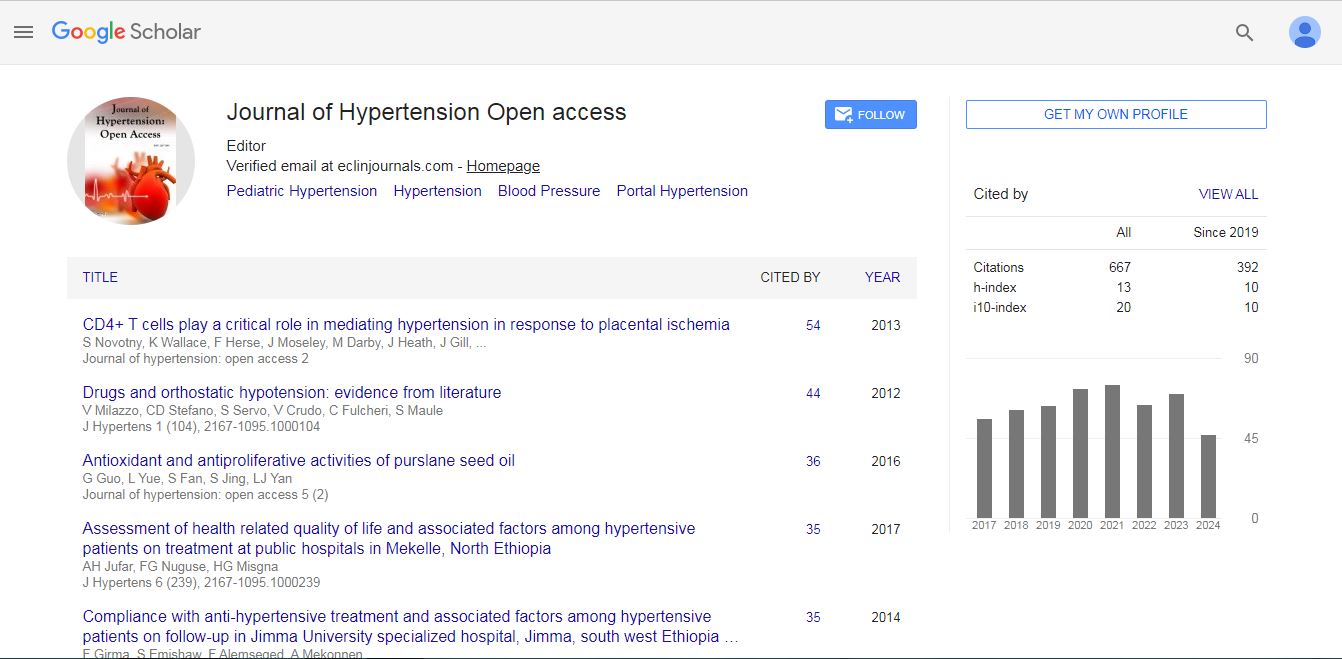
Journal of Hypertension: Open Access received 614 citations as per Google Scholar report