Commentary - (2025) Volume 9, Issue 4
Received: 01-Jul-2025, Manuscript No. fsb-26-189960;
Editor assigned: 03-Jul-2025, Pre QC No. P-189960;
Reviewed: 17-Jul-2025, QC No. Q-189960;
Revised: 22-Jul-2025, Manuscript No. R-189960;
Published:
29-Jul-2025
, DOI: 10.37421/2577-0543.2025.9.246
Citation: Watson, Emily. ”Excipients: Enhancing Drug Stability and Bioavailability.” J Formul Sci Bioavailab 09 (2025):246.
Copyright: © 2025 Watson E. This is an open-access article distributed under the terms of the Creative Commons Attribution License, which permits unrestricted use, distribution and reproduction in any medium, provided the original author and source are credited.
Pharmaceutical excipients are indispensable components in the development of effective drug formulations, contributing significantly to the stability and delivery of active pharmaceutical ingredients (APIs) [1].
Their role extends beyond mere inert fillers, encompassing crucial functions that directly impact drug performance and patient outcomes. One of the primary functions of excipients is to maintain the integrity of APIs, protecting them from various degradation pathways such as oxidation, hydrolysis, and photolysis, thereby ensuring the drug's potency throughout its shelf life [3].
This protective role is vital for extending the usability of pharmaceutical products and reducing waste. Furthermore, excipients are instrumental in enhancing drug bioavailability, a critical factor determining the amount of drug that reaches systemic circulation and exerts its therapeutic effect. This is often achieved by improving the solubility of poorly water-soluble APIs, which is a common challenge in drug development. Strategies like the formation of solid dispersions and complexation are employed, leveraging specific excipients to overcome these solubility limitations [1].
The selection of appropriate excipients directly influences these solubility enhancement techniques. Improving drug solubility through specialized excipients like polymers and surfactants is a cornerstone strategy for enhancing the oral bioavailability of drugs that are intrinsically poorly soluble. Advanced techniques such as amorphous solid dispersions and the development of nanoformulations critically rely on these excipients to accelerate the dissolution rate of APIs, which subsequently promotes their absorption into the bloodstream [2].
This is particularly important for oral dosage forms where dissolution is a rate-limiting step. In addition to solubility, excipients play a significant role in modulating drug permeability across biological membranes. Permeation enhancers, a specific class of excipients, are designed to temporarily increase the permeability of these membranes. This is particularly beneficial for drugs that exhibit poor absorption across the gastrointestinal tract, enabling them to achieve therapeutic concentrations more effectively [4].
Their application is key for drugs with limited passive diffusion. The chemical compatibility between an API and the chosen excipients is of paramount importance for guaranteeing drug stability over time. Excipients can actively counteract degradation by functioning as antioxidants, buffering agents to control pH, or light protectants. This proactive approach in excipient selection helps mitigate oxidative, hydrolytic, and photolytic degradation pathways that could otherwise compromise the drug's efficacy [3].
Understanding these interactions is crucial for formulation longevity. Physical properties of APIs, such as their crystalline or amorphous state, profoundly affect their solubility and subsequent bioavailability. Amorphous solid dispersions, often formulated using polymeric excipients, are a sophisticated approach to prevent API crystallization. By maintaining the drug in a higher-energy, more soluble amorphous state, these excipients significantly improve drug absorption [9].
This physical transformation is a key benefit of excipient use. Nanocarriers represent a significant advancement in drug delivery, and their efficacy is heavily dependent on the incorporation of specialized excipients. These excipients are designed to encapsulate drugs, shield them from degradation, enhance drug loading capacity, ensure stability within the nanocarrier, and facilitate controlled release profiles, all of which collectively contribute to improved bioavailability [6].
The design of nanocarriers is intricately linked to excipient properties. The interaction between APIs and excipients can, under certain circumstances, lead to the formation of degradation products, which can adversely affect both drug efficacy and safety. Therefore, conducting thorough stability studies to understand these potential interactions is critical. This understanding guides the selection of excipients that ensure long-term stability and consistent bioavailability of the drug product [7].
Vigilant assessment of drug-excipient interactions is essential. Excipients can be engineered to facilitate targeted drug delivery, thereby optimizing both drug stability and bioavailability. For instance, stimuli-responsive excipients can be designed to release the drug at a specific anatomical site or in response to particular physiological cues. This targeted release ensures localized therapeutic action, minimizes systemic exposure, and ultimately enhances treatment outcomes [10].
The intelligence of excipients is a growing field. Ultimately, the judicious selection of appropriate excipients is a fundamental aspect of pharmaceutical product development. Excipients influence a myriad of factors, including the polymorphic form, particle size, and susceptibility to degradation of the API. These influences collectively impact the drug's therapeutic efficacy, safety profile, and overall quality of the final dosage form [5].
The meticulous choice of excipients underpins successful drug development.
The fundamental role of pharmaceutical excipients in drug formulation and delivery cannot be overstated, as they are critical for stabilizing active pharmaceutical ingredients (APIs) against degradation, thereby extending product shelf life [1].
Beyond preservation, excipients are essential for enhancing drug bioavailability by actively improving characteristics such as solubility, permeability, and absorption. This involves sophisticated strategies like the development of solid dispersions and particle size reduction techniques [1].
The careful selection of excipients is thus paramount for optimizing drug performance. A key strategy employed to overcome the challenge of poor solubility in many APIs is the use of excipients like polymers and surfactants. These materials are instrumental in enhancing solubility, which directly translates to improved oral bioavailability. Advanced formulation techniques, including amorphous solid dispersions and nanoformulations, leverage these excipients to significantly increase the dissolution rate of APIs, leading to enhanced absorption [2].
This approach is vital for oral drug delivery. The chemical compatibility between an API and its accompanying excipients is a non-negotiable aspect of ensuring drug stability. Excipients can actively combat degradation pathways, including oxidation, hydrolysis, and photolysis, by serving as antioxidants, buffering agents, or light protectants. This judicious selection of excipients provides a robust defense against factors that compromise drug integrity [3].
Proactive measures in excipient selection are crucial for stability. Bioavailability can be significantly boosted through the strategic use of permeation enhancers. These specialized excipients function by temporarily increasing the permeability of biological membranes, which is particularly advantageous for drugs that struggle to be absorbed across the gastrointestinal tract. Their application facilitates greater drug absorption and efficacy [4].
Permeation enhancers are key to unlocking absorption potential. The selection of appropriate excipients is a cornerstone of successful pharmaceutical product development, fundamentally influencing both the physical and chemical stability of drug products. Excipients impact critical attributes such as the polymorphic form of the API, its particle size, and its inherent susceptibility to degradation, all of which have profound effects on the drug's therapeutic efficacy and safety [5].
Meticulous excipient selection guides product quality. Nanocarriers represent a major leap forward in drug delivery systems, and their effectiveness is intricately linked to the incorporation of specialized excipients. These excipients are engineered to encapsulate drugs, protect them from degradation, improve drug loading efficiency, ensure stability within the nanocarrier, and modulate drug release profiles, ultimately leading to enhanced bioavailability [6].
The design of nanocarriers is inseparable from excipient functionality. Drug-excipient interactions are a critical area of study, as they can potentially lead to the formation of degradation products that compromise drug efficacy and safety. Comprehensive stability studies are therefore essential to thoroughly understand these interactions. This understanding empowers formulators to select excipients that guarantee long-term stability and consistent bioavailability of the drug product [7].
Rigorous assessment of interactions is indispensable. Formulating drugs for improved oral absorption frequently involves modifying their inherent physicochemical properties. Excipients such as cyclodextrins are adept at forming inclusion complexes, which effectively enhance the apparent solubility and dissolution rate of hydrophobic drugs, thereby boosting their oral bioavailability [8].
Cyclodextrins offer a well-established route to solubility enhancement. The physical state of an API, whether crystalline or amorphous, exerts a substantial influence on its solubility and bioavailability. Amorphous solid dispersions, created using polymeric excipients, are a highly effective strategy to prevent API crystallization. By maintaining the drug in a higher-energy, more soluble amorphous state, these excipients significantly improve drug absorption [9].
The amorphous state is a significant driver of improved bioavailability. Excipients can be ingeniously engineered to facilitate targeted drug delivery, thereby optimizing both drug stability and bioavailability. For example, stimuli-responsive excipients can be designed to release the drug specifically at a desired site or in response to physiological cues. This targeted release ensures localized therapeutic action, minimizes unwanted systemic exposure, and ultimately improves treatment outcomes [10].
The development of 'smart' excipients heralds a new era in drug delivery.
Pharmaceutical excipients are vital for drug formulation, playing critical roles in stabilizing active pharmaceutical ingredients (APIs) and enhancing their bioavailability. They protect APIs from degradation, extend shelf life, and improve solubility, permeability, and absorption through strategies like solid dispersions and complexation. Excipients are also key in improving oral bioavailability by increasing dissolution rates, particularly for poorly soluble drugs, using techniques such as amorphous solid dispersions and nanoformulations. Chemical compatibility between APIs and excipients is essential for drug stability, with excipients acting as antioxidants, buffering agents, and light protectants. Permeation enhancers, a type of excipient, improve drug absorption by increasing membrane permeability. The physical state of an API, like crystalline versus amorphous, significantly impacts its bioavailability, with amorphous solid dispersions utilizing polymeric excipients to maintain solubility. Nanocarriers incorporate specialized excipients for drug encapsulation, protection, and controlled release. Understanding drug-excipient interactions is crucial for long-term stability and consistent bioavailability. Excipients can also enable targeted drug delivery through stimuli-responsive mechanisms, optimizing therapeutic outcomes. Ultimately, the careful selection of excipients influences API properties and impacts drug efficacy, safety, and overall product quality.
None
None
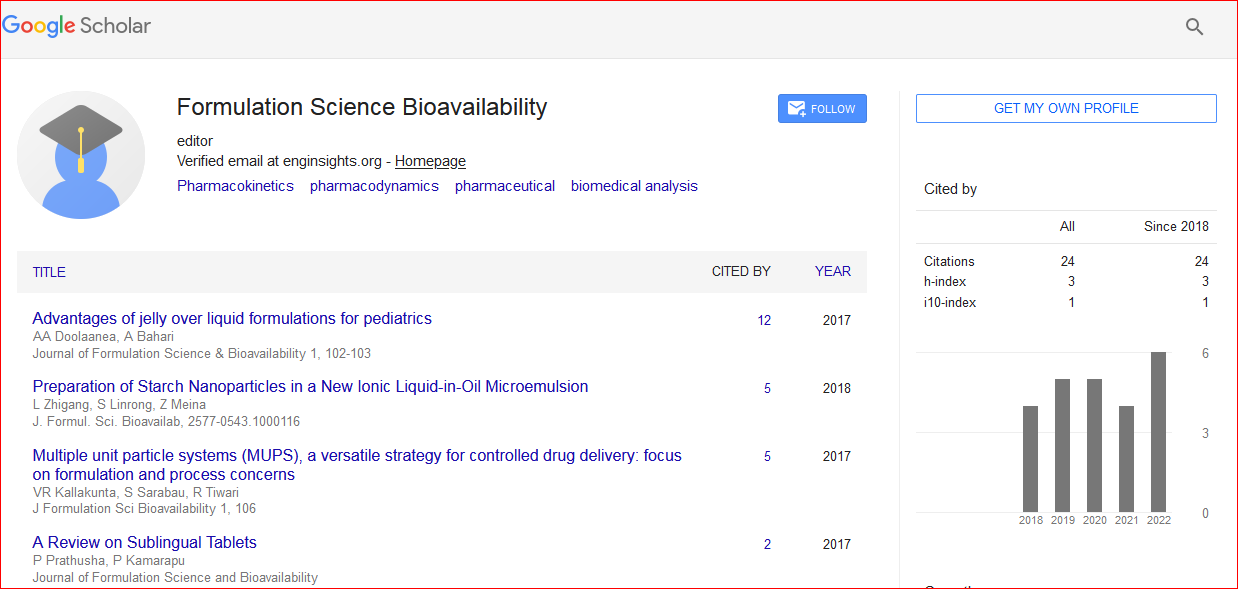
Journal of Formulation Science & Bioavailability received 23 citations as per Google Scholar report