Commentary - (2025) Volume 14, Issue 4
Received: 01-Dec-2025, Manuscript No. jms-25-177888;
Editor assigned: 03-Dec-2025, Pre QC No. P-177888;
Reviewed: 17-Dec-2025, QC No. Q-177888;
Revised: 22-Dec-2025, Manuscript No. R-177888;
Published:
29-Dec-2025
, DOI: 10.37421/2167-0943.2024.13.423
Citation: Soler, Vega. "Evolving T2DM Management: Novel Therapies, Holistic Care." J Metabolic Synd 14 (2025):423.
Copyright: © 2025 Soler V. This is an open-access article distributed under the terms of the Creative Commons Attribution License, which permits unrestricted use, distribution and reproduction in any medium, provided the original author and source are credited.
Type 2 Diabetes Mellitus (T2DM) is a complex metabolic disorder, and understanding its various facets, from molecular mechanisms to global health implications, is crucial. This review provides a thorough understanding of the pathophysiology of Type 2 Diabetes Mellitus, outlining the interplay of insulin resistance, beta-cell dysfunction, and increased hepatic glucose production. It details current management approaches, from lifestyle modifications to pharmacological interventions, and elucidates the common microvascular and macrovascular complications, stressing the need for integrated, patient-centered care[2].
This article delves into the sophisticated genetic architecture underlying Type 2 Diabetes, exploring how recent advancements have refined our understanding of its heritability. It covers discoveries in monogenic forms of diabetes, the development of polygenic risk scores, and the challenges and opportunities in translating these genetic insights into clinically actionable strategies for prevention and treatment[3].
This article explores the intricate and bidirectional relationship between obesity and Type 2 Diabetes, recognizing obesity as a primary driver of insulin resistance and beta-cell dysfunction. It illuminates the underlying pathophysiological mechanisms, including chronic inflammation and altered adipokine secretion, and discusses therapeutic strategies that target both weight reduction and glycemic control to improve long-term outcomes for patients[7].
This paper underscores the fundamental role of comprehensive lifestyle interventions in both preventing the onset and effectively managing Type 2 Diabetes. It reviews the evidence demonstrating how structured programs focusing on dietary changes, increased physical activity, and behavioral modifications can lead to significant reductions in diabetes incidence and improvements in glycemic control, weight loss, and overall health outcomes for individuals with T2DM[6].
This review meticulously examines the critical role of nutrition in both the prevention and management of Type 2 Diabetes. It synthesizes current dietary recommendations, comparing various nutritional approaches, such as low-carbohydrate, Mediterranean, and plant-based diets, and their respective impacts on glycemic control, weight management, and cardiovascular risk factors, emphasizing the importance of individualized dietary counseling[4].
This article explores the continuously evolving landscape of therapeutic strategies for Type 2 Diabetes Mellitus (T2DM). It highlights significant advancements in drug classes, such as GLP-1 receptor agonists and SGLT2 inhibitors, which offer benefits beyond glycemic control, extending to cardiovascular and renal protection. The authors also discuss emerging treatments and the future promise of personalized medicine in managing this complex condition[1].
This article provides an important update on the burgeoning evidence supporting the cardiovascular and renal benefits of SGLT2 inhibitors and GLP-1 receptor agonists in patients with Type 2 Diabetes. It discusses how these agents not only lower blood glucose but also significantly reduce the risk of major adverse cardiovascular events, heart failure hospitalization, and progression of chronic kidney disease, thereby reshaping treatment paradigms[5].
This review delves into innovative and emerging therapies for Type 2 Diabetes that extend beyond conventional glucose-lowering mechanisms. It discusses novel agents and approaches that address various aspects of T2DM pathophysiology, such as inflammation, fibrosis, and energy metabolism, with the aim of achieving not just glycemic control but also improved weight management, cardiovascular health, and renal protection[8].
This article highlights the significant and growing understanding of the gut microbiome's role in the pathogenesis and progression of Type 2 Diabetes. It explores how dysbiosis, an imbalance in gut microbial communities, contributes to insulin resistance, inflammation, and altered energy metabolism. The review also discusses the potential for microbiome-targeted therapies, such as prebiotics, probiotics, and fecal microbiota transplantation, as novel interventions for T2DM[9].
This comprehensive review offers updated perspectives on Diabetic Kidney Disease (DKD), a serious microvascular complication of Type 2 Diabetes. It outlines the complex interplay of metabolic, hemodynamic, and inflammatory factors in its pathophysiology. The article also covers advancements in early diagnosis, risk stratification, and the latest treatment strategies, including the renoprotective effects of SGLT2 inhibitors and GLP-1 receptor agonists, aimed at preserving kidney function[10].
Type 2 Diabetes Mellitus (T2DM) is characterized by a complex interplay of insulin resistance, beta-cell dysfunction, and increased hepatic glucose production, forming its core pathophysiology. This understanding provides a thorough outline of the disease mechanisms [2]. A significant driver of this condition is obesity, recognized as a primary cause of insulin resistance and beta-cell dysfunction, illuminating underlying pathophysiological mechanisms such as chronic inflammation and altered adipokine secretion. Therapeutic strategies targeting both weight reduction and glycemic control are crucial for improving long-term outcomes [7]. Beyond these factors, a sophisticated genetic architecture contributes to T2DM, with recent advancements enhancing our understanding of its heritability. Discoveries in monogenic forms of diabetes and the development of polygenic risk scores present both challenges and opportunities in translating these genetic insights into clinically actionable strategies for prevention and treatment [3].
Effective management and prevention of T2DM heavily rely on comprehensive lifestyle interventions. Evidence demonstrates how structured programs focusing on dietary changes, increased physical activity, and behavioral modifications can lead to significant reductions in diabetes incidence and improvements in glycemic control, weight loss, and overall health outcomes for individuals with T2DM [6]. Complementing this, nutrition plays a critical role in both prevention and management. This involves synthesizing current dietary recommendations and comparing various nutritional approaches, such as low-carbohydrate, Mediterranean, and plant-based diets, to understand their respective impacts on glycemic control, weight management, and cardiovascular risk factors. The importance of individualized dietary counseling cannot be overstated in this context [4].
The therapeutic landscape for T2DM is continuously evolving with significant advancements in drug classes. GLP-1 receptor agonists and SGLT2 inhibitors, for instance, offer substantial benefits beyond mere glycemic control, extending to crucial cardiovascular and renal protection. The future promise of personalized medicine in managing this complex condition is also a key area of discussion [1]. These agents have been shown to not only lower blood glucose but also significantly reduce the risk of major adverse cardiovascular events, heart failure hospitalization, and the progression of chronic kidney disease, thereby reshaping treatment paradigms through an important update on burgeoning evidence [5].
Innovative and emerging therapies for T2DM are now exploring mechanisms beyond conventional glucose lowering. This involves novel agents and approaches that address diverse aspects of T2DM pathophysiology, such as inflammation, fibrosis, and energy metabolism, with the aim of achieving not just glycemic control but also improved weight management, cardiovascular health, and renal protection [8]. Additionally, there's a significant and growing understanding of the gut microbiome's role in the pathogenesis and progression of T2DM. Dysbiosis, an imbalance in gut microbial communities, directly contributes to insulin resistance, inflammation, and altered energy metabolism. This understanding highlights the potential for microbiome-targeted therapies, including prebiotics, probiotics, and fecal microbiota transplantation, as novel interventions for T2DM [9].
Diabetic Kidney Disease (DKD) represents a serious microvascular complication of T2DM, driven by a complex interplay of metabolic, hemodynamic, and inflammatory factors in its pathophysiology. Advancements in early diagnosis, risk stratification, and the latest treatment strategies are crucial for preserving kidney function. These strategies often include leveraging the renoprotective effects of SGLT2 inhibitors and GLP-1 receptor agonists, offering updated perspectives on this condition [10]. Overall, managing T2DM necessitates an integrated, patient-centered approach that considers its multifaceted pathophysiology, genetic predispositions, the crucial role of lifestyle and nutrition, advanced pharmacotherapy, and emerging insights into systemic factors like the microbiome, all aimed at mitigating complications and improving long-term patient outcomes.
Type 2 Diabetes Mellitus (T2DM) is a multifaceted condition driven by insulin resistance, beta-cell dysfunction, and increased hepatic glucose production, further complicated by genetic predispositions and a strong link to obesity. Its management has evolved significantly, emphasizing integrated patient-centered care. Comprehensive lifestyle interventions, encompassing dietary changes, increased physical activity, and behavioral modifications, are fundamental for both prevention and glycemic control. Nutritional science highlights various dietary approaches, from low-carbohydrate to plant-based, advocating for individualized counseling to manage weight and cardiovascular risk. Recent advancements in pharmacological therapies have reshaped treatment paradigms. Drug classes such as GLP-1 receptor agonists and SGLT2 inhibitors offer substantial benefits beyond mere glucose lowering, providing significant cardiovascular and renal protection. This reduces the risk of major adverse cardiovascular events, heart failure hospitalization, and progression of chronic kidney disease. The field also sees the emergence of novel therapies targeting diverse pathophysiological aspects like inflammation, fibrosis, and energy metabolism, aiming for holistic improvements in weight management and organ protection. Understanding the gut microbiome's role in T2DM pathogenesis, specifically dysbiosis leading to insulin resistance and inflammation, opens doors for new microbiome-targeted interventions. Crucially, addressing complications like Diabetic Kidney Disease (DKD) remains a priority, with updated strategies focusing on early diagnosis, risk stratification, and the renoprotective effects of newer medications. The future of T2DM management increasingly points towards personalized medicine and a holistic approach to patient health.
None
None
Indexed at, Google Scholar, Crossref
Indexed at, Google Scholar, Crossref
Indexed at, Google Scholar, Crossref
Indexed at, Google Scholar, Crossref
Indexed at, Google Scholar, Crossref
Indexed at, Google Scholar, Crossref
Indexed at, Google Scholar, Crossref
Indexed at, Google Scholar, Crossref
Indexed at, Google Scholar, Crossref
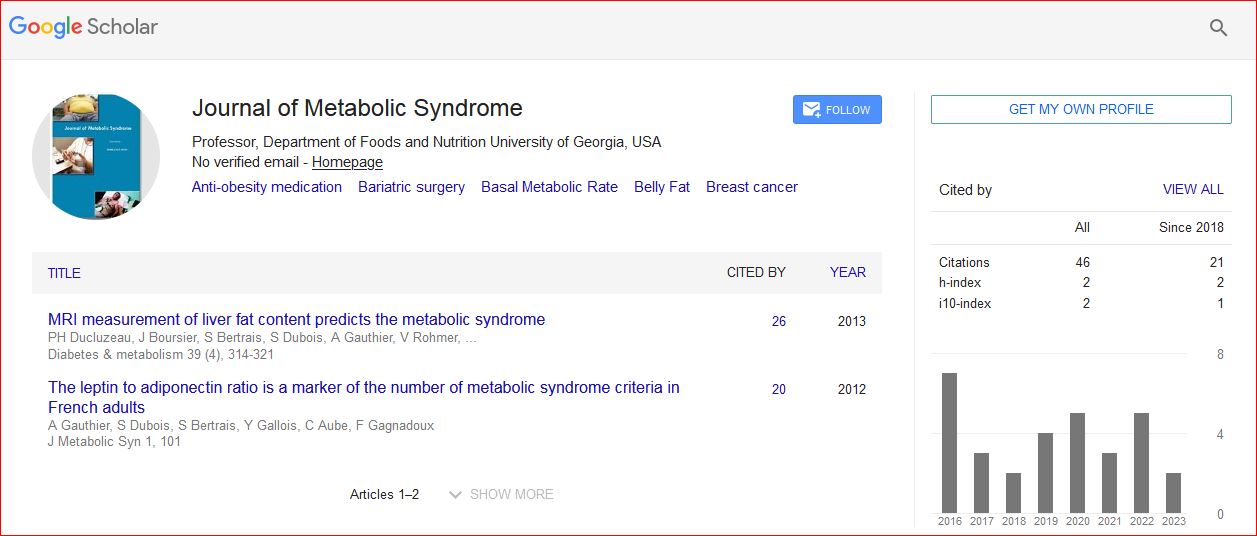
Journal of Metabolic Syndrome received 48 citations as per Google Scholar report