Commentary - (127) Volume 15, Issue 5
Received: 30-Sep-2025, Manuscript No. jmcj-25-176913;
Editor assigned: 02-Oct-2025, Pre QC No. P-176913;
Reviewed: 14-Oct-2025, QC No. Q-176913;
Revised: 21-Oct-2025, Manuscript No. R-176913;
Published:
28-Oct-2025
, DOI: 10.37421/2165-7912.2025.15.641
Citation: Becker, Adrian S.. "Evolving Opinion Journalism: Ethics, Bias, Digital Age." J Mass Communicat Journalism 15(2025):641.
Copyright: © 2025 Becker S. Adrian This is an open-access article distributed under the terms of the Creative Commons Attribution License, which permits unrestricted use,
distribution and reproduction in any medium, provided the original author and source are credited.
Opinion journalism stands as a dynamic and critical component of contemporary news media, constantly evolving in its forms, influence, and challenges across various global contexts. For example, extensive research delves into the op-ed as a distinct form of news discourse, meticulously analyzing its linguistic characteristics across different languages. This study effectively highlights how op-eds serve as powerful platforms for expressing subjective viewpoints while concurrently adhering to established journalistic conventions, showcasing notable variations in argumentative strategies and the nuanced rhetorical devices employed to persuade diverse readerships [1]. This foundational understanding underscores the complex interplay between subjective expression and objective reporting within this genre. A significant area of concern explores how journalists' personal political opinions can deeply influence public trust in news and audience perceptions of bias. Empirical studies suggest that when journalists openly express their political views, it can profoundly shape how audiences interpret news content, potentially diminishing overall credibility and, perhaps more critically, fueling partisan divides in contemporary media consumption [2].
This phenomenon directly contributes to observable audience behaviors, where partisan selective exposure and news avoidance are demonstrably influenced by the very nature of opinion journalism. Investigations reveal that individuals' pre-existing predispositions, when combined with the often-partisan framing present in opinion pieces, lead some to actively consume news that rigidly aligns with their established views, while others, conversely, choose to disengage from news entirely [3]. This creates fragmented media diets and challenges the ideal of a shared public understanding. The ethical dilemmas inherent in partisan opinion journalism are particularly acute in an era marked by heightened political polarization. Scholars examine the profound responsibilities of opinion journalists to actively foster informed public discourse, all while navigating the intense pressures of advocacy and steadfastly maintaining journalistic integrity [4].
Simultaneously, the profound digital transformation impacting opinion journalism is rapidly reshaping traditional practices. A compelling case study of Spanish media, for instance, illustrates precisely how conventional approaches are evolving in direct response to new technologies and shifting consumption habits. This highlights crucial adaptations in content creation, distribution mechanisms, and audience engagement strategies within the increasingly complex digital landscape [5]. These changes necessitate a constant re-evaluation of established practices and norms. Indeed, the very nature of opinion journalism is demonstrably changing as journalists worldwide adapt to the distinct logic of digital platforms and ever-shifting audience expectations. Research explores the innovative strategies journalists now employ to remain relevant and effectively engage readers in an environment increasingly dominated by intricate social media algorithms and highly personalized content feeds [6]. Beyond individual journalists, editorial boards also play a critical, often understated, role in shaping public opinion, primarily through newspaper editorials. These collective journalistic entities rigorously formulate positions on pivotal societal issues, thereby influencing reader perceptions and contributing significantly to broader political and social discourse [7].
This collective editorial voice can wield substantial power. Furthermore, the persuasive power in opinion pieces is not solely confined to text; visual elements in photojournalism also contribute significantly to the construction of persuasion. An analysis of the argumentative power of images reveals how specific visual narratives and framing choices can profoundly influence audience interpretation, either reinforcing or challenging textual opinions [8]. On a broader societal level, the diversity of voices and perspectives among op-ed contributors in elite US newspapers remains a vital subject of inquiry. This research assesses whether these influential platforms genuinely provide a broad range of viewpoints or if they tend to inadvertently favor certain demographics or ideological positions, thereby impacting the fairness and breadth of public discourse [9]. Looking ahead, the emerging landscape of Artificial Intelligence (AI) within opinion journalism presents both formidable opportunities and significant challenges. This area considers how AI tools might effectively assist in drafting, researching, or personalizing opinion pieces, alongside serious concerns about authenticity, ethical responsibility, and the potential far-reaching impact on traditional journalistic roles [10]. This future direction demands careful consideration as technology integrates further into journalistic practice.
Opinion journalism functions as a crucial, yet complex, domain within contemporary media, providing platforms for subjective viewpoints while often adhering to established journalistic standards. This genre, exemplified by the op-ed, showcases diverse linguistic characteristics and rhetorical strategies across different languages, demonstrating how writers seek to persuade readers effectively [1]. The ethical dimensions of this field are consistently scrutinized, especially given the current climate of heightened political polarization. Opinion journalists grapple with the dual responsibility of fostering informed public discourse while navigating advocacy pressures and upholding journalistic integrity [4]. Understanding these foundational aspects helps us appreciate the intricate role opinion pieces play in shaping public perception.
The influence of opinion journalism extends to how audiences consume and interpret news. Journalists' personal political opinions, for instance, are shown to impact public trust and perceptions of bias. When these views are expressed, they can significantly shape audience interpretation of news content, potentially affecting credibility and intensifying partisan divides [2]. This effect is compounded by partisan selective exposure and news avoidance behaviors. Research indicates that individuals' pre-existing beliefs, combined with the partisan framing in opinion pieces, lead some to consume only news that aligns with their views, while others opt out of news consumption entirely [3]. These dynamics highlight the challenges in achieving a broad, informed public sphere.
The advent of digital platforms has fundamentally reshaped opinion journalism. A case study focused on Spanish media illustrates this digital transformation, detailing how traditional practices are adapting to new technologies and evolving consumption habits. This includes significant changes in content creation, distribution methods, and audience engagement strategies [5]. Similarly, the very nature of opinion journalism is undergoing shifts as journalists adapt to the specific logic of digital platforms and evolving audience expectations. They employ new strategies to maintain relevance and engage readers in an environment increasingly influenced by social media algorithms and personalized content feeds [6]. These adaptations are critical for survival and influence in the modern media ecosystem.
Beyond individual journalists, institutional structures and non-textual elements also play significant roles in shaping opinion. Editorial boards, for example, hold a critical position in shaping public opinion through newspaper editorials. These collective entities meticulously formulate positions on key issues, directly influencing reader perceptions and contributing to broader political and social discourse [7]. Furthermore, visual elements in photojournalism contribute substantially to persuasion within opinion pieces. Analyses reveal the argumentative power of images, demonstrating how visual narratives and framing can influence audience interpretation, either reinforcing or challenging textual opinions [8]. This emphasizes that persuasion is a multi-modal endeavor.
Addressing the diversity of voices and perspectives among op-ed contributors is also paramount, particularly in influential platforms like elite US newspapers. Studies assess whether these outlets provide a genuinely broad range of viewpoints or if they lean towards certain demographics or ideological positions, which inevitably impacts the quality and breadth of public discourse [9]. Looking to the future, the integration of Artificial Intelligence (AI) into opinion journalism presents a complex landscape of opportunities and challenges. While AI tools could aid in drafting, researching, or personalizing content, there are significant concerns about authenticity, ethical responsibility, and the potential alteration of journalistic roles [10]. This evolving technological frontier demands careful consideration as the field progresses.
Opinion journalism is a dynamic and essential domain within contemporary media, constantly evolving and facing diverse challenges. Research highlights that op-eds function as distinct forms of news discourse, analyzing their linguistic characteristics and rhetorical devices used to persuade readers across different languages [1]. A significant concern revolves around the impact of journalists' personal political opinions, which can profoundly affect public trust and perceptions of bias, potentially fueling partisan divides in media consumption [2]. This phenomenon contributes to behaviors such as partisan selective exposure and news avoidance, where individuals gravitate towards news aligning with their views or disengage entirely due to partisan framing [3]. The ethical landscape of opinion journalism is particularly complex, especially in a politically polarized age. Opinion journalists bear a crucial responsibility to foster informed public discourse while balancing advocacy with journalistic integrity [4]. The digital revolution has ushered in a profound transformation, evident in how traditional practices, such as those in Spanish media, are adapting to new technologies for content creation, distribution, and audience engagement [5]. Journalists globally are also recalibrating their approaches to align with digital platform logic and shifting audience expectations, employing new strategies to remain relevant amidst algorithmic feeds and personalized content [6]. Beyond individual contributions, institutional elements like editorial boards play a critical role in shaping public opinion through carefully crafted newspaper editorials [7]. Visual elements in photojournalism also wield significant persuasive power, influencing interpretation and reinforcing or challenging textual opinions [8]. Furthermore, assessing the diversity of voices among op-ed contributors in influential newspapers is crucial to ensure a broad range of viewpoints in public discourse [9]. Looking ahead, the integration of Artificial Intelligence presents both opportunities for automated content creation and challenges concerning authenticity, ethical responsibility, and the evolving roles of journalists [10]. This body of work collectively illustrates the multifaceted nature and ongoing evolution of opinion journalism in a complex media environment.
None
None
Han L, Qingmei M, Xiaolin H. "The Op-Ed as a Genre of News Discourse: A Cross-Linguistic Analysis".Journal of Language and Politics 19 (2020):248-270.
Indexed at, Google Scholar, Crossref
Jiyoun K, Jaeho C, Woojin L. "The impact of journalists' political opinion on trust in news and perceptions of bias".Journalism & Mass Communication Quarterly 99 (2022):917-938.
Indexed at, Google Scholar, Crossref
Huyen T, Lance B, David S. "Partisan Selective Exposure and News Avoidance: Examining the Effects of Opinion Journalism on News Consumption".Political Communication 40 (2023):493-511.
Indexed at, Google Scholar, Crossref
Stephen JAW, Chris R, Robert HS. "The ethics of partisan opinion journalism in a polarized age".Journal of Media Ethics 35 (2020):119-133.
Indexed at, Google Scholar, Crossref
Ángel V, Javier D, Koldo M. "The Digital Transformation of Opinion Journalism: A Case Study of Spanish Media".International Journal of Communication 15 (2021):2679-2700.
Indexed at, Google Scholar, Crossref
Sophie EDVdW, Peter B, Sanne K. "The Changing Nature of Opinion Journalism: How Journalists Adapt to Platform Logic and Audience Expectations".Journalism Studies 24 (2023):2197-2216.
Indexed at, Google Scholar, Crossref
Mary MO, David CL, Jonathan ML. "The Role of Editorial Boards in Shaping Public Opinion: A Comparative Study of Newspaper Editorials".Journalism & Mass Communication Quarterly 98 (2021):886-907.
Indexed at, Google Scholar, Crossref
Anne H, Jane R, David C. "Visualizing Opinion: Photojournalism, Argumentation, and the Construction of Persuasion".Visual Communication 21 (2022):509-528.
Indexed at, Google Scholar, Crossref
Sarah LS, Kevin RD, Ben BG. "Diversity in Opinion Journalism: A Study of Op-Ed Contributors in Elite US Newspapers".Newspaper Research Journal 41 (2020):411-428.
Indexed at, Google Scholar, Crossref
Carl JL, Michelle AJ, Daniel GM. "Artificial Intelligence in Opinion Journalism: Exploring the Opportunities and Challenges of Automated Content Creation".Digital Journalism None (2024):OnlineFirst.
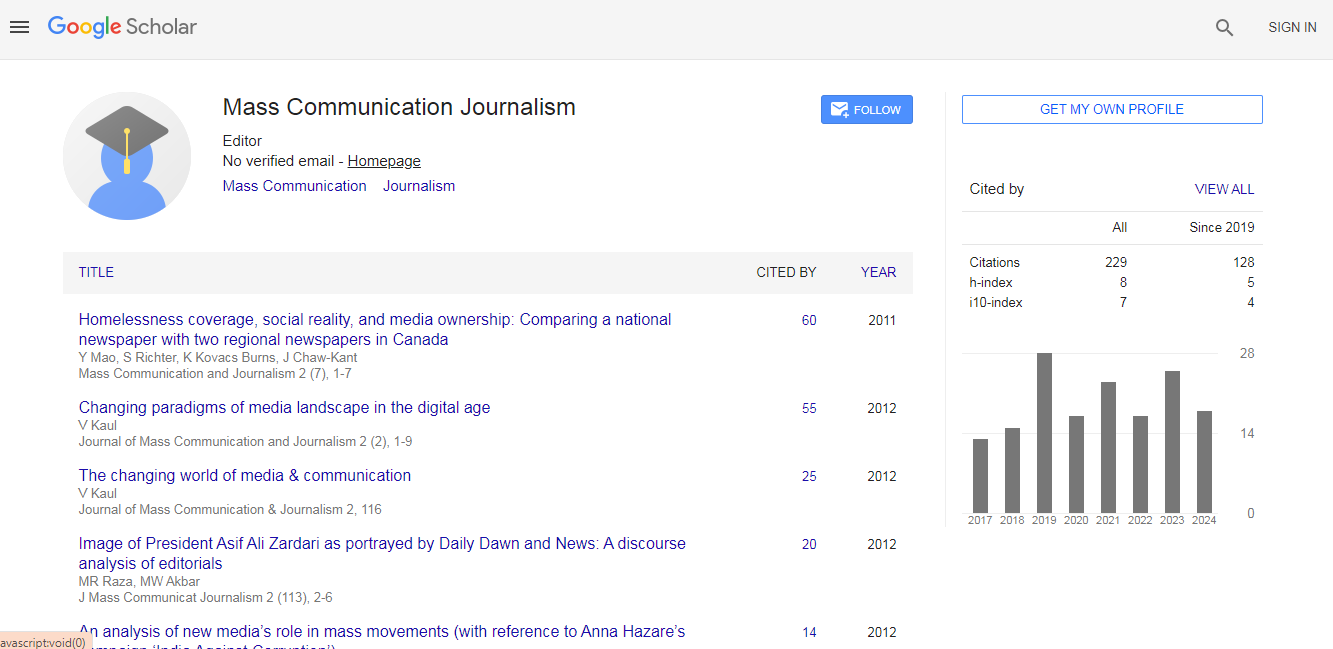
Journal of Mass Communication & Journalism received 205 citations as per Google Scholar report