Brief Report - (2025) Volume 14, Issue 4
Received: 03-Aug-2025, Manuscript No. jnc-25-173948;
Editor assigned: 05-Aug-2025, Pre QC No. P-173948;
Reviewed: 19-Aug-2025, QC No. Q-173948;
Revised: 25-Aug-2025, Manuscript No. R-173948;
Published:
30-Aug-2025
, DOI: 10.37421/2167-1168.2025.14.717
Citation: Okoro, David. ”Evolving Nursing Education: Tech, Competence, Well-being.” J Nurs Care 14 (2025):717.
Copyright: © 2025 Okoro D. This is an open-access article distributed under the terms of the Creative Commons Attribution License, which permits unrestricted use, distribution and reproduction in any medium, provided the original author and source are credited.
The field of nursing education continually evolves, driven by the need to prepare competent, ethical, and adaptable professionals for complex healthcare environments. Modern pedagogical approaches are integrating cutting-edge technologies and focusing on comprehensive student development, encompassing not just clinical skills but also critical thinking, ethical reasoning, and well-being. This collection of reviews highlights critical trends and foundational aspects shaping contemporary nursing education. Recent investigations, such as a scoping review on Virtual Reality (VR), illuminate how this immersive technology is transforming clinical training in nursing education. VR provides a safe and engaging environment, crucial for developing practical skills and refining decision-making abilities in complex patient care scenarios. The integration of VR signifies a progressive step in equipping future nurses with vital competencies, offering a dynamic and interactive way to learn complex patient care scenarios [1].
Understanding the broader context of health, another critical scoping review highlights the importance of integrating social determinants of health into nursing curricula. This integration is essential for nurses to deliver holistic and equitable care, as it helps them understand and address the root causes of health disparities. Such studies offer valuable insights into existing teaching methodologies and identify areas where curriculum design can be strengthened to better prepare nurses for diverse patient populations and societal health challenges [2].
Clinical reasoning forms the bedrock of effective patient care, and a detailed scoping review has identified various key factors influencing its development in undergraduate nursing students. These factors include the quality of effective teaching strategies, the richness and diversity of clinical experiences provided, and the recognition of individual student characteristics. Recognizing and nurturing these elements is paramount for fostering sound judgment and critical thinking abilities among aspiring nurses, enabling them to make informed decisions in complex situations [3].
The collaborative nature of modern healthcare demands that nurses work effectively within interprofessional teams. A systematic review evaluates the profound influence of interprofessional education (IPE) on nursing students' attitudes and perceptions. It clearly shows that IPE improves students' understanding of other healthcare roles and significantly enhances their collaborative practice readiness, which is crucial for the seamless functioning of modern healthcare teams and ultimately better patient outcomes [4].
The advent of Artificial Intelligence (AI) heralds a new era in nursing education, with a systematic review exploring its transformative impact. This research highlights how AI tools can effectively enhance learning experiences, automate various administrative tasks, and crucially prepare future nurses for increasingly technology-driven healthcare environments. This clearly points towards a significant and necessary shift in pedagogical approaches, moving towards more innovative and efficient educational models that embrace digital advancements [5].
A comprehensive systematic review has pinpointed various factors directly impacting nursing students' clinical competency, a cornerstone of professional practice. Effective clinical placements, consistent and supportive mentorship, the cultivation of strong self-efficacy, and positive, conducive learning environments emerge as crucial elements in cultivating the essential skills required for patient care. These findings offer practical guidance for educators aiming to optimize training programs and ensure student proficiency and readiness for the clinical setting [6].
Developing ethical competence is fundamental for professional nursing practice and patient advocacy. One systematic review meticulously investigates the factors influencing this critical competence in nursing students. The study underscores the profound importance of dedicated ethics education, the presence of positive role modeling, and structured exposure to real-world ethical dilemmas in fostering students' moral reasoning and sound decision-making abilities, essential components for navigating complex healthcare situations [7].
The demanding nature of nursing programs often leads to significant stress among students, making mental health and well-being a critical area of focus. A recent scoping review identifies various effective strategies for promoting mental health and well-being among nursing students. These interventions include mindfulness practices, robust peer support networks, and targeted resilience training, all vital for supporting students through challenging academic journeys and preparing them for the emotional demands of the profession [8].
Simulation-based education is a cornerstone of modern nursing training, and a systematic review delves into the different debriefing methods employed in this context. It confirms that structured and well-facilitated debriefing sessions are indispensable for maximizing learning outcomes. These sessions enable students to critically reflect on their performance, effectively integrate constructive feedback, and hone their critical thinking skills after engaging in simulated clinical experiences, thereby bridging theory and practice [9].
The effectiveness of various clinical teaching strategies used for undergraduate nursing students is a recurring theme in educational research. A thorough systematic review identifies and evaluates different approaches, highlighting the efficacy of methods like direct supervision, one-on-one mentorship, and reflective practice. These strategies are consistently shown to significantly enhance students' practical skills and bolster their confidence when operating in real-world clinical settings, ensuring a smooth transition from student to professional nurse [10].
Contemporary nursing education increasingly leverages technology to enhance learning outcomes and prepare students for evolving healthcare landscapes. Virtual Reality (VR) is notably utilized for clinical training, offering an immersive and safe environment where students can develop essential practical skills and refine their decision-making abilities without real-world risks [1]. This technological integration extends to the burgeoning field of Artificial Intelligence (AI). AI tools are being explored for their capacity to significantly improve learning experiences, automate various administrative tasks, and fundamentally prepare future nurses for an increasingly technology-centric healthcare environment. This points to a substantial shift in pedagogical strategies towards more innovative and efficient models [5]. Furthermore, within simulation-based nursing education, systematic reviews emphasize the critical role of structured and facilitated debriefing methods. These sessions are indispensable for students to critically reflect on their performance, effectively integrate feedback, and cultivate robust critical thinking skills after engaging in complex simulated clinical scenarios [9].
A core objective of nursing programs is the development of robust clinical competencies. Research meticulously identifies various factors that profoundly influence clinical reasoning skills in undergraduate students. These crucial elements include the implementation of effective teaching strategies, the provision of rich and varied clinical experiences, and an understanding of individual student characteristics, all of which collectively contribute to the formation of sound judgment in patient care [3]. Beyond clinical reasoning, a broader systematic review highlights diverse factors affecting overall clinical competency among nursing students. These encompass the quality and appropriateness of clinical placements, the presence and guidance of strong mentorship, the development of student self-efficacy, and the overall conduciveness of the learning environment [6]. Ethical competence is equally fundamental for professional nursing practice. Studies underscore the profound importance of dedicated ethics education, consistent and positive role modeling from instructors and mentors, and structured exposure to complex ethical dilemmas. These combined factors are essential in fostering students' moral reasoning and their ability to make sound ethical decisions in their future careers [7].
The design of nursing curricula is continually evolving to effectively address the multifaceted needs of patients and modern healthcare systems. A significant area of focus is the integration of social determinants of health into nursing education. This integration is deemed critical, as it enables nurses to provide truly holistic and equitable care by deeply understanding the broader societal factors that influence patient health and well-being. Such reviews offer valuable insights into existing teaching methodologies and pinpoint areas where curriculum design can be significantly strengthened to better prepare nurses for diverse patient populations and complex social contexts [2]. Concurrently, interprofessional education (IPE) plays an increasingly crucial role in enhancing nursing students' attitudes and perceptions. IPE is shown to foster a deeper understanding of the roles and contributions of other healthcare professionals, thereby significantly improving students' collaborative practice readiness. This readiness is an indispensable attribute for effective functioning within today's integrated, team-based healthcare settings, ensuring coordinated and comprehensive patient care [4].
Crucially, supporting student well-being and employing effective teaching strategies are paramount to successful nursing education outcomes. Nursing students frequently face significant academic and clinical stressors throughout their demanding programs. Therefore, promoting mental health and overall well-being is a critical area of focus, with reviews identifying effective interventions such as mindfulness practices, robust peer support networks, and targeted resilience training. These strategies are vital for sustaining students' mental health throughout their challenging academic journeys [8]. Complementing these support systems, a thorough systematic review identifies and evaluates various clinical teaching strategies specifically designed for undergraduate nursing students. Methods such as direct supervision, consistent mentorship, and the promotion of reflective practice are highlighted as particularly effective. These approaches are demonstrated to significantly enhance students' practical skills and crucially bolster their confidence when operating in real-world clinical settings, ultimately preparing them for autonomous and competent practice [10]. These efforts collectively ensure students are well-prepared, both clinically and personally, for their future professional roles.
The landscape of nursing education is undergoing significant evolution, driven by advancements in technology and a deeper understanding of student development needs. Modern approaches are incorporating Virtual Reality (VR) and Artificial Intelligence (AI) to create engaging learning experiences, optimize clinical training, and prepare future nurses for increasingly complex, technology-driven healthcare environments. There is a strong emphasis on developing core competencies such as clinical reasoning, overall clinical proficiency, and ethical decision-making, acknowledging the diverse factors that influence these skills. Educators are recognizing the vital role of effective clinical placements, mentorship, and tailored teaching strategies like direct supervision and reflective practice in building student confidence and practical expertise. Furthermore, curricula are evolving to integrate social determinants of health, ensuring nurses are equipped to provide holistic and equitable care, while interprofessional education (IPE) fosters crucial collaborative practice readiness. Attention is also being given to the holistic well-being of nursing students, with strategies focused on promoting mental health and resilience. The continuous refinement of simulation-based learning, particularly through structured debriefing, reinforces critical thinking and feedback integration. These efforts collectively aim to cultivate highly skilled, ethically aware, and resilient nursing professionals ready to meet contemporary healthcare challenges.
None
None
1. Minjung Y, Jinhee C, Mijeong C. "Using Virtual Reality for Clinical Training in Nursing Education: A Scoping Review".J Korean Acad Nurs 53 (2023):709-723.
Indexed at, Google Scholar, Crossref
2. Theodora M, C. AK, Millicent O. "Integrating Social Determinants of Health into Nursing Curricula: A Scoping Review".Int J Environ Res Public Health 19 (2022):12563.
Indexed at, Google Scholar, Crossref
3. Claire D, Rachel C, Anneliese D. "Factors influencing clinical reasoning in undergraduate nursing students: A scoping review".J Clin Nurs 30 (2021):3604-3624.
Indexed at, Google Scholar, Crossref
4. Marc Z, Deborah O, Jan R. "Impact of interprofessional education on nursing students' attitudes and perceptions: A systematic review".Nurse Educ Today 90 (2020):104443.
Indexed at, Google Scholar, Crossref
5. Hasan A, Emad A, Lama T. "The impact of artificial intelligence on nursing education: A systematic review".Nurse Educ Today 122 (2023):105703.
Indexed at, Google Scholar, Crossref
6. Ya-Ming L, Chia-Hui T, Chun-Yu L. "A systematic review of factors influencing the clinical competency of nursing students".J Clin Nurs 31 (2022):2806-2820.
Indexed at, Google Scholar, Crossref
7. Fatemeh M, Akbar Z, Kamal Z. "Factors affecting ethical competence in nursing students: A systematic review".BMC Med Ethics 22 (2021):111.
Indexed at, Google Scholar, Crossref
8. Xiang L, Fenfang D, Shuqin Y. "Promoting Mental Health and Well-being in Nursing Students: A Scoping Review".J Nurs Res 31 (2023):e295.
Indexed at, Google Scholar, Crossref
9. Pyoung-Joo O, Sung-Yong K, Seung K. "A systematic review of debriefing methods used in simulation-based nursing education".J Adv Nurs 78 (2022):18-32.
Indexed at, Google Scholar, Crossref
10. Mohsen A, Nasibeh A, Iraj A. "Clinical teaching strategies for undergraduate nursing students: A systematic review".J Clin Nurs 28 (2019):3125-3141.
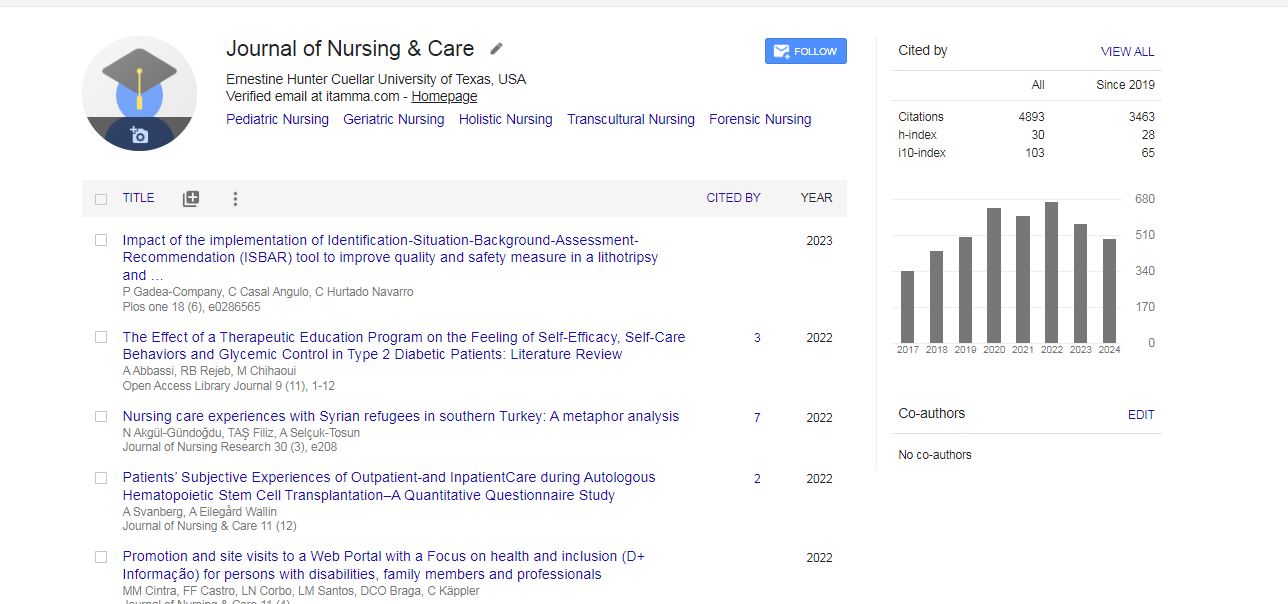
Journal of Nursing & Care received 4230 citations as per Google Scholar report