Opinion - (2025) Volume 14, Issue 2
Received: 01-Apr-2025, Manuscript No. jbfa-25-174134;
Editor assigned: 03-Apr-2025, Pre QC No. P-174134;
Reviewed: 17-Apr-2025, QC No. Q-174134;
Revised: 22-Apr-2025, Manuscript No. R-174134;
Published:
29-Apr-2025
, DOI: 10.37421/2167-0234.2025.14.524
Citation: Schmidt, Laura. ”Evolving Investment: AI, ESG, Behavioral Finance.” J Bus Fin Aff 14 (2025):524.
Copyright: © 2025 Schmidt L. This is an open-access article distributed under the terms of the Creative Commons Attribution License, which permits unrestricted use, distribution and reproduction in any medium, provided the original author and source are credited.
The contemporary financial landscape is a complex, dynamic arena, continually shaped by evolving technologies, shifting investor behaviors, and a growing emphasis on societal and environmental impact. Understanding these multifaceted drivers is paramount for making informed investment decisions and crafting resilient strategies. Recent academic inquiry has diligently explored these transformative elements, providing critical insights into the mechanisms that underpin modern financial markets. One significant area of focus involves the intricate relationship between corporate sustainability and financial performance. Research indicates that while sustainability efforts are generally beneficial, the tangible impact on a companyâ??s financial health is strongly moderated by its Environmental, Social, and Governance (ESG) scores [1].
This suggests that merely undertaking sustainable actions is insufficient; their effective reflection in recognized ESG metrics is what truly drives value creation and impacts the bottom line. Building on this, the broader field of sustainable finance and investment is rapidly becoming a central pillar in global financial markets. Itâ??s no longer just about ethical considerations; integrating ESG factors provides a critical lens for understanding long-term value creation and mitigating systemic risks, signaling a fundamental shift in investment paradigms [9].
Technological advancements, particularly in Artificial Intelligence (AI) and Machine Learning (ML), are profoundly reshaping the investment management industry. A comprehensive review highlights how AI is making its mark across various facets, from algorithmic trading to predictive analytics and risk assessment, fundamentally altering how investment decisions are made [2].
AI tools offer unparalleled capabilities for processing vast amounts of data and recognizing patterns that traditional methods simply cannot match, steering the industry towards more data-driven and automated strategies. Similarly, the application of Machine Learning in portfolio optimization is demonstrating significant advantages. ML techniques excel at handling the complex, non-linear relationships inherent in financial data, leading to the construction and management of investment portfolios that can achieve superior risk-adjusted returns and dynamic adjustments [4].
This presents a compelling case for moving beyond conventional models in today's increasingly complex market environment. The broader impact of FinTech on investment management is a dual narrative of immense opportunities and substantial challenges. It encompasses everything from robo-advisors and Blockchain to AI, promising streamlined processes and democratized access to financial services, yet demanding careful navigation through regulatory hurdles and cybersecurity risks [6].
Beyond technology, human psychology plays an undeniable role in financial outcomes. A systematic review delves into how psychological biases like overconfidence, herd mentality, and anchoring frequently steer investors away from rational choices [3].
Recognizing these common human tendencies is crucial for developing strategies to mitigate their negative impact, fostering more sound financial judgments. This becomes particularly evident when examining the volatile world of cryptocurrency investments. Research reveals that investor decisions in this unique asset class are driven by a complex mix of speculative motives, the Fear Of Missing Out (FOMO), perceived high returns, and technological appeal, where traditional financial theories often fall short in explaining behavior due to pronounced psychological biases and information asymmetry [10].
In light of these complexities, effective risk management is non-negotiable for informed investment decisions. A systematic review emphasizes that robust risk management goes beyond merely avoiding losses; it involves systematically identifying, assessing, and mitigating various types of financial risk [8].
This necessitates comprehensive frameworks that integrate quantitative models with qualitative judgments, enabling investors to navigate market uncertainties more strategically and protect their capital while pursuing growth. Furthermore, the investment landscape is expanding to include a greater emphasis on alternative investments. Assets such as private equity, hedge funds, real estate, and infrastructure are no longer considered niche but are vital components for diversification and enhanced returns, especially in volatile market conditions [5].
Institutions are increasingly allocating capital to these alternatives to meet objectives that traditional stocks and bonds alone cannot satisfy. Lastly, the concept of stock market efficiency, particularly in emerging economies, is being revisited with a nonlinear approach. This challenges the conventional wisdom of perfectly rational and efficient markets, uncovering evidence of predictable patterns and inefficiencies in developing markets [7].
This suggests potential opportunities for skilled active investors in less efficient environments, offering a contrasting view to the often-tough challenges of developed markets.
The current literature highlights several key areas transforming investment management, spanning from the integration of ethical considerations to the application of advanced technologies and a deeper understanding of market anomalies. One significant trend is the growing focus on sustainable practices and their financial ramifications. This study digs into how corporate sustainability actually impacts a company's financial performance, focusing on the role of Environmental, Social, and Governance (ESG) scores. What they found is that while sustainability efforts are generally good, the specific ESG scores a company achieves can significantly change how those efforts translate into financial gains [1]. It suggests that just doing 'sustainable' things isn't enough; how well those actions are reflected in recognized ESG metrics truly matters for value creation. Essentially, getting the numbers right on ESG makes a real difference to the bottom line. This perspective is further bolstered by a comprehensive review of sustainable finance and investment, which covers core principles, emerging trends, and the growing imperative for integrating ESG factors into financial decision-making. The paper argues that sustainable finance isn't just about ethics; it's a critical lens for understanding long-term value creation and mitigating systemic risks [9]. This is a clear signal that this approach is becoming central to global financial markets.
Here's the thing about Artificial Intelligence (AI) and Machine Learning (ML) in investment management: these technologies are fundamentally reshaping the industry. A review maps out the current landscape, showing where AI is making its mark, covering everything from algorithmic trading to predictive analytics and risk assessment. The big takeaway is that AI is fundamentally reshaping how investment decisions are made, offering new tools for data processing and pattern recognition that traditional methods just can't match [2]. It's a clear signal that the industry is moving towards more data-driven, automated strategies. Let's break down machine learning's role in portfolio optimization. This review examines how ML techniques are being applied to construct and manage investment portfolios more effectively. The key insight here is that ML can handle complex, non-linear relationships in financial data far better than traditional methods, leading to potentially superior risk-adjusted returns and dynamic portfolio adjustments [4]. It's a strong case for moving beyond conventional models in an increasingly complex market. This technological wave is part of a broader FinTech revolution. This review tells us about FinTech's impact on investment management: it's a double-edged sword, full of both massive opportunities and significant challenges. On the opportunity side, we're talking about robo-advisors, Blockchain, and AI streamlining processes and democratizing access to financial services. The flip side involves regulatory hurdles, cybersecurity risks, and the need for new skill sets [6]. It's a dynamic field demanding adaptation and careful navigation.
A critical aspect of investment involves understanding the human element and market dynamics. This systematic review really drills down into how our psychological biases mess with investment decisions. What it highlights is that common human tendencies like overconfidence, herd mentality, and anchoring frequently lead investors away from rational choices [3]. Understanding these biases isn't just an academic exercise; it's crucial for developing strategies that mitigate their negative impact, helping investors make more sound financial judgments. It's about recognizing that emotions play a bigger role than many like to admit. This is particularly relevant when considering the unique asset class of cryptocurrencies. This systematic review looks at what drives cryptocurrency investment decisions. What it finds is a mix of factors, from speculative motives and fear of missing out (FOMO) to perceived high returns and technological appeal [10]. It highlights that traditional financial theories often fall short in explaining investor behavior in the volatile crypto market, suggesting that psychological biases and information asymmetry play a more pronounced role. This makes a strong case for understanding the unique dynamics of this asset class.
Furthermore, managing risk is paramount. This systematic review dives into risk management strategies crucial for making informed investment decisions. It highlights that effective risk management isn't just about avoiding losses; it's about systematically identifying, assessing, and mitigating various types of financial risk [8]. The paper emphasizes the need for comprehensive frameworks that integrate quantitative models with qualitative judgments, ultimately helping investors navigate market uncertainties more strategically and protect their capital while pursuing growth. Finally, the investment universe is expanding beyond traditional assets. This review sheds light on the growing importance of alternative investments in the portfolios of institutions. What it shows is that assets like private equity, hedge funds, real estate, and infrastructure are no longer niche options but essential components for diversification and enhanced returns, especially in volatile markets [5]. Institutions are increasingly allocating capital here to achieve objectives that traditional stocks and bonds alone can't meet, highlighting a shift in strategic asset allocation. This research also takes a fresh look at stock market efficiency, especially in emerging economies, using a nonlinear approach. What this really means is they're challenging the old idea that markets are always rational and efficient, finding evidence that in many developing markets, there are still predictable patterns and inefficiencies that can be exploited [7]. It suggests that while developed markets might be tough nuts to crack, emerging markets could offer opportunities for skilled active investors due to their less-than-perfect efficiency.
Investment management is rapidly evolving, driven by technological advancements and a deeper understanding of market dynamics and human behavior. Research highlights the increasing importance of Environmental, Social, and Governance (ESG) factors, showing that how well sustainability efforts are reflected in ESG scores directly influences a company's financial performance. This emphasizes that simply engaging in sustainable practices is not enough; their proper measurement and recognition are vital for value creation. The integration of Artificial Intelligence (AI) and Machine Learning (ML) is fundamentally reshaping investment strategies. AI applications, from algorithmic trading to predictive analytics and risk assessment, provide new tools for processing vast amounts of data and recognizing complex patterns that traditional methods cannot. Similarly, ML techniques are proving superior in handling non-linear relationships in financial data, leading to more effective portfolio optimization and potentially higher risk-adjusted returns. These technologies are pushing the industry towards more data-driven, automated approaches. Alongside technological shifts, understanding human psychology remains critical. Studies reveal that behavioral biases such as overconfidence, herd mentality, and anchoring frequently lead investors away from rational decisions, especially in volatile markets like cryptocurrency where speculative motives and Fear Of Missing Out (FOMO) play significant roles. Effective risk management strategies, which systematically identify, assess, and mitigate financial risks, are therefore crucial for navigating market uncertainties and protecting capital. Furthermore, the investment landscape is diversifying with a growing emphasis on alternative investments like private equity, hedge funds, and real estate, which are now considered essential for portfolio diversification and enhanced returns, especially in volatile markets. FinTech, while offering significant opportunities through robo-advisors and Blockchain, also presents challenges related to regulation and cybersecurity. Finally, the efficiency of stock markets, particularly in emerging economies, is being re-examined, suggesting that predictable patterns and inefficiencies might still offer opportunities for active investors. This collective body of research paints a picture of a sophisticated and dynamic investment world demanding adaptive strategies and robust analytical tools.
None
None
Indexed at, Google Scholar, Crossref
Indexed at, Google Scholar, Crossref
Indexed at, Google Scholar, Crossref
Indexed at, Google Scholar, Crossref
Indexed at, Google Scholar, Crossref
Indexed at, Google Scholar, Crossref
Indexed at, Google Scholar, Crossref
Indexed at, Google Scholar, Crossref
Indexed at, Google Scholar, Crossref
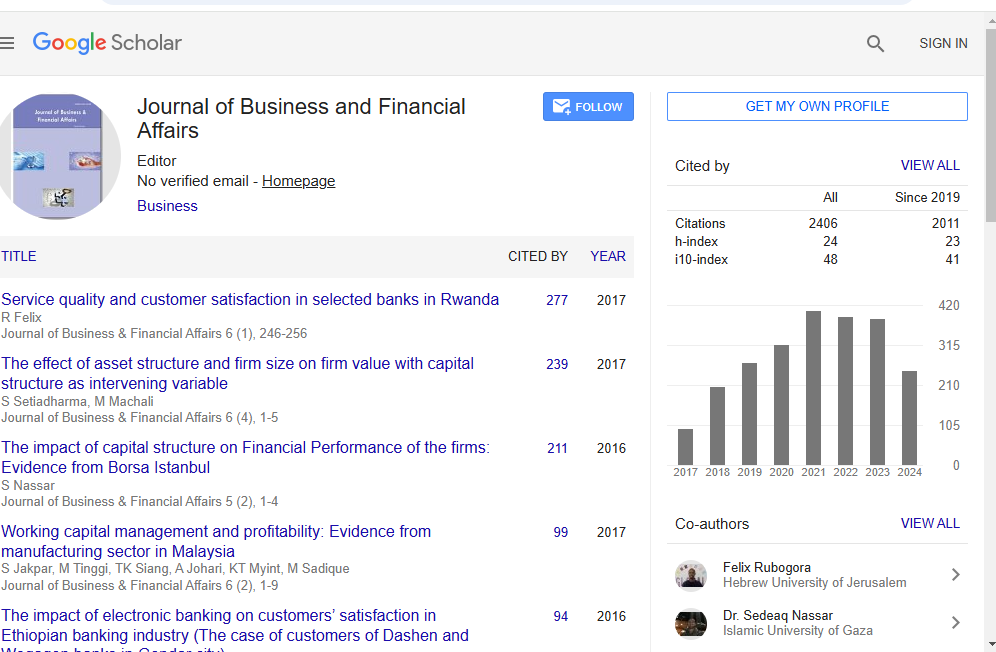
Journal of Business & Financial Affairs received 1726 citations as per Google Scholar report