Opinion - (2025) Volume 15, Issue 6
Received: 27-Nov-2025, Manuscript No. jmcj-25-176938;
Editor assigned: 01-Dec-2025, Pre QC No. P-176938;
Reviewed: 15-Dec-2025, QC No. Q-176938;
Revised: 22-Dec-2025, Manuscript No. R-176938;
Published:
29-Dec-2025
, DOI: 10.37421/2165-7912.2025.15.659
Citation: Santos, Gabriela M. Evolving Global News: Challenges, Trust, AI. J Mass Communicat Journalism 15(2025):659.
Copyright: © 2025 Santos M. Gabriela This is an open-access article distributed under the terms of the Creative Commons Attribution License, which permits unrestricted use, distribution and reproduction in any medium, provided the original author and source are credited.
Research thoroughly investigates the sourcing practices of global news organizations, revealing a notable reliance on a limited number of "news hubs". This situation suggests that even with widespread coverage, the foundational information often originates from a few powerful, long-standing centers, prompting important questions about diversity and perspective in international reporting [1].
Another study looks at how global news constructs its coverage of climate change, illustrating the profound ways media influences public and political understanding of this critical issue. The findings highlight distinct patterns in how climate-related news is presented by various national and international outlets, directly shaping global political discourse and policy decisions [2].
The multi-faceted nature of disinformation is a central concern, as explored in depth, which helps explain its widespread presence in today's digital global news environment. This analysis unpacks the intricate connections between false information, deliberately fabricated stories, and the significant challenges these elements pose to factual reporting and the trustworthiness of transnational news streams among audiences [3].
A comparative study examines how individuals consuming transnational news develop a sense of global identity and cosmopolitanism. By comparing audiences in South Korea and the United States, this work reveals how exposure to international news reporting can significantly broaden perspectives and cultivate a stronger connection to global issues that extend far beyond national boundaries [4].
The increasing influence of Artificial Intelligence (AI) in global journalism is also carefully mapped, identifying emerging trends and crucial future research directions. It demonstrates that AI is fundamentally transforming many aspects, from news gathering and production to content distribution across international networks, presenting both exciting opportunities and complex ethical considerations for the industry [5].
An analysis across nations investigates how perceived media bias affects trust in global news sources. This comparison clarifies that audience trust in international news is far from uniform; it is profoundly influenced by how impartial or biased people judge different media outlets to be, which in turn impacts their choices in news consumption [6].
Major global news outlets’ visual framing of the Rohingya refugee crisis is scrutinized, specifically focusing on the use of images and visual narratives. The research uncovers consistent patterns in how these elements are employed to depict humanitarian crises, thereby influencing international public opinion and shaping subsequent policy responses [7].
A forward-looking article proposes a new research agenda for global journalism ethics, acknowledging the complex moral dilemmas encountered by journalists operating across international borders. It underscores the urgent need to re-evaluate existing ethical frameworks in a contemporary world where news creation and consumption are increasingly transnational and heavily mediated by digital technologies [8].
The profound link between the flow of global news and local attitudes towards international events is investigated. This work clearly shows that the content people encounter in global news can significantly shape their perceptions and opinions regarding issues occurring far from their immediate environment, demonstrating the tangible local impact of global reporting [9].
Finally, a study delves into the factors influencing when and why social media users place trust in news content shared on these platforms within a global context. It highlights the crucial importance of source cues—such as the identity of the sharer or the perceived origin of the news—in determining whether diverse international online communities perceive information as credible [10].
Global news organizations often rely on a limited number of 'news hubs,' challenging the perception of diverse international reporting and raising questions about the origins of information [1]. This issue becomes even more critical when considering the multi-faceted nature of disinformation, which permeates today's digital global news landscape. Understanding the interplay between false information, fabricated narratives, and their challenge to factual reporting is essential for maintaining audience trust in transnational news streams [3]. Audience trust in international news is not uniform; it's heavily influenced by how impartial or biased people perceive various media outlets to be, directly impacting their consumption choices [6]. In the realm of social media, the credibility of shared news content heavily depends on source cues, such as who shared the news or its perceived origin, especially within diverse international online communities [10].
The way global news frames climate change significantly shapes public and political understanding worldwide. Specific patterns emerge in how climate news is constructed across different outlets, influencing political discourse and policy responses [2]. Similarly, the visual framing of crises, like the Rohingya refugee crisis, by major global news outlets reveals patterns in how images and visual narratives are used. These visual elements play a powerful role in depicting humanitarian crises, thereby influencing international public opinion and policy responses [7]. Such framing decisions highlight the profound responsibility of media in shaping global narratives.
Consumption of transnational news profoundly impacts individuals, fostering a sense of global identity and cosmopolitanism. A comparative study between audiences in South Korea and the United States, for example, demonstrates how exposure to international reporting can broaden perspectives and forge connections to global issues beyond national borders [4]. Furthermore, there's a strong link between global news flow and local attitudes towards international events. What people encounter in global news can significantly shape their perceptions and opinions about issues far from their immediate surroundings, illustrating the tangible local effects of global reporting [9]. This suggests that global news is not just consumed passively but actively influences individual worldviews and community perspectives.
The growing influence of Artificial Intelligence (AI) is transforming global journalism, affecting everything from news gathering and production to content distribution across international networks. This brings both new opportunities and complex ethical considerations, pointing to crucial future research avenues in the field [5]. Alongside technological advancements, a fresh research agenda for global journalism ethics is necessary. Journalists working across borders face complex moral challenges, underscoring the need to re-evaluate ethical frameworks in a world where news production and consumption are increasingly transnational and digitally mediated [8]. These two areas, technology and ethics, are intertwined in shaping the future of credible and responsible global reporting.
Global news organizations increasingly operate within a complex and evolving landscape, characterized by both traditional challenges and new digital frontiers. Research shows a surprising reliance on a limited number of 'news hubs' for international reporting, raising questions about diversity in perspective [1]. The framing of critical issues like climate change and humanitarian crises through media coverage significantly shapes public understanding and policy responses globally [2, 7]. Disinformation poses a pervasive threat, with fabricated narratives undermining factual reporting and audience trust in transnational news streams [3]. Trust in global news sources is further complicated by perceived media bias, impacting consumption choices across nations [6]. Within social media, the credibility of news content relies heavily on source cues [10]. Despite these challenges, transnational news consumption can foster a sense of global identity and cosmopolitanism, broadening perspectives and connecting audiences to international issues [4]. The flow of global news also profoundly influences local attitudes towards international events, demonstrating its tangible impact on communities [9]. The future of global journalism is being shaped by the growing influence of Artificial Intelligence (AI), which is transforming news gathering, production, and distribution, while simultaneously introducing new ethical dilemmas [5]. This necessitates a new research agenda for global journalism ethics, to adapt frameworks for a digitally mediated, transnational news environment [8]. Together, these studies highlight critical aspects of global news, from its production and reception to its societal impacts and future trajectory.
None
None
Elad S, Yael B, Ayelet H. "The geography of news production: Where do global news networks get their news from?".Journalism Studies 21 (2020):1215-1234.
Indexed at, Google Scholar, Crossref
Ulrika O, Peter B, Mats E. "Global climate news and the mediatization of climate change politics".Environmental Communication 16 (2022):585-601.
Indexed at, Google Scholar, Crossref
Edson CT, Zheng WL, Rich L. "Fact, fiction, and friction: Unpacking the dimensions of disinformation".New Media & Society 22 (2020):1321-1339.
Indexed at, Google Scholar, Crossref
Dongsub K, Jungpil C, Qi W. "The impact of transnational news consumption on global identity and cosmopolitanism: A comparative study of South Korea and the United States".International Communication Gazette 83 (2021):177-197.
Indexed at, Google Scholar, Crossref
Lanying H, Cheryl RG, Yu W. "Artificial intelligence in global journalism: Mapping the field and identifying future research directions".Journalism & Mass Communication Quarterly 98 (2021):701-723.
Indexed at, Google Scholar, Crossref
Yu JL, Eui K, Dongwon C. "The impact of perceived media bias on trust in global news sources: A cross-national comparison".Journalism 24 (2023):1735-1752.
Indexed at, Google Scholar, Crossref
Urmila K, Helen S, Peter J. "The visual framing of crises: An analysis of global news coverage of the Rohingya refugee crisis".Media, Culture & Society 43 (2021):1210-1227.
Indexed at, Google Scholar, Crossref
Stephen JAW, Silvio W, Tom O. "Global journalism ethics: Toward a new research agenda".Journalism Studies 21 (2020):1202-1214.
Indexed at, Google Scholar, Crossref
Chien-Ying W, Huiping H, Wan-Ying L. "Global news, local effects: How news flow shapes attitudes toward international events".Mass Communication and Society 23 (2020):1-22.
Indexed at, Google Scholar, Crossref
Anne SK, Christian F, Caroline H. "When do social media users trust news shared on platforms? Examining the role of source cues in a global context".Journalism & Mass Communication Quarterly 99 (2022):165-188.
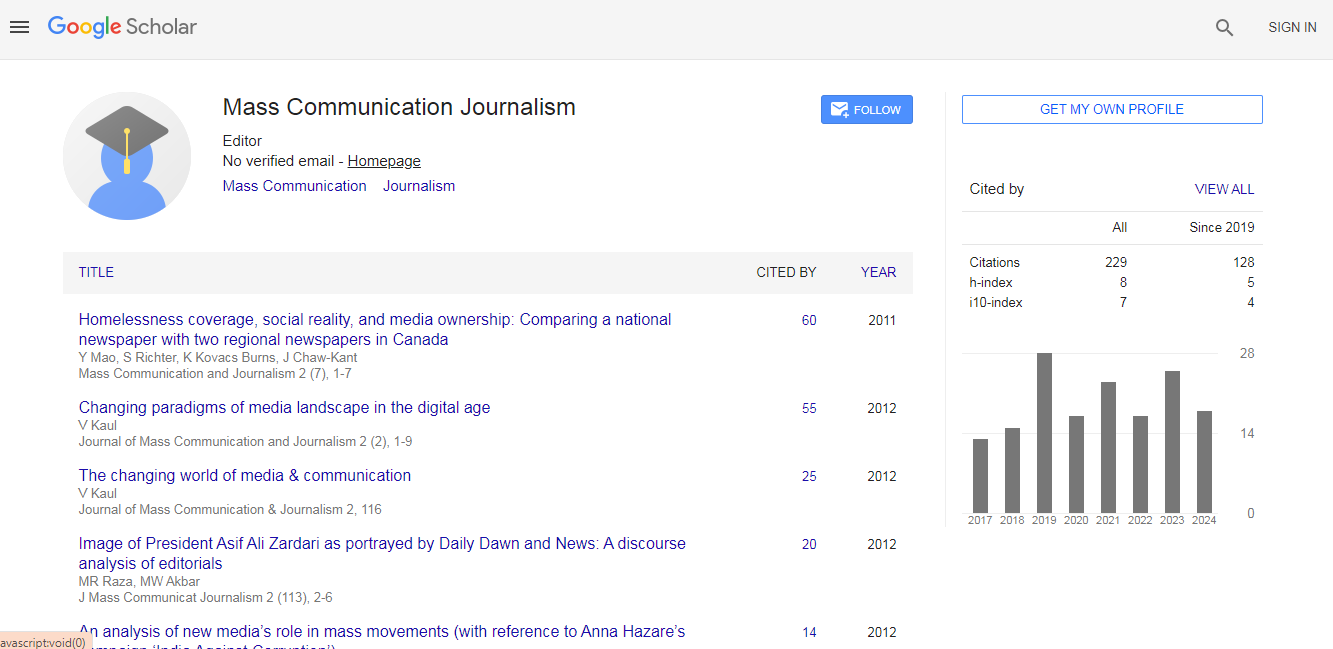
Journal of Mass Communication & Journalism received 205 citations as per Google Scholar report