Opinion - (2025) Volume 16, Issue 3
Received: 01-May-2025, Manuscript No. assj-25-172507;
Editor assigned: 05-May-2025, Pre QC No. P-172507;
Reviewed: 19-May-2025, QC No. Q-172507;
Revised: 22-May-2025, Manuscript No. R-172507;
Published:
29-May-2025
, DOI: 10.37421/2151-6200.2025.16.668
Citation: Garcia, Sofia. "Evolving Economies: Policy Innovations and Challenges." Arts Social Sci 16(2025):668
Copyright: © 2025 Garcia S. This is an open-access article distributed under the terms of the Creative Commons Attribution License, which permits unrestricted use, distribution and reproduction in any medium, provided the original author and source are credited.
This article explores how behavioral science, specifically 'nudging' and 'boosting' techniques, can improve public health outcomes. It reviews various interventions designed to guide people towards better health choices, emphasizing that simple, subtle prompts or empowering individuals with skills can be highly effective. The key takeaway is that these approaches offer practical, low-cost ways to influence behavior without restricting freedom [1].
Here's the thing: carbon pricing is a major tool for climate action, but its real-world implementation is tricky. This review dives into various global carbon pricing policies, looking at their design and how well they actually work. It highlights common challenges like market volatility and political resistance, offering insights into what makes a carbon pricing scheme effective and equitable [2].
The gig economy reshapes work, presenting both economic opportunities and significant regulatory hurdles. This paper offers a comprehensive look at the gig economy's effects on labor markets, income distribution, and consumer welfare. It emphasizes the need for new policy frameworks to address worker protections, fair competition, and data privacy in this evolving landscape [3].
Monetary policy is facing a new world, especially after the pandemic. This article examines the critical challenges central banks confront, like persistent inflation, supply chain disruptions, and changing labor markets. It suggests that future monetary policy needs innovative approaches, perhaps moving beyond traditional tools to maintain economic stability and foster growth [4].
The resilience of global supply chains has become a hot topic, especially after recent shocks. This paper analyzes how economic impacts from disruptions ripple through international trade networks and discusses various policy responses. It highlights the importance of diversification and strategic stockpiling for maintaining stability in an interconnected global economy [5].
What this really means is, human capital plays a crucial role in both sustainable development and easing poverty, particularly in developing nations. This study offers empirical evidence, showing that investing in education, health, and skills directly contributes to long-term economic growth and improves living standards, proving vital for breaking cycles of poverty [6].
Automation is transforming the labor market, and this paper provides an economic perspective on the future of work. It reviews how technological advancements impact employment, wages, and skills requirements across various sectors. The analysis suggests that while automation displaces some jobs, it also creates new ones, necessitating adaptive policies for workforce reskilling and education [7].
Fiscal policy in a post-COVID-19 world faces unique challenges for economic stability. This article examines how governments can effectively use taxation and spending to counter economic shocks and promote recovery. It discusses the balancing act between stimulating growth, managing public debt, and addressing long-term structural issues that were exacerbated by the pandemic [8].
Cryptocurrencies are fundamentally changing the financial landscape. This article offers an economic perspective on their impact, exploring their role as assets, mediums of exchange, and their potential to disrupt traditional banking. It also delves into the significant regulatory challenges governments face in integrating these digital assets into the existing financial system [9].
Let's break it down: health economics is seeing a wave of innovation, both in research methods and their application to policy. This review highlights key methodological advancements that improve how we evaluate healthcare interventions and policies. It discusses how these innovations can lead to more efficient and equitable healthcare systems globally [10].
In public health, behavioral science is proving invaluable by leveraging 'nudging' and 'boosting' techniques to guide people toward better health choices [1]. These interventions, extensively reviewed, emphasize that simple, subtle prompts or empowering individuals with practical skills can be remarkably effective. They offer practical, low-cost ways to influence behavior without restricting personal freedom, ultimately improving public health outcomes [1]. Complementing this, the field of health economics is experiencing a wave of innovation, focusing on significant methodological advancements and their direct policy implications. Research highlights how these new, improved methods enhance the evaluation of complex healthcare interventions and policies, ultimately leading to the design of more efficient and equitable healthcare systems globally [10].
Here's the thing: major economic policies are at a critical juncture, particularly concerning climate action and the pursuit of post-pandemic stability. Carbon pricing, while recognized as a crucial tool for climate action, faces intricate real-world implementation challenges across various global policies [2]. These hurdles include significant market volatility and persistent political resistance, making its effective and equitable design a complex endeavor [2]. What this really means is, monetary policy confronts an entirely new global landscape, especially in the wake of the recent pandemic. Central banks are grappling with persistent inflation, widespread supply chain disruptions, and rapidly changing labor markets [4]. Future monetary policy will need innovative approaches, perhaps moving beyond traditional tools to successfully maintain economic stability and foster robust growth in this complex environment [4]. Similarly, fiscal policy in the post-COVID-19 era faces unique and profound challenges for ensuring long-term economic stabilization. Governments must skillfully use taxation and public spending to effectively counter economic shocks and promote a strong recovery [8]. This involves a delicate balancing act: stimulating economic growth, responsibly managing public debt, and critically addressing long-term structural issues that were significantly exacerbated by the pandemic [8].
The future of work is undergoing significant transformation, fundamentally influenced by both evolving economic models and rapid technological advancements. The gig economy, for instance, dramatically reshapes traditional work structures, presenting both substantial economic opportunities for individuals and considerable regulatory hurdles for policymakers [3]. This calls for new, adaptable policy frameworks specifically designed to address worker protections, ensure fair competition, and safeguard critical data privacy in this rapidly evolving employment landscape [3]. Parallel to this, automation is fundamentally transforming the labor market, impacting employment levels, wage structures, and the specific skill requirements across various sectors of the economy [7]. Analysis consistently suggests that while automation may displace some existing jobs, it concurrently creates entirely new ones, thereby necessitating proactive and adaptive policies for comprehensive workforce reskilling and education to prepare for these ongoing changes [7]. Let's break it down: cryptocurrencies are also fundamentally changing the financial landscape, impacting global economies in profound ways. This involves exploring their emerging role as innovative assets, their function as alternative mediums of exchange, and their potent capacity to disrupt traditional banking systems and financial institutions [9]. Governments worldwide face considerable regulatory challenges in their ongoing efforts to effectively integrate these novel digital assets into the established financial system without compromising stability [9].
The resilience of global supply chains has become a critically hot topic, especially in the wake of recent global shocks and widespread disruptions. Analysis reveals how the economic impacts of these disruptions ripple extensively through international trade networks, necessitating diverse and robust policy responses [5]. This highlights the increasing importance of strategic diversification and robust stockpiling as key measures for maintaining stability within our highly interconnected global economy and mitigating future risks [5]. What this really means is, human capital plays a truly crucial and undeniable role in both fostering sustainable development and effectively alleviating poverty, particularly within developing nations [6]. Empirical evidence consistently demonstrates that direct investment in areas like comprehensive education, improved health infrastructure, and essential skill development contributes significantly to long-term economic growth and ultimately leads to improved living standards, proving absolutely vital for breaking persistent cycles of poverty [6].
Modern economic and social landscapes are evolving rapidly, prompting diverse innovations and policy considerations across various sectors. In public health, behavioral science techniques like 'nudging' and 'boosting' offer practical, low-cost ways to influence choices without restricting freedom, complemented by methodological advances in health economics aimed at creating more efficient healthcare systems. Regarding environmental policy, carbon pricing is a critical climate action tool, though its effective global implementation faces challenges from market volatility and political resistance. The world of work is also undergoing significant shifts: the gig economy presents both economic opportunities and regulatory hurdles concerning worker protections and data privacy. Automation continues to transform labor markets, displacing some jobs while creating others, which calls for adaptive policies for workforce reskilling and education. Macroeconomic stability is a recurring theme, with monetary policy post-pandemic needing innovative approaches to tackle persistent inflation and supply chain disruptions. Similarly, fiscal policy faces the challenge of balancing growth stimulation with public debt management and addressing structural issues exacerbated by recent global events. Global supply chain resilience has become paramount, emphasizing diversification and strategic stockpiling to mitigate economic impacts from disruptions. Human capital is recognized as crucial for sustainable development and poverty alleviation, particularly in developing countries, through investments in education and health. Finally, cryptocurrencies are reshaping finance, acting as new assets and mediums of exchange, presenting significant regulatory challenges for governments integrating these digital assets into traditional financial systems. Overall, these insights highlight the complex interplay of economic forces, technological progress, and social well-being, demanding adaptable and innovative policy responses.
None
None
Indexed at, Google Scholar, Crossref
Indexed at, Google Scholar, Crossref
Indexed at, Google Scholar, Crossref
Indexed at, Google Scholar, Crossref
Indexed at, Google Scholar, Crossref
Indexed at, Google Scholar, Crossref
Indexed at, Google Scholar, Crossref
Indexed at, Google Scholar, Crossref
Indexed at, Google Scholar, Crossref
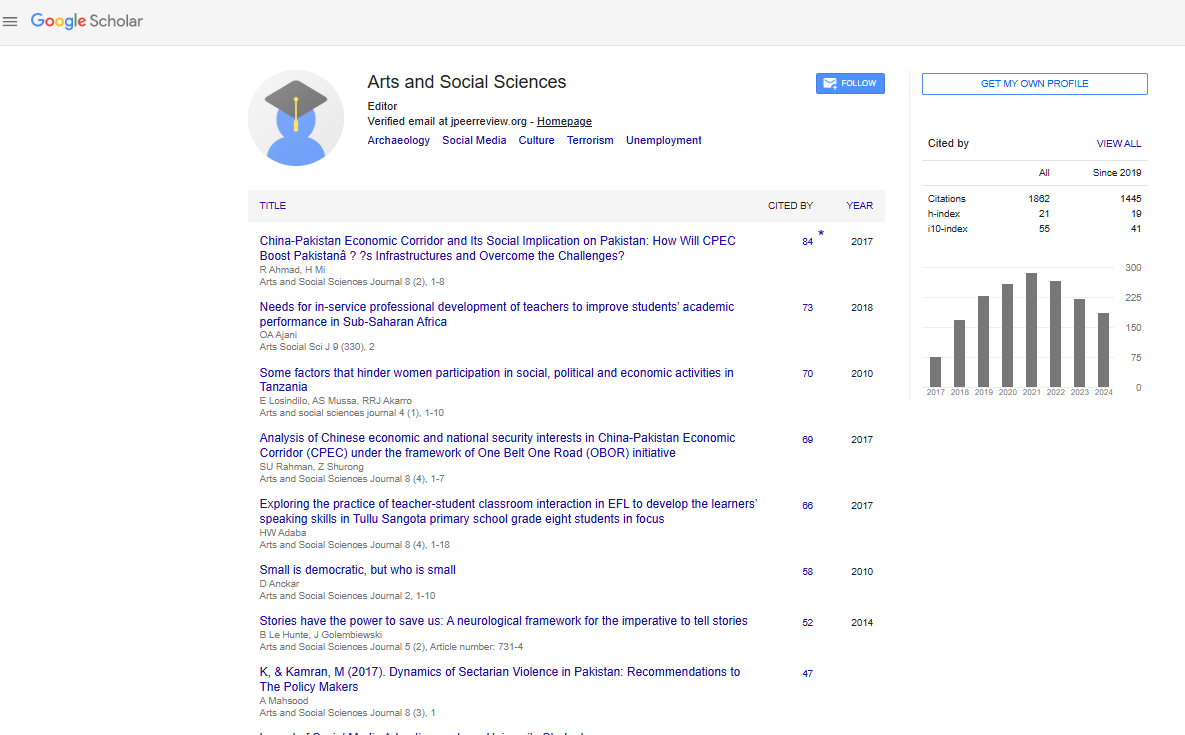
Arts and Social Sciences Journal received 1413 citations as per Google Scholar report