Commentary - (2025) Volume 14, Issue 6
Received: 01-Dec-2025, Manuscript No. jbfa-25-176848;
Editor assigned: 03-Dec-2025, Pre QC No. P-176848;
Reviewed: 17-Dec-2025, QC No. Q-176848;
Revised: 22-Dec-2025, Manuscript No. R-176848;
Published:
29-Dec-2025
, DOI: 10.37421/2161-0673.2025.14.561
Citation: Park, Jae-Min. ”Evolving Economic Models for Policy Challenges.” J Bus Fin Aff 14 (2025):561.
Copyright: © 2025 Park J. This is an open-access article distributed under the terms of the Creative Commons Attribution License, which permits unrestricted use, distribution and reproduction in any medium, provided the original author and source are credited.
This article offers a deep dive into New Keynesian models, exploring their current structure and proposing various extensions to make them more effective for today's macroeconomic policy challenges. It highlights how these models are evolving to better capture real-world economic complexities, especially concerning monetary policy decisions [1].
Here's the thing about climate change and monetary policy: this paper uses an integrated assessment model to show how central banks can consider climate risks when setting policy. What this really means is bringing environmental factors into the core of macroeconomic stability analysis, which is a new and important area for economic modeling [2].
This piece looks at how Machine Learning is reshaping economic forecasting. It covers the promise and the practical challenges of using sophisticated algorithms to predict economic trends, suggesting that while these tools offer significant advantages, understanding their limitations is just as crucial for economists [3].
Let's break down Agent-based modeling for policy making. This study demonstrates how these models can simulate complex interactions within an economy, specifically using the COVID-19 pandemic to analyze economic activity. It really shows the power of disaggregated simulations in understanding dynamic policy impacts [4].
This review offers an insightful overview of forecasting with factor models, highlighting their traditional applications and charting new directions for future research. It underscores how these models efficiently extract information from large datasets, making them invaluable for macroeconomic predictions [5].
Focusing on macro-financial models, this paper examines their critical role in analyzing financial stability. It explains how these models integrate macroeconomic dynamics with financial sector vulnerabilities, providing tools for regulators and policymakers to anticipate and mitigate systemic risks [6].
What this really means for fiscal policy is explored in this survey, particularly focusing on models with heterogeneous agents. It highlights how acknowledging differences among households and firms profoundly changes the predicted effects of government spending and taxation, offering a more nuanced view than traditional representative agent models [7].
This article provides a comprehensive review of causal inference within econometrics. It delves into various methodologies used to establish cause-and-effect relationships in economic data, emphasizing the critical importance of careful identification strategies for robust policy analysis and decision-making [8].
Here's the thing about modeling the energy transition: this review maps out the landscape of energy-economy models. It explores how these models help forecast the impacts of energy policies and technological shifts on the economy, crucial for navigating the path to sustainable energy systems [9].
This paper delves into Computable General Equilibrium (CGE) models, specifically their role in analyzing trade policy. It highlights recent advancements and challenges in using these economy-wide models to understand the complex effects of trade agreements and tariffs across various sectors and countries [10].
The contemporary economic landscape demands sophisticated modeling approaches to tackle intricate policy challenges. One key area of focus involves extending traditional frameworks, like New Keynesian models, to enhance their effectiveness in addressing todayâ??s macroeconomic policy dilemmas. What this really means is making these models better equipped to capture real-world economic complexities, especially when it comes to guiding monetary policy decisions [1]. Simultaneously, the scope of monetary policy itself is broadening to include environmental considerations. Integrated assessment models are now being used to demonstrate how central banks can factor climate risks into their policy settings, thereby bringing environmental stability into the core of macroeconomic analysis [2]. Furthermore, understanding the distribution of wealth and income is crucial for effective government action. Fiscal policy analysis is seeing a shift towards models with heterogeneous agents, which highlight how differences among households and firms can profoundly alter the predicted effects of government spending and taxation, offering a far more nuanced view than older representative agent models [7]. This evolution underscores a move towards more granular and realistic economic representations.
Economic forecasting, a critical input for sound policy, is being revolutionized by advanced analytical tools. Machine Learning, for instance, is actively reshaping how economists predict trends, leveraging sophisticated algorithms to process vast datasets. While the promise of these tools is significant, understanding their practical challenges and inherent limitations is just as crucial for their effective application [3]. In a similar vein, factor models continue to prove invaluable for macroeconomic predictions. These models efficiently extract pertinent information from large datasets, and ongoing research is charting new directions for their application, ensuring their continued relevance and power in anticipating economic shifts [5]. Here's the thing: the integration of these diverse forecasting methodologies allows for a more robust and comprehensive predictive capacity, which is vital for proactive policy interventions.
Specialized modeling frameworks are essential for dissecting complex issues across various economic sectors. For maintaining financial stability, macro-financial models play a critical role by integrating macroeconomic dynamics with financial sector vulnerabilities. They provide essential tools for regulators and policymakers to anticipate and effectively mitigate systemic risks before they escalate [6]. Moreover, navigating the global energy transition requires robust analytical support. Energy-economy models are being developed to map out the landscape of energy policies and technological shifts, helping to forecast their economic impacts and guide nations towards sustainable energy systems [9]. On the international trade front, Computable General Equilibrium (CGE) models are instrumental for trade policy analysis. They offer an economy-wide perspective to understand the intricate effects of trade agreements and tariffs across different sectors and countries, shedding light on both recent advancements and persistent challenges in their application [10]. These specialized models allow for targeted and informed policy interventions in critical areas.
Underlying these applications is a continuous drive for methodological innovation in econometrics. Agent-based modeling, for example, offers a powerful way to simulate complex interactions within an economy, moving beyond aggregate representations. This study demonstrates how these disaggregated simulations can effectively analyze dynamic policy impacts, particularly as seen in analyses related to the COVID-19 pandemic and economic activity [4]. Another fundamental aspect is causal inference, which is central to establishing credible cause-and-effect relationships in economic data. A comprehensive review of causal inference methodologies emphasizes the critical importance of careful identification strategies for robust policy analysis and decision-making, ensuring that policy interventions are based on sound empirical evidence [8]. These advancements in modeling and econometric techniques signify a significant leap towards more sophisticated and reliable economic analysis, ultimately supporting better policy outcomes.
This collection of articles highlights the diverse and evolving landscape of economic modeling and its application to contemporary policy challenges. It explores advancements in New Keynesian models, adapting them for modern macroeconomic policy, especially concerning monetary decisions [1]. The papers delve into how central banks are incorporating climate risks into monetary policy using integrated assessment models [2], and how fiscal policy can be better understood through models that account for heterogeneous agents, revealing more nuanced effects of government actions [7]. Forecasting techniques are also a major theme, with discussions on Machine Learning's role in predicting economic trends despite its challenges [3], and the continued utility of factor models for extracting information from large datasets [5]. The collection also covers specialized models vital for specific policy areas. This includes macro-financial models for analyzing financial stability and mitigating systemic risks [6], energy-economy models for guiding the transition to sustainable systems [9], and Computable General Equilibrium (CGE) models for understanding the complex impacts of trade policies [10]. Furthermore, the importance of methodological innovation is clear, with studies showcasing Agent-based modeling for simulating economic interactions and policy impacts, such as during the COVID-19 pandemic [4]. There's also a strong emphasis on causal inference in econometrics, stressing the need for robust identification strategies in policy analysis [8]. What this really means is a concerted effort across various fronts to develop more sophisticated, realistic, and effective tools for understanding and shaping economic outcomes.
None
None
Indexed at, Google Scholar, Crossref
Indexed at, Google Scholar, Crossref
Indexed at, Google Scholar, Crossref
Indexed at, Google Scholar, Crossref
Indexed at, Google Scholar, Crossref
Indexed at, Google Scholar, Crossref
Indexed at, Google Scholar, Crossref
Indexed at, Google Scholar, Crossref
Indexed at, Google Scholar, Crossref
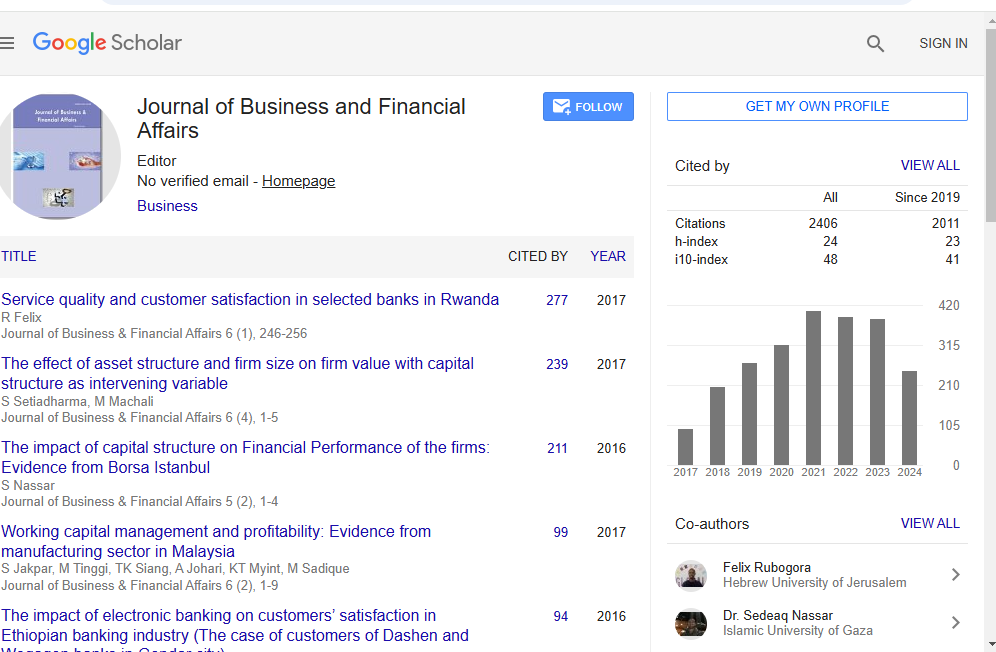
Journal of Business & Financial Affairs received 1726 citations as per Google Scholar report