Opinion - (2025) Volume 11, Issue 5
Received: 02-Sep-2025, Manuscript No. ohcr-25-174317;
Editor assigned: 04-Sep-2025, Pre QC No. P-174317;
Reviewed: 17-Sep-2025, QC No. Q-174317;
Revised: 23-Sep-2025, Manuscript No. R-174317;
Published:
30-Sep-2025
, DOI: 10.37421/2471-8726.2025.11.214
Citation: Green, Thomas. ”Evolving Dental Radiology: AI, CBCT, Diagnostics.” Oral Health Case Rep 11 (2025):214.
Copyright: © 2025 Green T. This is an open-access article distributed under the terms of the Creative Commons Attribution License, which permits unrestricted use, distribution and reproduction in any medium, provided the original author and source are credited.
Artificial Intelligence (AI) shows remarkable promise in the accurate identification of periapical lesions when utilized with panoramic radiographs, consistently demonstrating high diagnostic accuracy. This significant technological advancement could aid dental practitioners immensely in achieving early and precise diagnoses, thereby markedly improving patient outcomes. The AI systems streamline the often-complex interpretation of imaging data, making the diagnostic process more efficient and less prone to human error [1].
Cone-Beam Computed Tomography (CBCT) offers superior diagnostic accuracy for the detection of root resorption when compared to traditional conventional radiography. Its advanced three-dimensional imaging capabilities are absolutely crucial for a precise assessment and effective treatment planning of this frequently complex dental pathology. Understanding the intricate details provided by CBCT allows for more targeted and successful interventions, which is a major step forward in dental diagnostics [2].
Distinguishing between Odontogenic Keratocysts (OKC) and Orthokeratinized Odontogenic Cysts (OOC) based purely on their radiographic features presents significant diagnostic challenges for clinicians. While both types of cysts can manifest as well-defined radiolucencies on images, a careful and detailed evaluation of their size, specific location, and internal characteristics is critical for proper classification and appropriate management strategies. This differentiation is vital for patient prognosis [3].
Radiographic findings indicative of osteomyelitis in the jaws exhibit a broad spectrum, ranging from subtle changes such as bone rarefaction and loss of normal trabecular patterns to more distinct and advanced features, including sequestra formation and clear periosteal reaction. Early and accurate radiographic interpretation of these signs is absolutely vital for initiating effective treatment protocols and preventing the potentially severe progression of the disease. A keen eye is necessary for early intervention [4].
Panoramic radiographs serve as an invaluable tool for identifying a wide array of dental anomalies, providing a comprehensive, broad overview of the entire dentition and the surrounding anatomical structures. The observed prevalence of specific anomalies shows variation across different populations, which further highlights the immense importance of routine radiographic screening for their early detection and timely intervention. Proactive screening significantly improves patient care [5].
Artificial Intelligence (AI) is rapidly and fundamentally transforming the field of dental and maxillofacial radiology, offering an array of promising tools designed for enhanced image analysis capabilities, automated detection of various pathologies, and overall improved diagnostic accuracy. Its strategic integration holds substantial potential to significantly optimize clinical workflow and elevate the standard of patient care within the dental domain. This technological evolution reshapes diagnostic paradigms [6].
Incidental findings within the paranasal sinuses, often observed on Cone-Beam Computed Tomography (CBCT) scans, are remarkably common. These findings frequently reveal previously unrecognized pathologies that may necessitate further detailed investigation or specific management. It is imperative that radiologists maintain extreme vigilance in identifying these unexpected findings to ensure comprehensive and holistic patient care, preventing potential health oversights [7].
Cone-Beam Computed Tomography is recognized as an exceptionally valuable tool for accurately assessing mandibular bone quality, particularly relevant in patients who present with osteoporosis. Radiographic indicators such as precise bone density measurements and analyses of trabecular patterns can furnish crucial insights into overall skeletal health, thereby greatly aiding in the detailed treatment planning for dental implants or other necessary interventions. This provides a foundation for successful outcomes [8].
Radiographic features characteristic of pediatric aggressive periodontitis frequently encompass severe alveolar bone loss around both primary and permanent teeth, often accompanied by distinct vertical defects. Early and accurate recognition of these signs through comprehensive radiographic examination is absolutely crucial for a timely diagnosis and prompt intervention, which is essential to prevent extensive and irreversible damage to the developing dentition. Preventing progression is paramount for pediatric patients [9].
Osteoradionecrosis of the jaw exhibits distinct and recognizable radiographic characteristics, which notably include irregular radiolucency, the formation of sequestrum, and noticeable bone resorption. These findings are particularly observed in patients with a history of head and neck radiation therapy. Such radiographic evidence is essential for achieving an accurate diagnosis and for guiding the development of appropriate and effective management strategies for this complex condition [10].
Artificial Intelligence (AI) demonstrates significant promise in the accurate identification of periapical lesions on panoramic radiographs, showing high diagnostic accuracy, which can significantly aid practitioners in early and precise diagnosis, ultimately improving patient outcomes through streamlined interpretation of complex imaging data [1]. More broadly, Artificial Intelligence (AI) is rapidly transforming dental and maxillofacial radiology by offering promising tools for enhanced image analysis, automated detection of pathologies, and improved diagnostic accuracy. Its integration holds the potential to significantly optimize workflow and patient care in the field, representing a major leap in diagnostic capabilities [6]. This integration of AI not only speeds up the diagnostic process but also minimizes potential human error, leading to more consistent and reliable clinical decisions. The evolving role of AI promises to redefine diagnostic standards in dentistry, making complex cases more manageable and contributing to better therapeutic strategies for patients [1, 6].
Cone-Beam Computed Tomography (CBCT) provides superior diagnostic accuracy for detecting root resorption compared to conventional radiography, with its three-dimensional imaging capabilities proving crucial for precise assessment and comprehensive treatment planning of this often complex dental pathology [2]. Furthermore, Cone-Beam Computed Tomography (CBCT) scans frequently reveal incidental findings in paranasal sinuses. These findings are common and often disclose unrecognized pathologies that may necessitate further investigation or management, underscoring the vigilance required from radiologists to ensure comprehensive patient care [7]. The detailed, volumetric data from CBCT allows clinicians to visualize intricate anatomical structures and pathological processes that might be overlooked with two-dimensional imaging. This enhanced visualization capability supports more informed clinical decisions, from initial diagnosis to long-term follow-up for various dental conditions [2, 7].
Cone-Beam Computed Tomography is also a valuable tool for assessing mandibular bone quality, especially in patients diagnosed with osteoporosis. Radiographic indicators, such as precise bone density measurements and an analysis of trabecular patterns, can provide crucial insights into skeletal health, which is essential for aiding in treatment planning for dental implants or other interventions [8]. In addition to advanced imaging, panoramic radiographs remain valuable for identifying various dental anomalies, offering a broad overview of the dentition and surrounding structures. The prevalence of specific anomalies varies across populations, emphasizing the importance of radiographic screening for early detection and intervention to prevent more severe complications [5]. Understanding the underlying bone structure is foundational for many dental procedures, particularly those involving restorative or surgical interventions. The detailed information obtained from CBCT allows for a tailored approach to patient care, optimizing outcomes by considering individual skeletal health [8]. Moreover, conventional panoramic imaging complements these advanced techniques by providing a wide-field view, which is essential for a preliminary assessment of overall dental health and identifying widespread developmental issues or anomalies [5].
Distinguishing between Odontogenic Keratocysts (OKC) and Orthokeratinized Odontogenic Cysts (OOC) based purely on radiographic features presents diagnostic challenges. While both can appear as well-defined radiolucencies, careful evaluation of size, location, and internal characteristics is critical for proper classification and appropriate management [3]. Radiographic findings of osteomyelitis in the jaws exhibit a wide spectrum, from subtle changes like bone rarefaction and loss of trabecular patterns to more distinct features such as sequestra formation and periosteal reaction. Early and accurate radiographic interpretation is vital for effective treatment and preventing disease progression [4]. The nuances in radiographic presentation of different cystic lesions highlight the complexity of oral pathology diagnosis, where subtle distinctions guide definitive treatment. Misdiagnosis can lead to inappropriate management, underscoring the need for meticulous radiographic analysis [3]. Similarly, the varied manifestations of osteomyelitis demand a thorough understanding of imaging signs to ensure prompt and effective intervention, preventing chronic issues and significant patient morbidity [4].
Radiographic features of pediatric aggressive periodontitis often include severe alveolar bone loss around primary or permanent teeth, sometimes with vertical defects. Early recognition through radiographic examination is crucial for timely diagnosis and intervention to prevent extensive damage to the developing dentition [9]. Osteoradionecrosis of the jaw presents with distinct radiographic characteristics, including irregular radiolucency, sequestrum formation, and bone resorption, particularly in patients with a history of head and neck radiation therapy. These findings are essential for accurate diagnosis and guiding appropriate management strategies [10]. Addressing aggressive periodontitis in pediatric patients requires prompt and accurate radiographic assessment to mitigate severe, irreversible damage to alveolar bone. The early identification of these distinct features allows for targeted therapies that can preserve oral health into adulthood [9]. Moreover, for patients undergoing radiation therapy, identifying the specific radiographic signs of osteoradionecrosis is critical. This helps in managing a potentially devastating complication, ensuring that clinical decisions are based on comprehensive imaging evidence and tailored to the patient's history and presentation [10].
Dental and maxillofacial radiology is rapidly advancing with new technologies and refined diagnostic approaches. Artificial Intelligence (AI) shows immense potential in improving diagnostic accuracy for conditions like periapical lesions on panoramic radiographs and generally enhancing image analysis and pathology detection, optimizing clinical workflows. Cone-Beam Computed Tomography (CBCT) stands out for its superior diagnostic capabilities, particularly in detecting root resorption and assessing mandibular bone quality, especially in osteoporotic patients. CBCT also frequently reveals incidental findings in paranasal sinuses, emphasizing the need for thorough interpretation. Traditional panoramic radiographs remain vital for broad overviews and identifying various dental anomalies, highlighting the importance of regular screening. Complex pathologies like Odontogenic Keratocysts and Orthokeratinized Odontogenic Cysts present diagnostic challenges due to similar radiographic appearances, necessitating careful evaluation of specific features. Similarly, osteomyelitis in the jaws manifests with a range of radiographic signs, from subtle bone changes to sequestra formation, requiring early and accurate interpretation. Pediatric aggressive periodontitis demands prompt radiographic examination to detect severe alveolar bone loss and prevent extensive damage. Finally, osteoradionecrosis of the jaw exhibits distinct radiographic characteristics crucial for diagnosis and management in patients with a history of radiation therapy. Together, these studies underscore the evolving landscape of dental imaging, emphasizing precision, early detection, and the role of advanced technologies in improving patient outcomes.
None
None
1. Yasser FAA, Mohammed YA, Ahmed AA. "Artificial intelligence for diagnosis of periapical lesions on dental panoramic radiographs: a systematic review and meta-analysis.".Int J Environ Res Public Health 20 (2023):3465.
Indexed at, Google Scholar, Crossref
2. Wesam NA, Emad SA, Fares AA. "Diagnostic accuracy of cone-beam computed tomography in detecting root resorption: A systematic review and meta-analysis.".Clin Oral Investig 27 (2023):111-124.
Indexed at, Google Scholar, Crossref
3. Jamal MA, Fadi RS, Abdullah KA. "Radiographic features of odontogenic keratocyst (OKC) and orthokeratinized odontogenic cyst (OOC): a systematic review.".Dentomaxillofac Radiol 49 (2020):20190184.
Indexed at, Google Scholar, Crossref
4. Abdulhadi KA, Yasser FAA, Mohammed YA. "Radiological findings of osteomyelitis in the jaws: A systematic review.".Saudi Dent J 35 (2023):1-10.
Indexed at, Google Scholar, Crossref
5. Manal AA, Mohammed SA, Hajar AA. "Prevalence of dental anomalies in a Saudi population using panoramic radiographs: a systematic review and meta-analysis.".J Clin Exp Dent 14 (2022):e957-e966.
Indexed at, Google Scholar, Crossref
6. Fatimah MA, Maged AA, Abdullah SA. "Artificial intelligence in dental and maxillofacial radiology: a systematic review.".Dentomaxillofac Radiol 50 (2021):20200424.
Indexed at, Google Scholar, Crossref
7. Saud AA, Wesam NA, Emad SA. "Prevalence of incidental findings in paranasal sinuses on cone beam computed tomography scans: A systematic review and meta-analysis.".Oral Surg Oral Med Oral Pathol Oral Radiol 135 (2023):295-303.
Indexed at, Google Scholar, Crossref
8. Abdulhadi MA, Wesam NA, Emad SA. "Evaluation of mandibular bone quality using cone-beam computed tomography in patients with osteoporosis: A systematic review.".Oral Radiol 39 (2023):169-178.
Indexed at, Google Scholar, Crossref
9. Mohammed YA, Yasser FAA, Ahmed AA. "Radiographic features of pediatric aggressive periodontitis: A systematic review.".Clin Exp Dent Res 9 (2023):765-773.
Indexed at, Google Scholar, Crossref
10. Ahmed AA, Yasser FAA, Mohammed YA. "Radiographic characteristics of osteoradionecrosis of the jaw: A systematic review.".Oral Maxillofac Surg Clin North Am 35 (2023):209-218.
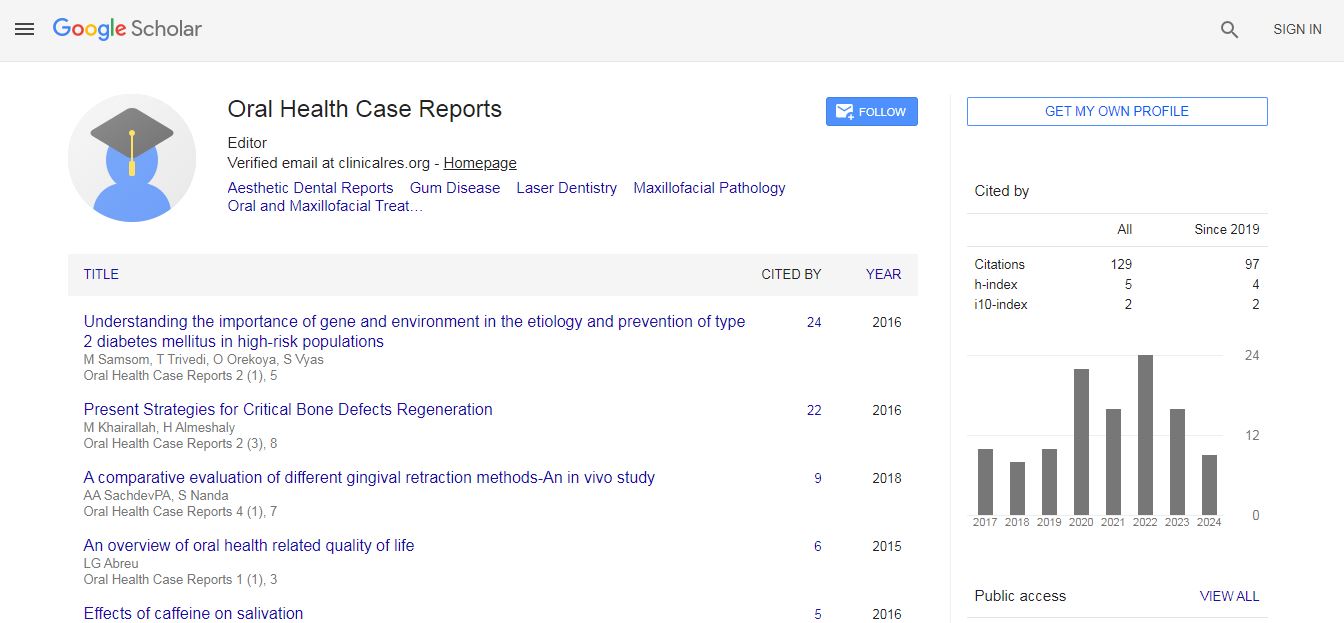
Oral Health Case Reports received 120 citations as per Google Scholar report