Opinion - (2025) Volume 14, Issue 4
Received: 01-Jul-2025, Manuscript No. pbt-25-173765;
Editor assigned: 03-Jul-2025, Pre QC No. P-173765;
Reviewed: 17-Jul-2025, QC No. Q-173765;
Revised: 22-Jul-2025, Manuscript No. R-173765;
Published:
29-Jul-2025
, DOI: 10.37421/2167-7689.2025.14.494
Citation: Brooks, Ethan. ”Evolving Clinical Trials: Regulation, Technology, Challenges.” Pharmaceut Reg Affairs 14 (2025):494.
Copyright: © 2025 Brooks E. This is an open-access article distributed under the terms of the Creative Commons Attribution License, which permits unrestricted use,
distribution and reproduction in any medium, provided the original author and source are credited.
This article examines how regulatory processes adapted during public health emergencies like COVID-19 to accelerate clinical trials. It highlights the crucial role of streamlined approvals and emergency use authorizations in rapid drug and vaccine development, emphasizing lessons learned for future crisis preparedness. The authors discuss both the benefits of accelerated pathways and the need to maintain rigorous safety and efficacy standards[1].
This paper analyzes the impact of the COVID-19 pandemic on clinical trial conduct and approval processes in India from a regulatory standpoint. It details how the crisis led to rapid adaptations, including the use of virtual tools and expedited reviews, to continue essential research and develop treatments. The authors highlight the need for robust frameworks that can balance urgency with regulatory oversight during health emergencies[9].
This paper analyzes the new European Clinical Trials Regulation (CTR), exploring its potential to improve the efficiency and quality of clinical trials across the EU. It discusses the aim of the CTR to create a more harmonized and transparent regulatory environment, addressing previous complexities. The authors assess how this new framework could foster innovation and reduce administrative burdens for researchers and sponsors[2].
This review provides an overview of the United States Food and Drug Administration's (FDA) expedited programs designed for serious conditions. It details pathways like Fast Track, Breakthrough Therapy, Accelerated Approval, and Priority Review, explaining their criteria and implications for drug development. The authors critically examine the balance between speeding up access to needed therapies and ensuring sufficient evidence for safety and effectiveness[3].
This paper analyzes regulatory innovation in the European Union and the United States concerning Advanced Therapy Medicinal Products (ATMPs). It compares the different approaches taken by EMA and FDA to regulate these complex, often personalized therapies, including gene and cell therapies. The authors highlight specific challenges in development, manufacturing, and approval, suggesting strategies for more efficient and harmonized regulatory pathways[7].
This paper discusses the unique challenges faced when conducting clinical trials for rare diseases, including small patient populations, diagnostic difficulties, and lack of established endpoints. It highlights the importance of adaptive trial designs, international collaboration, and special regulatory considerations to facilitate the development and approval of orphan drugs. The authors propose strategies to overcome these hurdles and bring effective treatments to patients with rare conditions[5].
This article explores the growing role of artificial intelligence (AI) in clinical trials, outlining its advantages in areas like patient recruitment, data analysis, and biomarker discovery. It also addresses significant challenges, including regulatory hurdles, data privacy concerns, and the need for robust validation of AI algorithms. The authors suggest that AI can streamline processes, but ethical and governance frameworks must evolve concurrently[4].
This article examines the increasing role of real-world evidence (RWE) in regulatory decision-making for drug and biologics approvals. It discusses how data collected outside of traditional clinical trials, from sources like electronic health records and registries, can complement or even inform regulatory pathways. The authors explore the methodological considerations, regulatory frameworks, and future potential of RWE to enhance post-market surveillance and broaden indications[6].
This article discusses the global landscape of clinical trial disclosure and transparency. It covers the evolving regulatory requirements and ethical imperatives for registering trials and publishing results worldwide. The authors address the benefits of increased transparency for public trust and evidence-based medicine, while also acknowledging the challenges faced by sponsors in harmonizing diverse international mandates[8].
This article explores the growing influence of patient engagement on clinical trial design and regulatory outcomes. It argues that incorporating patient perspectives from the early stages of trial planning can lead to more patient-centric studies, better recruitment and retention, and ultimately, more relevant and successful drug approvals. The authors discuss various methods of patient engagement and their positive impact on the overall development process[10].
During public health emergencies such as the COVID-19 pandemic, regulatory processes worldwide underwent significant adaptation to expedite clinical trials and accelerate the development of crucial drugs and vaccines [1]. These adaptations included streamlined approvals and the implementation of emergency use authorizations, which proved vital in rapidly bringing therapies to patients. Lessons learned from such crises underscore the importance of maintaining rigorous safety and efficacy standards while enabling swift regulatory responses for future preparedness [1]. In India, specifically, the pandemic prompted rapid adjustments to clinical trial conduct, incorporating virtual tools and expedited reviews to ensure continued research and treatment development, highlighting the necessity for regulatory frameworks that can balance urgency with oversight during health emergencies [9].
Efforts to improve the efficiency and quality of clinical trials extend beyond emergency situations. The new European Clinical Trials Regulation (CTR) aims to create a more harmonized and transparent regulatory environment across the European Union, addressing previous complexities and fostering innovation by reducing administrative burdens for researchers and sponsors [2]. Similarly, the United States Food and Drug Administration (FDA) employs various expedited programs for serious conditions, including Fast Track, Breakthrough Therapy, Accelerated Approval, and Priority Review. These pathways are designed to speed up access to needed therapies, with careful consideration given to the balance between rapid availability and the requirement for sufficient evidence of safety and effectiveness [3].
Specific therapeutic areas present unique regulatory and logistical challenges. For instance, conducting clinical trials for rare diseases is particularly difficult due to small patient populations, diagnostic complexities, and the absence of established endpoints. Overcoming these hurdles often requires adaptive trial designs, robust international collaboration, and specialized regulatory considerations to facilitate the development and approval of orphan drugs, ultimately aiming to bring effective treatments to patients with rare conditions [5]. Moreover, Advanced Therapy Medicinal Products (ATMPs), such as gene and cell therapies, represent complex and often personalized treatments. Regulatory bodies like the European Medicines Agency (EMA) and the FDA have adopted different innovative approaches to govern these products, facing challenges in their development, manufacturing, and approval, with ongoing efforts to achieve more efficient and harmonized pathways [7].
Technology is increasingly transforming clinical trial methodologies and regulatory decision-making. Artificial Intelligence (AI) is gaining a significant role, offering advantages in areas like patient recruitment, data analysis, and biomarker discovery. However, the integration of AI also necessitates addressing regulatory hurdles, data privacy concerns, and the critical need for validating AI algorithms, ensuring that ethical and governance frameworks evolve alongside technological advancements [4]. Concurrently, Real-World Evidence (RWE), derived from sources like electronic health records and registries, is becoming vital in regulatory decision-making for drug and biologics approvals. RWE can complement traditional clinical trials, inform regulatory pathways, and enhance post-market surveillance, broadening indications with careful methodological and framework considerations [6].
Beyond technological shifts, the focus on transparency and patient involvement is reshaping clinical research. There's a global movement towards greater clinical trial disclosure and transparency, driven by evolving regulatory requirements and ethical imperatives for trial registration and results publication. This increased transparency aims to build public trust and support evidence-based medicine, despite the complexities faced by sponsors in harmonizing diverse international mandates [8]. Patient engagement has also emerged as a critical factor influencing clinical trial design and regulatory outcomes. Integrating patient perspectives early in the planning stages leads to more patient-centric studies, better recruitment and retention, and ultimately, more relevant and successful drug approvals, demonstrating a positive impact on the entire development process [10].
The landscape of clinical trials and their regulation is constantly evolving, driven by public health emergencies, technological advancements, and a growing emphasis on efficiency and transparency. During crises like COVID-19, regulatory processes demonstrated adaptability, utilizing streamlined approvals and emergency use authorizations to expedite drug and vaccine development, highlighting critical lessons for future preparedness. Concurrently, new frameworks like the European Clinical Trials Regulation aim to harmonize and enhance trial quality across the EU, reducing administrative burdens and fostering innovation. The United States Food and Drug Administration also employs expedited programs for serious conditions, balancing rapid access to therapies with essential safety and efficacy standards. Challenges persist in specialized areas. Clinical trials for rare diseases grapple with small patient populations and diagnostic difficulties, necessitating adaptive designs and international collaboration. Similarly, Advanced Therapy Medicinal Products (ATMPs), including gene and cell therapies, present unique regulatory hurdles, prompting innovation in the EU and US to create more efficient pathways. Technology, too, is transforming trials, with Artificial Intelligence (AI) offering advantages in patient recruitment and data analysis; it brings its own regulatory and ethical considerations, though. Real-World Evidence (RWE) is increasingly influencing regulatory decisions, complementing traditional trials and enhancing post-market surveillance. The global push for clinical trial disclosure and transparency is also prominent, aiming to build public trust and support evidence-based medicine, despite the complexities of harmonizing international mandates. Patient engagement is another critical aspect, leading to more patient-centric designs and improved outcomes.
None
None
1. Shefali K, Divya K, Poonam S. "Regulatory considerations for accelerating clinical trials during public health emergencies: Lessons from COVID-19".Indian J Med Res 154 (2021):S66-S74.
Indexed at, Google Scholar, Crossref
2. Francesco P, Peter A, Hans-Georg E. "The new European Clinical Trials Regulation: an opportunity for better clinical trials?".Nat Rev Clin Oncol 17 (2020):449-459.
Indexed at, Google Scholar, Crossref
3. Aaron SK, Thomas JH, Jerry A. "The United States Food and Drug Administration Expedited Programs for Serious Conditions: An Overview".JAMA Intern Med 179 (2019):1223-1231.
Indexed at, Google Scholar, Crossref
4. Jeewon L, Jaewoo L, Kyungbo L. "Artificial intelligence in clinical trials: advantages and challenges".J Korean Med Sci 37 (2022):e167.
Indexed at, Google Scholar, Crossref
5. Corey CM, Amanda WL, Julie W. "Challenges and future directions for clinical trials in rare diseases".Orphanet J Rare Dis 16 (2021):226.
Indexed at, Google Scholar, Crossref
6. Neelam BP, Laurens PDV, Douglas LG. "The Use of Real-World Evidence in Regulatory Decision-Making for Drug and Biologics Approvals".Ther Innov Regul Sci 56 (2022):969-977.
Indexed at, Google Scholar, Crossref
7. Mickael DW, Tim VdD, Kris D. "Regulatory Innovation in the European Union and United States: The Case of Advanced Therapy Medicinal Products".Front Med 8 (2021):708006.
Indexed at, Google Scholar, Crossref
8. Pei ML, Natalie B, Lex MB. "Navigating the Complexities of Clinical Trial Disclosure and Transparency: A Global Perspective".Eur J Clin Invest 53 (2023):e13988.
Indexed at, Google Scholar, Crossref
9. Priyanka S, Twinkle P, Aakash V. "Impact of COVID-19 pandemic on clinical trial conduct and approval in India: a regulatory perspective".Indian J Pharmacol 52 (2020):440-444.
Indexed at, Google Scholar, Crossref
10. Donald LP, Lesley BB, Patricia P. "The Impact of Patient Engagement on Clinical Trial Design and Regulatory Outcomes".Ther Innov Regul Sci 55 (2021):317-327.
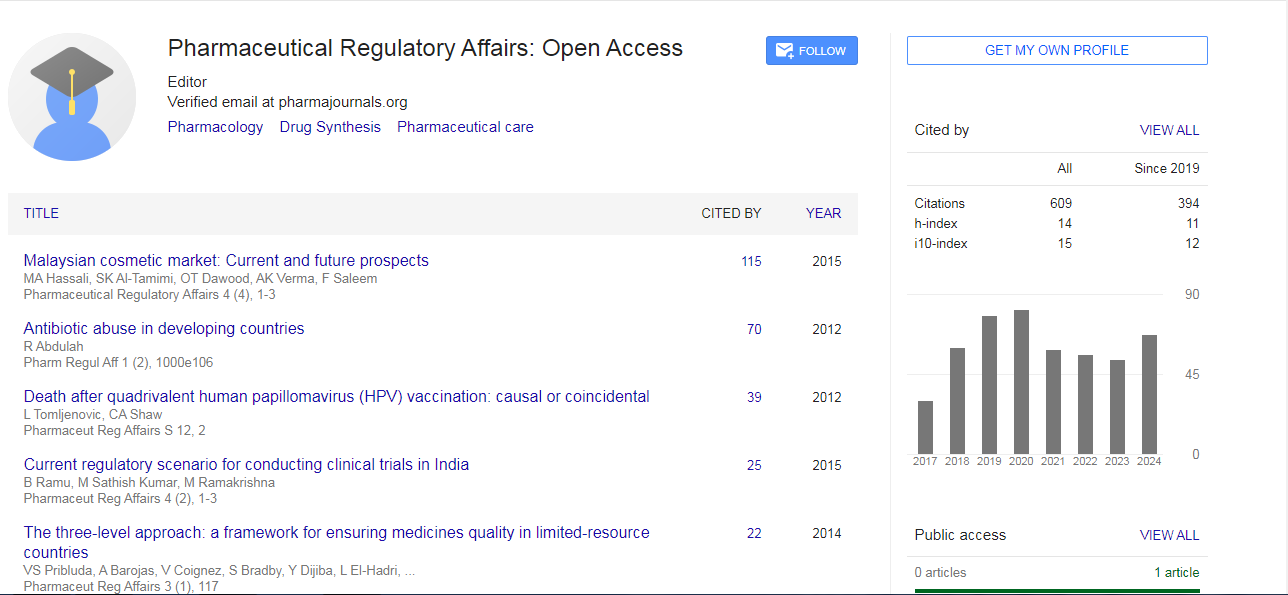
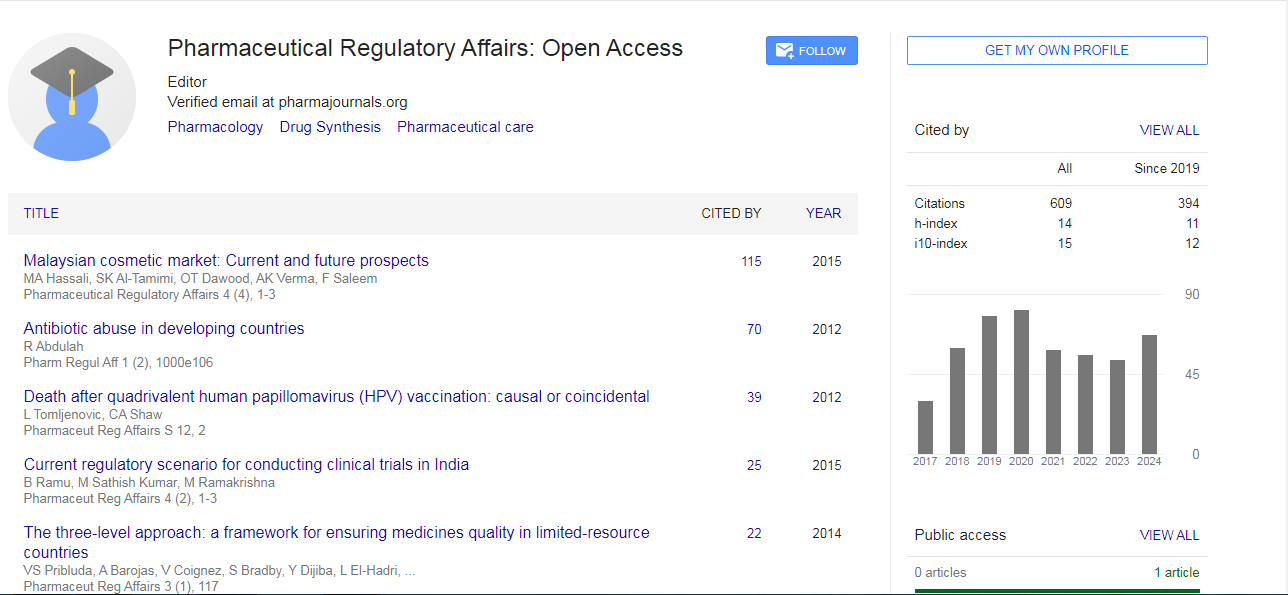
Pharmaceutical Regulatory Affairs: Open Access received 533 citations as per Google Scholar report