Brief Report - (2025) Volume 17, Issue 6
Received: 03-Nov-2025, Manuscript No. jcst-25-176307;
Editor assigned: 05-Nov-2025, Pre QC No. P-176307;
Reviewed: 19-Nov-2025, QC No. Q-176307;
Revised: 24-Nov-2025, Manuscript No. R-176307;
Published:
01-Dec-2025
, DOI: 10.37421/1948-5956.2025.17.731
Citation: Nakamura, Hiroshi. "Evolving Cancer Screening: Detection,
Personalization, Access." J Cancer Sci Ther 17 (2025):731.
Copyright: © 2025 Nakamura H. This is an open-access article distributed under the terms of the Creative Commons Attribution License, which permits unrestricted use,
distribution and reproduction in any medium, provided the original author and source are credited.
The contemporary landscape of breast cancer screening is fundamentally shaped by an emphasis on personalized risk assessment. This approach integrates various advanced imaging modalities beyond traditional mammography, particularly for individuals identified as high-risk. Discussions around evolving guidelines consistently highlight the critical importance of shared decision-making, allowing patients and clinicians to jointly acknowledge both the benefits and potential harms associated with screening strategies [1].
Significant updates have been introduced in multi-society guidelines for colorectal cancer screening and surveillance within the US. These revisions include critical changes to recommended starting ages and screening intervals across a spectrum of modalities. The guidelines underscore their pivotal role in effectively reducing colorectal cancer incidence and mortality, primarily through facilitating early detection and timely polyp removal [2].
An essential overview of updated lung cancer screening guidelines provides clear criteria for identifying high-risk individuals. The effectiveness of low-dose Computed Tomography (LDCT) as a primary screening tool is a central point of these recommendations. Clinicians are urged to fully understand these guidelines to accurately identify eligible patients and ensure appropriate screening, thereby leading to improved patient outcomes [3].
Cervical cancer screening guidelines are undergoing a notable evolution, with a comprehensive narrative review exploring the evidence base and clinical implications. A key development is the shift towards primary Human Papillomavirus (HPV) testing and the adoption of co-testing strategies. These advancements aim to strike a crucial balance between achieving early detection and minimizing the risks of overtreatment across diverse age groups [4].
For primary care physicians, prostate cancer screening presents an updated perspective, guided by evolving recommendations that advocate for shared decision-making. This process considers individual patient risk factors, personal preferences, and overall life expectancy. The review sheds light on the inherent complexities of Prostate-Specific Antigen (PSA) testing, meticulously weighing its benefits in early detection against the recognized risks of overdiagnosis and overtreatment [5].
An international consensus statement delivers comprehensive guidelines for the robust management of individuals deemed to be at high risk for pancreatic cancer. This document meticulously outlines various surveillance strategies and specific screening modalities. It provides precise recommendations tailored for genetic predisposition syndromes and familial pancreatic cancer, with the overarching goal of enhancing early detection and ultimately improving patient outcomes [6].
The successful implementation of cancer screening guidelines and innovative strategies is vital for enhancing access and improving overall outcomes. This involves adopting a systematic approach designed to overcome existing disparities and significant barriers to screening uptake. Coordinated efforts, effective patient navigation programs, and strategic leveraging of technology are highlighted as crucial components for achieving effective population-level cancer prevention [7].
A clinical practice guideline from the American Association for the Study of Liver Diseases offers comprehensive recommendations for the surveillance of Hepatocellular Carcinoma (HCC). It clearly delineates target populations, establishes optimal screening intervals, and specifies appropriate imaging modalities. The guideline emphasizes the critical importance of regular surveillance for at-risk individuals, as early detection significantly boosts treatment efficacy and patient survival rates [8].
Current guidelines, emerging trends, and future perspectives in gastric cancer screening are critically examined, particularly within high-prevalence regions. The review discusses the diverse global approaches, ranging from extensive mass screening programs to more targeted surveillance initiatives. Ongoing efforts are focused on optimizing screening modalities and enhancing the effectiveness of identifying high-risk individuals [9].
Ovarian cancer screening in the general population is a subject of ongoing critical evaluation, with a narrative review exploring current evidence and future directions. This area faces considerable challenges in developing truly effective screening tools, primarily due to the disease's relatively low incidence and the absence of specific early symptoms. Consequently, research efforts are primarily directed towards identifying biomarkers and advanced imaging techniques specifically for high-risk groups, rather than advocating for widespread population screening [10].
The evolving landscape of cancer screening underscores a pervasive shift towards personalized risk assessment and the strategic utilization of diverse imaging modalities. This modern approach aims to significantly improve early detection and ultimately enhance patient outcomes across a spectrum of cancer types. Central to this paradigm is the recognition that effective screening requires a nuanced understanding of individual patient profiles and disease-specific characteristics [1, 2, 3]. The continuous refinement of guidelines reflects an ongoing commitment to balancing the immense benefits of early intervention with the potential harms, such as overdiagnosis and overtreatment, thereby promoting more informed and shared decision-making in clinical practice [4, 5]. Specific advancements in screening protocols are evident across several common cancers. Breast cancer screening now leverages personalized risk models and advanced imaging techniques beyond conventional mammography, particularly for high-risk individuals [1]. This ensures a more targeted and effective screening regimen. For colorectal cancer, multi-society guidelines in the US have introduced updated recommendations regarding starting ages and surveillance intervals, which are crucial for reducing incidence and mortality through proactive polyp removal [2]. Lung cancer screening guidelines similarly emphasize identifying high-risk individuals, advocating for the use of low-dose Computed Tomography (LDCT) to improve outcomes, stressing the need for clinicians to be well-versed in these recommendations [3]. Cervical cancer screening has undergone a significant transformation, with a clear trend towards primary Human Papillomavirus (HPV) testing and co-testing strategies. These approaches are carefully designed to optimize early detection while consciously minimizing the risk of overtreatment, catering to the specific needs of different age groups [4]. Similarly, prostate cancer screening guidelines have evolved to prioritize shared decision-making. This involves a thorough consideration of patient risk factors, individual preferences, and life expectancy. Primary care physicians are increasingly guided to navigate the complexities of Prostate-Specific Antigen (PSA) testing, acknowledging its early detection benefits alongside the potential for overdiagnosis and subsequent overtreatment [5]. Addressing cancers with higher risk profiles or complex screening challenges is also a key focus. International consensus statements provide comprehensive guidelines for managing individuals at high risk for pancreatic cancer, detailing specific surveillance strategies and screening modalities. These are particularly vital for those with genetic predisposition syndromes and familial pancreatic cancer, aiming to enhance early detection and patient outcomes [6]. Furthermore, the American Association for the Study of Liver Diseases has issued a clinical practice guideline for Hepatocellular Carcinoma (HCC) surveillance. This document specifies target populations, optimal screening intervals, and imaging modalities, underscoring the critical role of regular monitoring in at-risk individuals to significantly improve treatment efficacy and survival [8]. Beyond specific disease guidelines, there's a strong emphasis on the strategic implementation of cancer screening initiatives to enhance access and overall outcomes. This involves systematic approaches to overcome disparities and various barriers to screening uptake, highlighting the importance of coordinated efforts, patient navigation, and the strategic deployment of technology for effective population-level prevention [7]. Gastric cancer screening, especially in high-prevalence regions, continues to evolve with ongoing research into optimizing modalities and more effectively identifying high-risk individuals globally [9]. In contrast, ovarian cancer screening in the general population presents unique challenges. Due to its low incidence and lack of specific early symptoms, current research predominantly focuses on developing biomarkers and advanced imaging for high-risk groups, rather than widespread population screening [10].
The landscape of cancer screening is characterized by evolving guidelines across various cancer types, fundamentally aiming for earlier detection and improved patient outcomes. Key themes include personalized risk assessment, the integration of advanced imaging modalities, and the importance of shared decision-making. Breast cancer screening, for instance, emphasizes individualized risk and diverse imaging beyond mammography, while colorectal cancer guidelines update ages and intervals for early detection and polyp removal. Lung cancer screening targets high-risk individuals with low-dose Computed Tomography (LDCT), and cervical cancer screening moves towards Human Papillomavirus (HPV) testing, balancing early detection with avoiding overtreatment. Prostate cancer screening advocates for patient-centered decisions, weighing Prostate-Specific Antigen (PSA) benefits against overdiagnosis. Comprehensive guidelines also address high-risk pancreatic cancer surveillance, and Hepatocellular Carcinoma (HCC) monitoring with specific recommendations. Furthermore, effective implementation strategies are vital to overcome disparities and improve access across all cancer screenings, using coordinated efforts and technology. While gastric cancer screening is optimized in high-prevalence areas, ovarian cancer screening in the general population remains challenging, with research focusing on high-risk groups due to low incidence and vague early symptoms.
Indexed at, Google Scholar, Crossref
Indexed at, Google Scholar, Crossref
Indexed at, Google Scholar, Crossref
Indexed at, Google Scholar, Crossref
Indexed at, Google Scholar, Crossref
Indexed at, Google Scholar, Crossref
Indexed at, Google Scholar, Crossref
Indexed at, Google Scholar, Crossref
Indexed at, Google Scholar, Crossref
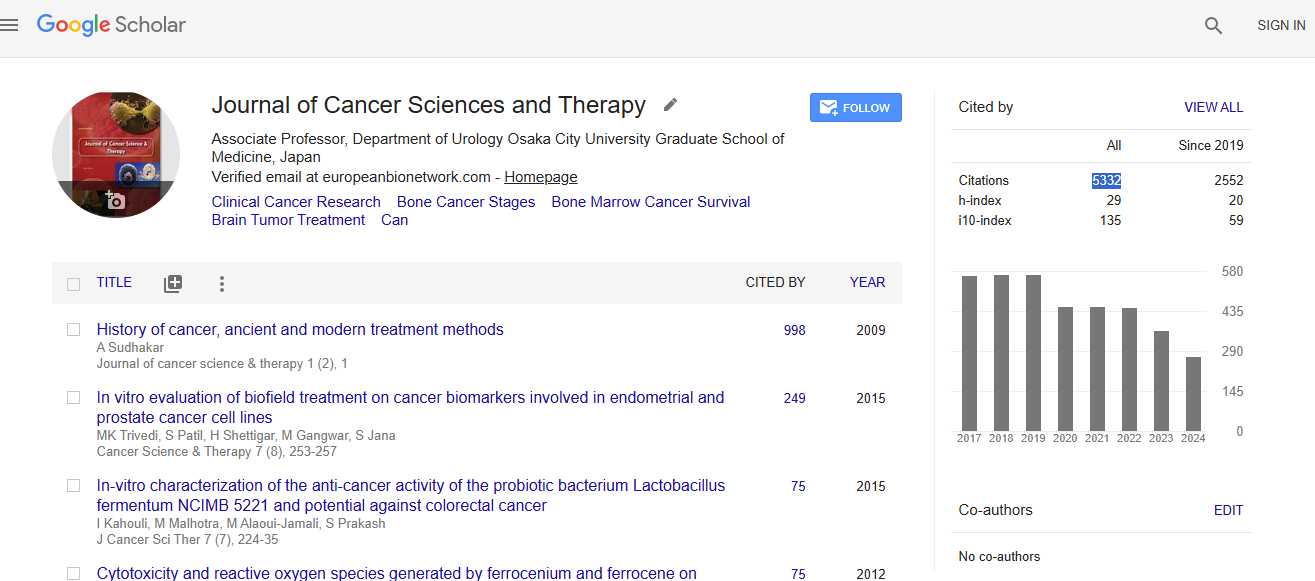
Cancer Science & Therapy received 5332 citations as per Google Scholar report