Commentary - (2025) Volume 13, Issue 2
Received: 01-Apr-2025
Editor assigned: 03-Apr-2025
Reviewed: 17-Apr-2025
Revised: 22-Apr-2025
Published:
29-Apr-2025
, DOI: 10.37421/2329-9517.2025.13.657
Citation: Maria Gonzalez. ”Evolving ACS/MI Management: Diagnostics
to Rehabilitation.” J Cardiovasc Dis Diagn 13 (2025):657.
Copyright: © 2025 G. Maria This is an open-access article distributed under the terms of the Creative Commons Attribution License, which permits unrestricted use, distribution
and reproduction in any medium, provided the original author and source are credited.
Myocardial infarction (MI), a critical cardiovascular event, continues to be a major health challenge, necessitating continuous refinement in diagnostic approaches, treatment strategies, and long-term patient care. Recent research offers a multifaceted perspective on MI, ranging from global guidelines to highly specific patient considerations. Comprehensive, evidence-based recommendations for managing acute coronary syndromes (ACS) are pivotal. The 2023 ESC Guidelines for the management of acute coronary syndromes offers a thorough framework for diagnosis, risk stratification, and treatment strategies, advocating for individualized patient care informed by the latest advancements in the field [1].
The evolution of diagnostic tools profoundly impacts the timely and accurate identification of MI. High-sensitivity cardiac troponin assays have transformed rapid and accurate MI diagnosis. A clinical review details their evolving role, clinical utility, interpretation challenges, and their significant impact on patient management algorithms, highlighting their indispensable nature in modern cardiology [2].
Complementing biochemical markers, advanced imaging techniques provide crucial insights into myocardial damage and recovery. Cardiac Magnetic Resonance Imaging (MRI) proves its prognostic value, particularly in patients with myocardial infarction without ST-segment elevation. This method identifies key prognostic markers associated with myocardial damage and subsequent adverse cardiovascular events, thereby offering significant insights for refined risk stratification [3].
Beyond single modalities, a practical guide to multimodality imaging in acute myocardial infarction outlines the role of various imaging modalities, including echocardiography, cardiac MRI, and nuclear imaging, in the comprehensive assessment of acute MI, aiding in diagnosis, risk stratification, and guiding therapeutic decisions [8].
Considering the diverse patient demographics and comorbidities is essential for effective MI management. Diabetes Mellitus, for example, significantly influences cardiovascular risk factors and outcomes in MI patients. Insights from the SWEDEHEART registry reveal distinct prognostic implications and underscore the necessity for tailored management strategies in this specific patient group [4].
Moreover, sex-specific differences in myocardial infarction are increasingly recognized. Research investigates significant disparities in presentation, diagnosis, management, and outcomes between sexes, advocating for tailored clinical strategies to improve care for both men and women [7].
A particular demographic requiring specialized attention is young adults experiencing MI. An article on myocardial infarction in young adults details its incidence, unique clinical presentations, diagnostic challenges, treatment strategies, and long-term outcomes, emphasizing the need for specialized care in this particular group [10].
Therapeutic interventions and post-event management are integral to improving patient prognosis. Early and intensive lipid-lowering therapy post-acute myocardial infarction has been rigorously evaluated. A systematic review and meta-analysis demonstrate significant benefits in reducing recurrent cardiovascular events and improving patient prognosis [5].
However, successful revascularization can lead to myocardial reperfusion injury. A comprehensive review details the mechanisms, current diagnostic methods, and emerging therapeutic approaches aimed at mitigating this critical complication, which remains a challenge in MI treatment [6].
For long-term recovery and secondary prevention, cardiac rehabilitation programs are indispensable. A state-of-the-art review summarizes current knowledge on cardiac rehabilitation for MI patients, highlighting its critical role in secondary prevention, improving functional capacity, and enhancing quality of life through structured exercise and lifestyle modifications [9].
Collectively, these studies emphasize a holistic approach to myocardial infarction care, integrating guideline-based recommendations, advanced diagnostics, personalized treatment protocols considering patient-specific factors, effective therapeutic interventions, and robust secondary prevention strategies. This integrated perspective is crucial for advancing patient outcomes and improving the quality of life for individuals affected by MI.
Myocardial infarction (MI) remains a significant challenge in global health, with continuous research efforts aimed at improving diagnostic accuracy, refining treatment protocols, and optimizing long-term patient outcomes. The foundational aspects of MI management are frequently updated through comprehensive guidelines. For instance, the 2023 ESC Guidelines for the management of acute coronary syndromes offers extensive, evidence-based recommendations for acute coronary syndromes (ACS). These guidelines meticulously cover diagnosis, risk stratification, and treatment strategies, with a strong emphasis on individualized patient care and integrating the latest advancements in the field [1]. The accurate and timely diagnosis of MI is paramount, and the evolution of diagnostic tools plays a crucial role. High-sensitivity cardiac troponin assays are central to this advancement, enabling rapid and precise diagnosis of MI. A clinical review thoroughly explores their clinical utility, the challenges encountered in their interpretation, and their profound impact on current patient management algorithms [2].
Beyond initial biochemical markers, advanced imaging techniques provide critical insights into myocardial health and damage. Cardiac Magnetic Resonance Imaging (MRI) serves as a powerful tool in assessing patients with myocardial infarction without ST-segment elevation. This study identifies key prognostic markers directly related to myocardial damage and the likelihood of subsequent adverse cardiovascular events, thereby offering vital information for more accurate risk stratification [3]. Furthermore, a comprehensive approach often requires integrating various imaging methods. A practical guide on multimodality imaging in acute myocardial infarction details the synergistic role of different modalities, including echocardiography, cardiac MRI, and nuclear imaging. This integrated approach is invaluable for the comprehensive assessment of acute MI, aiding not only in diagnosis and risk stratification but also in guiding personalized therapeutic decisions [8].
Patient-specific factors significantly influence both the trajectory and outcomes of MI. The presence of comorbidities like diabetes mellitus, for example, alters the landscape of cardiovascular risk factors and overall patient outcomes following MI. Research based on the SWEDEHEART registry provides insights into these cardiovascular risk factors and outcomes in MI patients with and without diabetes mellitus, highlighting distinct prognostic implications and underscoring the necessity for tailored management strategies for this particular patient group [4]. Moreover, biological sex plays a role in how MI manifests and progresses. Investigations into sex differences in myocardial infarction reveal significant disparities in presentation, diagnosis, management, and long-term outcomes. These findings advocate for the development and implementation of tailored clinical strategies to effectively improve care for both men and women affected by MI [7]. A distinct demographic needing specialized consideration is young adults. An article meticulously examines myocardial infarction in young adults, detailing its incidence, unique clinical presentations, specific diagnostic challenges, appropriate treatment strategies, and long-term outcomes. This highlights the imperative for specialized care pathways designed for this particular demographic [10].
Therapeutic interventions and post-event rehabilitation are crucial for mitigating adverse outcomes and promoting recovery. Early and intensive lipid-lowering therapy post-acute myocardial infarction has shown substantial efficacy. A systematic review and meta-analysis conclusively demonstrate significant benefits in reducing recurrent cardiovascular events and markedly improving patient prognosis [5]. However, the process of restoring blood flow can sometimes lead to additional injury. Myocardial reperfusion injury, a critical complication following successful revascularization in MI, is thoroughly reviewed. This review discusses its underlying mechanisms, current diagnostic methods to identify it, and emerging therapeutic approaches aimed at mitigating this significant post-ischemic damage [6]. Finally, ensuring long-term patient well-being necessitates robust secondary prevention efforts. Cardiac rehabilitation programs are foundational for MI patients. A state-of-the-art review summarizes current knowledge, emphasizing their critical role in secondary prevention, improving functional capacity, and enhancing the overall quality of life through structured exercise and comprehensive lifestyle modifications [9]. These collective findings underscore the dynamic and evolving understanding of MI, guiding clinical practice towards more personalized and effective patient care.
This body of work provides a comprehensive overview of acute coronary syndromes (ACS) and myocardial infarction (MI) management, spanning diagnostic advancements, risk stratification, and therapeutic interventions. It highlights the 2023 ESC Guidelines, which offer evidence-based recommendations for ACS, emphasizing individualized patient care and the latest field advancements. A key diagnostic improvement is the evolving role of high-sensitivity cardiac troponin assays for rapid and accurate MI diagnosis, along with the interpretation challenges and their impact on patient management algorithms. Advanced imaging modalities like cardiac MRI are explored for their prognostic value in non-ST-segment elevation MI, identifying markers for myocardial damage and adverse cardiovascular events. Further, a multimodality imaging guide details the use of echocardiography, cardiac MRI, and nuclear imaging for comprehensive assessment, diagnosis, risk stratification, and therapeutic decisions in acute MI. The research also addresses specific patient populations, including the impact of diabetes mellitus on cardiovascular risk factors and outcomes, revealing the need for tailored management strategies. Significant sex-specific differences in MI presentation, diagnosis, management, and outcomes are investigated, advocating for adapted clinical approaches. Furthermore, MI in young adults is examined, noting its unique incidence, clinical presentations, and long-term outcomes, underscoring the need for specialized care. Therapeutic strategies covered include the efficacy of early and intensive lipid-lowering therapy post-acute MI for reducing recurrent cardiovascular events. Myocardial reperfusion injury, a critical complication, is detailed concerning its mechanisms, diagnosis, and treatment. Finally, cardiac rehabilitation programs are presented as vital for secondary prevention, improving functional capacity, and enhancing quality of life post-MI through structured interventions.
Indexed at, Google Scholar, Crossref
Indexed at, Google Scholar, Crossref
Indexed at, Google Scholar, Crossref
Indexed at, Google Scholar, Crossref
Indexed at, Google Scholar, Crossref
Indexed at, Google Scholar, Crossref
Indexed at, Google Scholar, Crossref
Indexed at, Google Scholar, Crossref
Indexed at, Google Scholar, Crossref
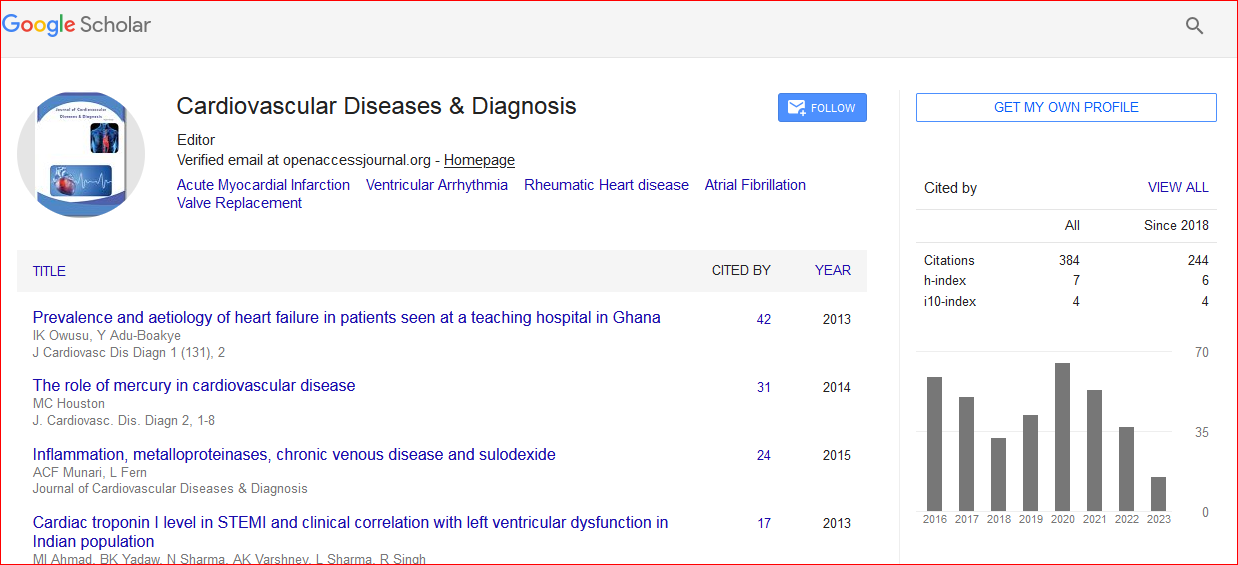
Cardiovascular Diseases & Diagnosis received 427 citations as per Google Scholar report