Brief Report - (2025) Volume 10, Issue 3
Received: 01-May-2025, Manuscript No. apn-26-179079;
Editor assigned: 04-May-2025, Pre QC No. P-179079;
Reviewed: 14-May-2025, QC No. Q-179079;
Revised: 21-May-2025, Manuscript No. R-179079;
Published:
28-May-2025
, DOI: 10.37421/2573-0347.2025.10.428
Citation: Mendel, Lucas. Evidence-Based Practice: Improving Patient Care and Nursing. J Adv Practice Nurs 10 (2025):428.
Copyright: © 2025 Mendel L. This is an open-access article distributed under the terms of the Creative Commons Attribution License, which permits unrestricted use,
distribution and reproduction in any medium, provided the original author and source are credited.
Evidence-based practice (EBP) stands as a cornerstone in the delivery of high-quality nursing care, effectively integrating the most robust research findings with the invaluable clinical expertise of practitioners and the unique values held by patients. This systematic approach ensures that nursing interventions are not only effective and safe but also inherently patient-centered, ultimately leading to demonstrably improved health outcomes and enhanced healthcare efficiency across the board [1].
The journey toward mastering evidence-based practice in nursing is fundamentally a commitment to continuous lifelong learning and the cultivation of sharp critical thinking skills. Nurses are expected to actively engage with research, moving beyond mere passive consumption to a deeper understanding and application of its principles. Foundational to this engagement is a solid grasp of research methodologies, statistical analyses, and the critical hierarchy of evidence itself [2].
Translating research findings into tangible clinical practice often presents a complex and multifaceted process. A variety of barriers, including significant time constraints, a general lack of essential resources, and a pervasive resistance to adopting new changes, can significantly hinder the successful integration of EBP. Developing strategies to proactively overcome these obstacles is crucial for progress [3].
Patient outcomes are undeniably and directly impacted by the inherent quality of nursing care provided. This quality is significantly amplified through the dedicated integration of evidence-based practice into daily workflows. By grounding clinical decisions in the most current and relevant research, nurses can offer more effective treatments, proactively reduce the incidence of adverse events, and ultimately elevate patient satisfaction levels [4].
Critical appraisal of research literature stands as a fundamental skill and a vital component of EBP. Nurses must diligently develop and refine their abilities to thoroughly evaluate the validity, reliability, and practical applicability of various research studies. This rigorous evaluation involves a deep understanding of diverse research designs, the capacity to identify potential biases, and the skill to assess the overall strength and credibility of the evidence presented [5].
The pivotal role of leadership in actively fostering and nurturing a culture that embraces EBP cannot be overstated. Nurse leaders are tasked with championing EBP, strategically allocating necessary resources, and providing consistent support for nurses who are actively engaging in research utilization. Creating dedicated opportunities for nurses to present research findings, actively participate in guideline development, and engage in quality improvement projects driven by evidence is paramount for embedding EBP into the fabric of daily practice [6].
Integrating research evidence into the complex landscape of clinical decision-making necessitates that nurses thoughtfully move beyond traditional, established approaches. This evolution requires a proactive effort to seek out and skillfully synthesize the best available evidence from a diverse array of credible sources, including comprehensive systematic reviews, rigorous meta-analyses, and authoritative clinical practice guidelines [7].
The overarching advancement of the nursing profession is intrinsically and profoundly linked to the consistent adoption and diligent application of evidence-based practice. By grounding their professional activities in the foundation of solid research, nurses actively contribute to the ever-expanding body of nursing knowledge and significantly elevate the profession's esteemed standing within the healthcare community [8].
Patient engagement is increasingly recognized as a critical and indispensable component of EBP. This emphasis lies in the thorough integration of individual patient preferences and deeply held values directly into the process of clinical decision-making. Nurses facilitate this crucial collaboration by openly communicating evidence-based options, engaging in thorough discussions about potential benefits and associated risks, and consistently respecting individual patient choices and autonomy [9].
An ethical imperative to consistently provide the very best possible patient care serves as a powerful driving force behind the widespread adoption of EBP within the nursing field. Fundamental ethical principles, such as beneficence and non-maleficence, are directly and powerfully supported by the diligent use of evidence to ensure that all interventions are both highly effective and impeccably safe. Nurses bear a profound ethical responsibility to remain current with evolving research and to seamlessly integrate this knowledge into their practice to uphold the highest attainable standards of patient care [10].
Evidence-based practice (EBP) is essential for delivering high-quality nursing care, merging the best available research with clinical expertise and patient values. This approach ensures that nursing interventions are effective, safe, and patient-centered, leading to improved health outcomes and healthcare efficiency. Nurses who employ EBP are adept at critically appraising research, translating findings into practice, and evaluating intervention impacts, fostering continuous improvement [1].
The continuous journey of evidence-based practice in nursing mandates a steadfast dedication to lifelong learning and the development of robust critical thinking skills. Nurses must actively engage with research, moving beyond passive reception to critical analysis and application. A fundamental understanding of research methodologies, statistical analyses, and the hierarchy of evidence is paramount for effective practice [2].
Translating research into the practical realm of clinical practice often proves to be a complex endeavor. Numerous barriers, such as severe time constraints, insufficient access to resources, and inherent resistance to change, can impede the widespread adoption of EBP. Implementing targeted strategies to surmount these obstacles is vital for successful integration [3].
Patient outcomes are directly and significantly influenced by the quality of nursing care delivered. This quality is substantially enhanced through the integration of EBP into daily practice. By basing clinical decisions on the latest research findings, nurses can provide more effective treatments, reduce the occurrence of adverse events, and improve overall patient satisfaction [4].
Critical appraisal of research is a foundational skill within the framework of EBP. Nurses are required to develop the competence to meticulously evaluate the validity, reliability, and practical applicability of research studies. This process necessitates an understanding of various research designs, the ability to identify potential biases, and the skill to assess the overall strength of the evidence presented [5].
The influence of leadership in cultivating an environment supportive of EBP is crucial. Nurse leaders must actively advocate for EBP, ensure the allocation of necessary resources, and provide ongoing support for nurses engaged in research utilization. Creating avenues for nurses to present research, contribute to guideline development, and participate in evidence-driven quality improvement projects is key to embedding EBP [6].
Integrating research evidence into clinical decision-making requires nurses to transcend traditional practices. This involves actively seeking and synthesizing the best available evidence from a variety of sources, including systematic reviews, meta-analyses, and clinical practice guidelines. The ability to discern high-quality evidence from less robust studies directly impacts the efficacy of patient care [7].
The professional advancement of nursing is intrinsically tied to the adoption and consistent application of EBP. By grounding their practice in evidence, nurses contribute to the growth of nursing knowledge and enhance the profession's standing. This commitment ensures nursing care evolves to meet the dynamic needs of patients and the healthcare system [8].
Patient engagement represents a vital aspect of EBP, emphasizing the incorporation of patient preferences and values into clinical decision-making. Nurses facilitate this by clearly communicating evidence-based options, discussing potential benefits and risks, and respecting patient choices. This collaborative approach ensures care plans are both evidence-informed and aligned with patient goals [9].
The ethical obligation to provide the best possible patient care drives the adoption of EBP in nursing. Principles such as beneficence and non-maleficence are directly supported by using evidence to ensure effective and safe interventions. Nurses have an ethical duty to stay current with research and integrate it into practice to uphold the highest standards of patient care [10].
Evidence-based practice (EBP) is critical for high-quality nursing care, integrating research, clinical expertise, and patient values to improve outcomes and efficiency. It requires lifelong learning, critical thinking, and understanding research methodologies. Overcoming barriers like time and resource limitations is key to its implementation. EBP directly enhances patient outcomes by informing effective treatments and reducing adverse events. Nurses must critically appraise research to ensure its validity and applicability. Leadership plays a vital role in fostering an EBP culture, providing resources and support. Integrating evidence involves seeking and synthesizing diverse sources. EBP contributes to nursing professional advancement and the evolution of care. Patient engagement in decision-making, respecting preferences, is a crucial aspect of EBP. Ethically, nurses are obligated to use evidence to ensure safe and effective care, upholding the highest standards.
None
None
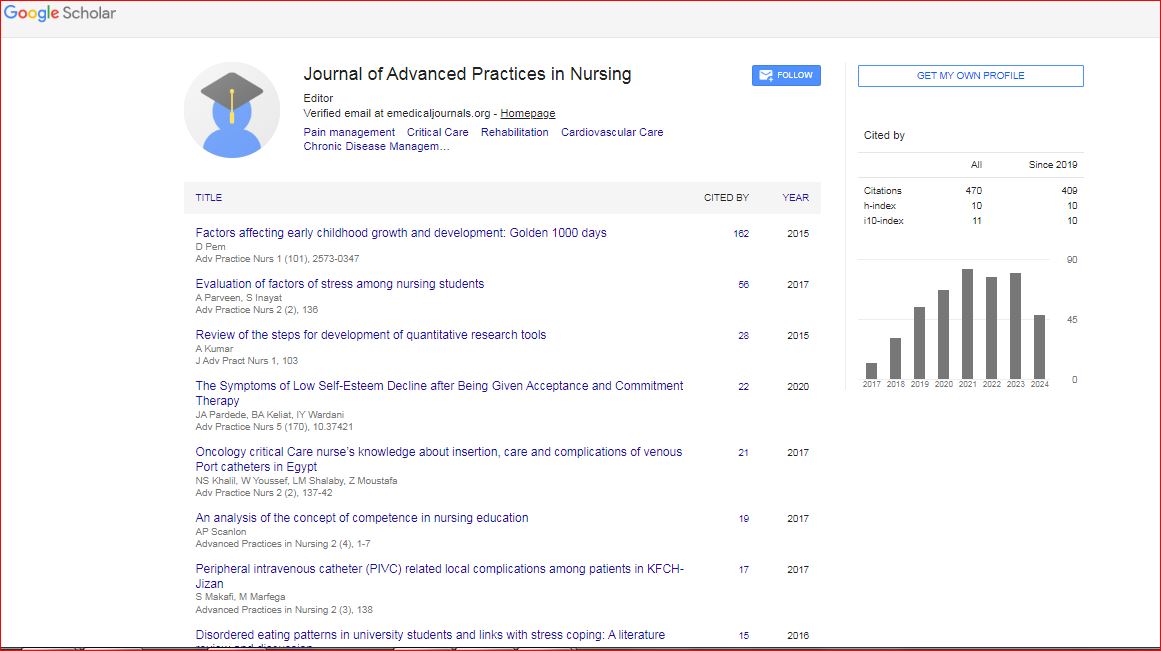
Journal of Advanced Practices in Nursing received 410 citations as per Google Scholar report