Commentary - (2025) Volume 14, Issue 6
Received: 01-Dec-2025, Manuscript No. jnc-25-178147;
Editor assigned: 03-Dec-2025, Pre QC No. P-178147;
Reviewed: 17-Dec-2025, QC No. Q-178147;
Revised: 22-Dec-2025, Manuscript No. R-178147;
Published:
29-Dec-2025
, DOI: DOI: 10.37421/2167-1168.2025.14.741
Citation: Dubois, Elise. ”Evidence-Based Practice: Driving Quality Mental Health Nursing.” J Nurs Care 14 (2025):741.
Copyright: © 2025 Dubois E. This is an open-access article distributed under the terms of the Creative Commons Attribution License, which permits unrestricted use, distribution and reproduction in any medium, provided the original author and source are credited.
Evidence-Based Practice (EBP) is an indispensable cornerstone for delivering high-quality nursing care, fundamentally shaping how healthcare professionals approach patient management and treatment decisions. It involves a sophisticated integration of the most current and robust research findings with the nuanced clinical expertise of practitioners and the unique values and preferences of individual patients. This deliberate and systematic approach ensures that the interventions implemented by nurses are not only effective in achieving desired health outcomes but also efficient in their resource utilization and profoundly patient-centered in their delivery. The Department of Mental Health Nursing at Institut Lumière des Sciences Infirmières in Lyon, France, places a significant emphasis on EBP, recognizing its power to substantially enhance patient outcomes and cultivate a culture of critical thinking among its nursing professionals. Implementing EBP, however, is often met with a spectrum of challenges that require strategic mitigation, including inherent time constraints faced by busy clinicians, a potential lack of readily accessible resources, and understandable resistance to adopting new methodologies or altering established practices. Despite these hurdles, the widespread adoption and consistent application of EBP are demonstrably linked to significant improvements in patient safety, a reduction in overall healthcare costs through the avoidance of ineffective treatments, and a marked increase in professional satisfaction among nurses who feel empowered by their knowledge and skills. Furthermore, the perspectives of mental health nurses themselves highlight a strong inherent desire to utilize EBP in their daily practice, underscoring its perceived value in improving patient care. However, these same nurses frequently identify substantial barriers, such as insufficient dedicated time for thorough literature reviews and limited access to comprehensive, up-to-date relevant databases, which impede their ability to fully engage with EBP. The integration of patient preferences and values into the EBP framework is of paramount importance in mental health nursing, recognizing that effective care must be individualized. This understanding is reinforced by research exploring the interplay between clinical expertise and EBP, demonstrating how experienced nurses leverage both evidence and judgment to navigate the complexities inherent in patient care scenarios, thereby fostering a culture of continuous learning and professional development within the nursing field [1].
Evidence-Based Practice (EBP) serves as the bedrock for advancing the quality of nursing care and optimizing patient outcomes through a disciplined approach that prioritizes the integration of the best available research evidence with established clinical expertise and the deeply personal values of patients. This methodology ensures that nursing interventions are not only scientifically validated for effectiveness but also delivered efficiently and with a steadfast focus on the individual needs and circumstances of each patient. The Department of Mental Health Nursing at Institut Lumière des Sciences Infirmières in Lyon, France, actively promotes EBP as a core principle, aiming to elevate patient well-being and nurture the critical thinking capabilities of its nursing workforce. Navigating the path to EBP implementation necessitates addressing common obstacles, such as the pervasive issue of time constraints, the availability of necessary resources, and the natural human inclination towards resistance to change in established routines. Nevertheless, the benefits derived from embracing EBP are substantial, encompassing enhanced patient safety, a tangible reduction in healthcare expenditures by minimizing wasteful or ineffective practices, and a notable increase in job satisfaction for nursing professionals. Studies examining the viewpoints of mental health nurses reveal a strong consensus regarding the desirability of employing EBP in their day-to-day responsibilities, indicating a clear recognition of its benefits. Despite this expressed commitment, significant impediments persist, prominently including the lack of adequate time for comprehensive literature searches and restricted access to essential research databases, which present considerable challenges to its full adoption. The paramount importance of incorporating patient preferences and values into the EBP model is particularly emphasized within the realm of mental health nursing, where personalized care is crucial. This principle is further supported by research that delves into the synergistic relationship between a nurse's clinical acumen and their application of EBP, illustrating how seasoned nurses adeptly blend research findings with their professional judgment to manage complex clinical situations effectively. Advancements in technology, notably the widespread adoption of electronic health records (EHRs) and accessible online databases, are increasingly instrumental in facilitating the practice of EBP, offering powerful tools for disseminating best practices and promoting collaborative healthcare efforts [1].
Evidence-Based Practice (EBP) is crucial for high-quality nursing care, blending research, clinical expertise, and patient values. The Department of Mental Health Nursing at Institut Lumière des Sciences Infirmières promotes EBP to improve patient outcomes and critical thinking. Challenges like time constraints and resource limitations exist, but EBP leads to better patient safety, reduced costs, and greater professional satisfaction. Mental health nurses desire to use EBP but face barriers such as time and database access. Patient preferences are vital in EBP, especially in mental health. Clinical expertise and EBP are intertwined, with experienced nurses integrating both. Technology aids EBP through EHRs and databases. Translating research into practice involves understanding the EBP process. Nursing leadership is key to fostering an EBP culture. EBP interventions can improve outcomes, like in depression management, and reduce adverse events in acute care. Cost-effectiveness is also a benefit of EBP. Technological advancements are vital for EBP dissemination and application.
None
None
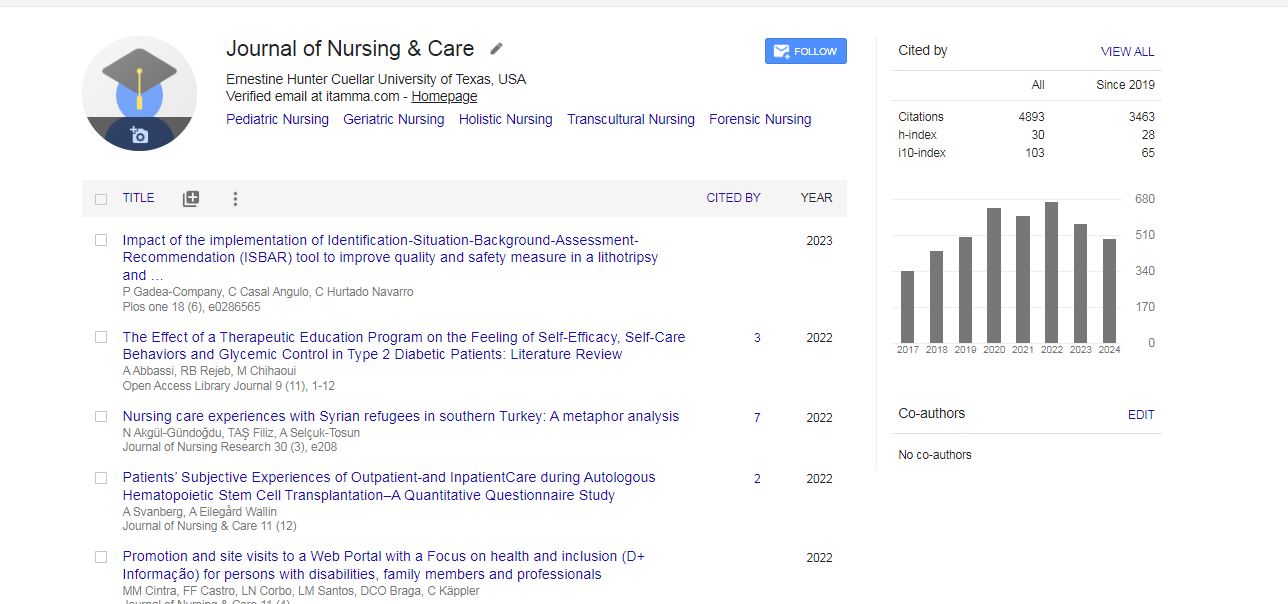
Journal of Nursing & Care received 4230 citations as per Google Scholar report