Perspective - (2025) Volume 14, Issue 6
Received: 01-Dec-2025, Manuscript No. jsp-26-182291;
Editor assigned: 03-Dec-2025, Pre QC No. P-182291;
Reviewed: 17-Dec-2025, QC No. Q-182291;
Revised: 22-Dec-2025, Manuscript No. R-182291;
Published:
29-Dec-2025
, DOI: 10.37421/2165-7939.2025.14.757
Citation: Al-Zahra, Fatima A.. ”Evidence-Based Guidelines For Modern Spine Care.” J Spine 14 (2025):757.
Copyright: © 2025 Al-Zahra A. Fatima This is an open-access article distributed under the terms of the Creative Commons Attribution License, which permits unrestricted use, distribution and reproduction in any medium, provided the original author and source are credited.
The advent of evidence-based guidelines has fundamentally reshaped the landscape of modern spine care, offering a structured approach to optimize treatment strategies and patient outcomes. These guidelines, meticulously developed from rigorous research, aim to standardize clinical practice and mitigate variability, ensuring that patients receive the most effective and appropriate care available. They serve as crucial tools for clinicians, empowering them to make informed decisions across a spectrum of spinal conditions, from common ailments to complex pathologies [1].
For degenerative cervical spine disorders, the application of evidence-based guidelines has been particularly impactful. Through comprehensive overviews that synthesize existing literature via meta-analysis and systematic reviews, these guidelines provide clear recommendations for conditions like cervical spondylosis and radiculopathy. The multidisciplinary nature of spine care is inherently addressed, as these guidelines facilitate enhanced communication and coordinated management among various medical specialties involved in patient care [2].
In the realm of surgical interventions for lumbar spinal stenosis, evidence-based reviews play a pivotal role in evaluating current practices and acknowledging their limitations. By delving into the comparative effectiveness of different surgical techniques and identifying factors that influence decision-making, these reviews guide clinicians toward optimizing patient selection and embracing shared decision-making for improved outcomes and reduced complications [3].
The management of adult spinal deformities, such as scoliosis and kyphosis, also benefits significantly from an evidence-based approach. Current guidelines outline diagnostic criteria, treatment algorithms, and prognostic factors, reflecting the evolution of surgical techniques and the continuous need for high-quality research to refine treatment recommendations and ensure optimal patient care [4].
Conservative management strategies for acute and chronic low back pain have been critically evaluated through evidence-based reviews. These assessments meticulously examine the efficacy of interventions like physical therapy, exercise, manual therapy, and pharmacological approaches, underscoring the importance of patient education and self-management within the framework of evidence-based care [5].
Spinal infections, including conditions like discitis and vertebral osteomyelitis, necessitate a robust evidence-based approach for diagnosis and management. Current guidelines offer recommendations for imaging, laboratory investigations, and antimicrobial therapy, emphasizing the critical need for prompt diagnosis and treatment to prevent substantial morbidity and improve patient prognosis [6].
The optimization of perioperative care for patients undergoing spine surgery is another area where evidence-based guidelines offer significant value. These guidelines encompass recommendations for preoperative optimization, intraoperative management, and postoperative recovery, aiming to minimize complications and enhance overall patient satisfaction through multidisciplinary collaboration [7].
The practice of minimally invasive spine surgery is increasingly guided by evidence-based reviews, which compare these techniques to traditional open procedures. By focusing on outcomes such as reduced blood loss, shorter hospital stays, and faster recovery, these reviews highlight the importance of appropriate patient selection for these advanced surgical methods [8].
Spinal trauma management is critically informed by evidence-based guidelines that address initial assessment, imaging, and the choice between surgical and non-surgical treatment strategies. These guidelines emphasize the vital role of timely and accurate diagnosis in preventing secondary injury and facilitating optimal functional recovery for patients with spinal fractures [9].
Finally, the application of evidence-based guidelines extends to interventional pain management for spinal conditions. Reviews examining various injection techniques, such as epidural steroid and facet joint injections, provide evidence supporting their efficacy in treating chronic pain, stressing the importance of judicious patient selection and comprehensive outcome measurement [10].
The paramount importance of evidence-based guidelines in modern spine care cannot be overstated, as they are instrumental in standardizing treatment approaches and enhancing patient outcomes. These guidelines, forged from rigorous research, aim to reduce variations in practice by providing clinicians with a reliable framework for decision-making regarding common spinal conditions, thereby improving the overall quality of care [1].
The development and application of evidence-based guidelines for cervical spine disorders represent a significant advancement in clinical practice. By employing meta-analysis and systematic reviews to synthesize existing literature, these guidelines offer well-founded recommendations for managing conditions such as cervical spondylosis and radiculopathy, fostering a more coordinated and effective multidisciplinary approach to patient care [2].
For lumbar spinal stenosis, evidence-based reviews are crucial for evaluating the efficacy of surgical interventions and informing clinical decisions. These reviews facilitate a deeper understanding of comparative surgical techniques and the factors influencing treatment choices, promoting patient selection and shared decision-making to optimize surgical outcomes [3].
In the context of adult spinal deformities, evidence-based guidelines provide a structured approach to diagnosis and treatment. They outline current best practices for conditions like scoliosis and kyphosis, reflecting the ongoing evolution of surgical techniques and the persistent need for high-quality research to refine therapeutic recommendations [4].
Conservative management strategies for low back pain are continually refined through evidence-based approaches. Reviews critically assess the efficacy of interventions such as physical therapy, exercise, and pharmacological treatments, emphasizing the integral role of patient education and self-management in achieving favorable outcomes [5].
Spinal infections require a systematic, evidence-based approach to diagnosis and management. Guidelines provide clear recommendations for diagnostic modalities and antimicrobial therapies, aiming to ensure prompt identification and effective treatment, thereby minimizing potential morbidity and improving patient recovery [6].
The perioperative care of patients undergoing spine surgery is significantly enhanced by evidence-based guidelines. These guidelines offer a comprehensive roadmap for preoperative, intraoperative, and postoperative management, promoting multidisciplinary collaboration to reduce complications and improve patient satisfaction [7].
Minimally invasive spine surgery has seen considerable advancements driven by evidence-based practice. Comparative reviews help to elucidate the benefits of these techniques over traditional open procedures, highlighting improved outcomes in areas such as blood loss, hospital stay, and recovery time, contingent on appropriate patient selection [8].
Spinal trauma management is guided by evidence-based principles that inform initial assessment, imaging interpretation, and the selection of appropriate treatment strategies. These guidelines are essential for preventing secondary injury and optimizing functional recovery following spinal fractures [9].
Interventional pain management for spinal conditions benefits from the application of evidence-based guidelines, which evaluate the efficacy of various injection techniques. These guidelines emphasize the importance of careful patient selection and rigorous outcome measurement to ensure the effective and appropriate use of these procedures for chronic pain management [10].
This collection of articles emphasizes the critical role of evidence-based guidelines in modern spine care. It covers their application in managing a wide range of spinal conditions, including low back pain, cervical disorders, spinal stenosis, adult spinal deformities, spinal infections, spinal trauma, and interventional pain management. The importance of rigorous research, systematic reviews, meta-analyses, and multidisciplinary collaboration in developing and implementing these guidelines is consistently highlighted. The focus remains on standardizing treatment, improving patient outcomes, and guiding informed clinical decision-making, particularly in surgical and conservative interventions. The reviews also touch upon perioperative care and the use of minimally invasive techniques, underscoring the ongoing evolution and need for high-quality research to refine recommendations.
None
None
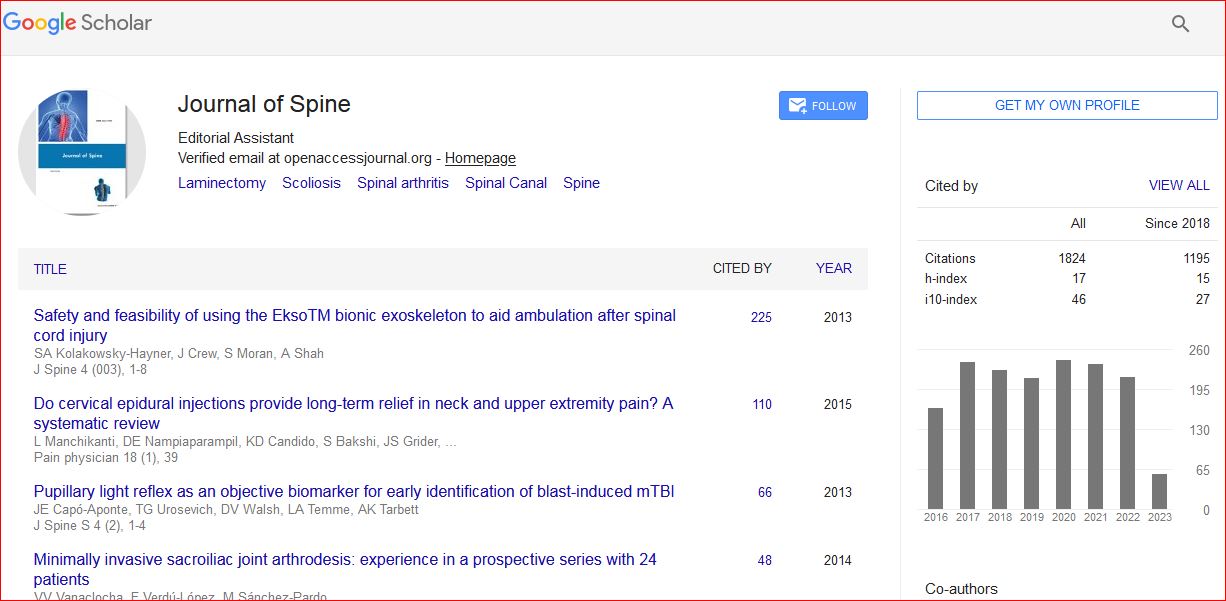
Journal of Spine received 2022 citations as per Google Scholar report