Opinion - (2025) Volume 14, Issue 6
Received: 03-Nov-2025, Manuscript No. aim-25-178059;
Editor assigned: 05-Nov-2025, Pre QC No. P-178059;
Reviewed: 19-Nov-2025, QC No. Q-178059;
Revised: 24-Nov-2025, Manuscript No. R-178059;
Published:
29-Nov-2025
, DOI: 10.37421/2427-5162.2025.14.602
Citation: Singh, Arun V.. ”Evidence for Integrative CAM in Older Adult Well-being.” Alt Integr Med 14 (2025):602.
Copyright: © 2025 Singh V. Arun This is an open-access article distributed under the terms of the Creative Commons Attribution License, which permits unrestricted use, distribution and reproduction in any medium, provided the original author and source are credited.
Complementary and alternative medicine (CAM) approaches are increasingly recognized for their potential to enhance the well-being of older adults. A systematic review highlights how mind-body practices and herbal remedies can improve psychological, social, and physical health outcomes in geriatric populations, underscoring CAM's broad applicability [1].
Chronic pain management is a significant challenge in geriatric care, often requiring non-pharmacological interventions. A meta-analysis provides strong evidence for acupuncture's effectiveness in this domain, demonstrating its capacity to significantly reduce pain intensity and improve physical function among older adults [2].
Cognitive health is a critical aspect of aging, particularly for individuals experiencing mild cognitive impairment or dementia. Mindfulness-based interventions have shown promise as supportive therapies, with a systematic review indicating potential benefits for cognitive function, mood, and overall quality of life in this vulnerable group [3].
Maintaining balance and preventing falls are crucial for independence and quality of life in older adults. Yoga programs, through a meta-analysis, have been identified as effective interventions, significantly improving balance parameters and reducing fall risk, thus serving as a valuable preventive strategy [4].
Behavioral challenges, such as agitation and anxiety, frequently accompany dementia in long-term care settings. Aromatherapy emerges as a potential non-pharmacological approach, with a systematic review pinpointing specific essential oils that contribute to calming behaviors and enhancing well-being in older adults with dementia [5].
Cognitive decline can be influenced by various factors, and herbal medicines are being explored for their neuroprotective properties. A meta-analysis showcases the efficacy of certain herbs in improving cognitive function, memory, and attention in geriatric individuals, offering a natural adjunct to conventional treatments [6].
Chronic conditions are prevalent among older adults, necessitating comprehensive management strategies. Tai Chi practice has been investigated as an integrative therapy, with a systematic review and meta-analysis revealing its benefits in improving physical function, reducing pain, and enhancing the overall quality of life for this demographic [7].
Osteoarthritis pain profoundly impacts mobility and quality of life in older adults. Massage therapy presents a viable non-pharmacological alternative, as concluded by a meta-analysis that found significant reductions in pain and improvements in functional status, promoting better well-being [8].
Mental health in older adults is intricately linked with nutrition. A review underscores the role of functional foods and specific dietary supplements in improving mood, mitigating symptoms of depression, and supporting cognitive well-being within geriatric populations [9].
Behavioral disturbances in older adults with dementia pose considerable challenges for caregivers and affect patient quality of life. Music therapy has been shown to be effective in reducing agitation and behavioral issues, with a meta-analysis confirming its significant positive impact on behavioral outcomes and overall well-being as a non-pharmacological intervention [10].
The synthesis of evidence regarding complementary and alternative medicine (CAM) highlights its comprehensive benefits for older adults. This review specifically examines mind-body practices and herbal remedies, noting their capacity to foster improvements across psychological, social, and physical health domains within geriatric populations, thus validating their integration into care plans [1]. Acupuncture, a traditional Chinese medicine technique, has gained recognition for its role in chronic pain management. A detailed meta-analysis focused on older adults confirmed that acupuncture not only significantly diminishes pain intensity but also markedly enhances physical function, positioning it as a potent non-pharmacological option in contemporary geriatric pain protocols [2]. Mindfulness-based interventions (MBIs) are increasingly explored for their therapeutic potential in age-related cognitive challenges. This systematic review elaborates on the impact of MBIs on older adults with mild cognitive impairment or dementia, reporting encouraging findings regarding cognitive function, mood regulation, and an elevated quality of life, suggesting their role as a supportive component in cognitive health strategies [3]. Falls represent a major health concern for older adults, often leading to serious injuries and decreased independence. A comprehensive meta-analysis of yoga programs elucidates their efficacy in bolstering balance parameters and effectively reducing the risk of falls, thereby establishing yoga as a practical and beneficial preventive measure within geriatric care [4]. Aromatherapy offers a gentle yet effective approach to managing challenging behaviors in dementia. This systematic review meticulously evaluates the evidence for aromatherapy in ameliorating agitation and anxiety among older adults with dementia residing in long-term care facilities, identifying specific essential oils that contribute to a calmer demeanor and improved overall well-being [5]. Herbal medicine has a long history of use and is now being scientifically scrutinized for its neuroprotective effects. A meta-analysis investigating various herbal medicines substantiates their potential to improve cognitive function in older adults, specifically highlighting certain compounds that may enhance memory, attention, and general cognitive health in geriatric individuals [6]. Tai Chi, a mind-body exercise, provides a multifaceted approach to managing chronic conditions in older adults. A systematic review and meta-analysis underscore its significant benefits, including enhanced physical function, reduced pain levels, and an improved quality of life, positioning Tai Chi as a valuable integrative therapy for a broad spectrum of geriatric health issues [7]. Massage therapy offers a drug-free alternative for alleviating musculoskeletal discomfort. This meta-analysis, specifically examining its role in osteoarthritis pain among older adults, concludes that massage effectively reduces pain and improves functional status, thereby offering a meaningful non-pharmacological intervention to improve well-being for geriatric patients suffering from chronic joint pain [8]. Nutritional interventions play a pivotal role in supporting mental health as individuals age. A thorough review explores the contribution of functional foods and targeted dietary supplements, identifying various compounds and dietary patterns that are associated with improved mood, reduced depressive symptoms, and enhanced overall cognitive well-being in older adult populations [9]. Music therapy, a non-invasive intervention, holds considerable promise for managing behavioral symptoms associated with dementia. This meta-analysis demonstrates the significant effectiveness of music interventions in reducing agitation and other behavioral disturbances among older adults with dementia, ultimately leading to improved behavioral outcomes and an enhanced quality of life for this vulnerable population [10].
This collection of systematic reviews and meta-analyses provides comprehensive evidence for the utility of complementary and alternative medicine (CAM) and various integrative therapies in promoting the well-being of older adults. Key findings demonstrate that CAM approaches, including mind-body practices, herbal remedies, and functional foods, can significantly improve a range of health outcomes. Acupuncture and massage therapy are effective in chronic pain management, while yoga and Tai Chi enhance physical function, balance, and fall prevention. Mindfulness-based interventions and herbal medicines show promise for cognitive function and mood in those with mild cognitive impairment or dementia. Furthermore, aromatherapy and music therapy are identified as valuable non-pharmacological strategies for reducing agitation and behavioral disturbances in older adults with dementia. Collectively, these studies support the integration of diverse therapeutic modalities to address the complex health needs of the geriatric population, improving physical, psychological, and cognitive well-being.
None
None
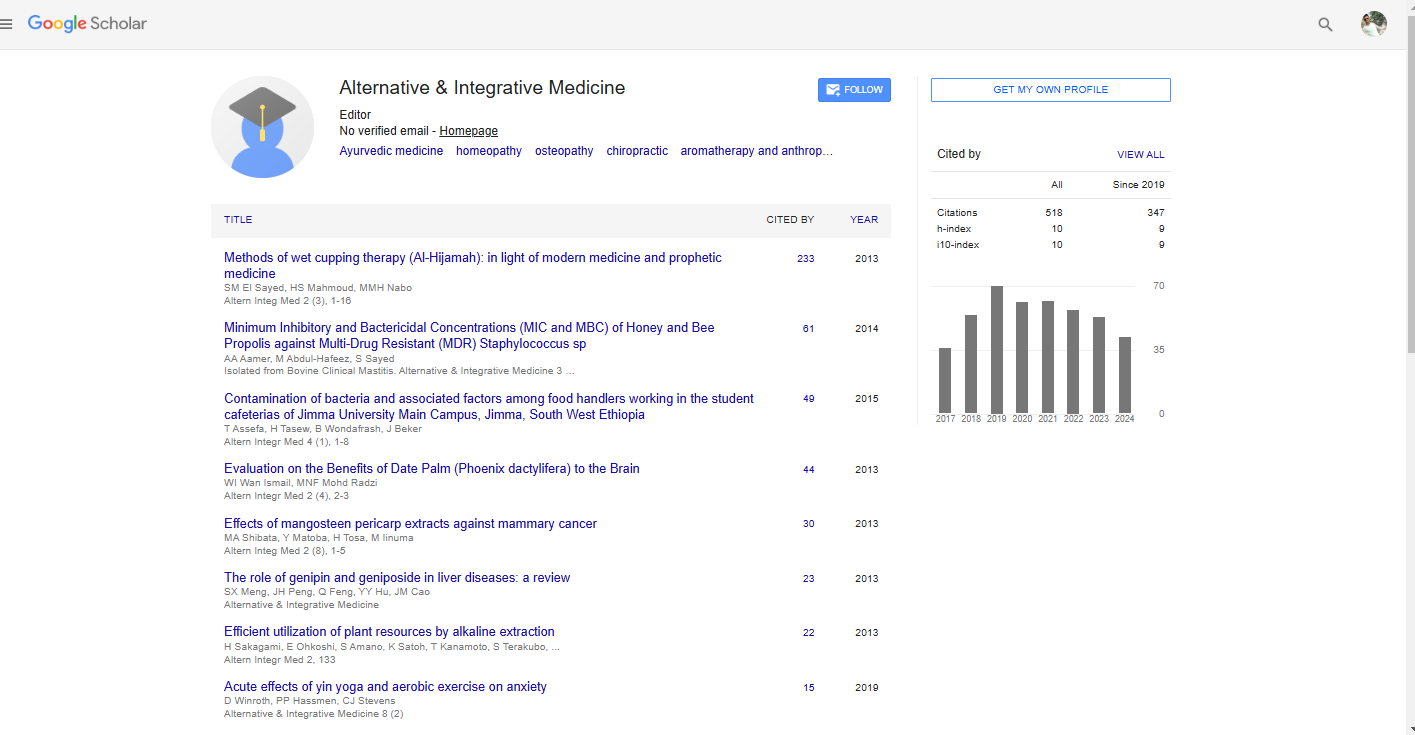
Alternative & Integrative Medicine received 476 citations as per Google Scholar report