Brief Report - (2025) Volume 10, Issue 4
Received: 01-Aug-2025, Manuscript No. jcct-26-183222;
Editor assigned: 04-Aug-2025, Pre QC No. P-183222;
Reviewed: 18-Aug-2025, QC No. Q-183222;
Revised: 22-Aug-2025, Manuscript No. R-183222;
Published:
29-Aug-2025
, DOI: 10.37421/2577-0535.2025.9.320
Citation: Park, Min-Jae. ”Ethical Pediatric Oncology Trials: Challenges and Innovations.” J Cancer Clin Trials 10 (2025):320.
Copyright: © 2025 Park M. This is an open-access article distributed under the terms of the Creative Commons Attribution License, which permits unrestricted use, distribution and reproduction in any medium, provided the original author and source are credited.
Pediatric oncology clinical trials represent a critical frontier in the fight against childhood cancers, demanding meticulous attention to both ethical considerations and methodological rigor. The unique vulnerabilities of child patients necessitate robust informed consent processes, assent from the child when appropriate, and a careful balance of the risk-benefit ratio in trial design. This approach ensures that the pursuit of scientific advancement does not compromise the well-being of these young individuals [1].
Methodological innovations are paramount in pediatric oncology trials, addressing the inherent challenges posed by small patient populations and the need for international collaboration. Adaptive trial designs, the role of biomarkers, and statistical considerations for limited sample sizes are key areas of focus. Furthermore, the ethical imperative to provide access to investigational therapies through compassionate use programs underscores the commitment to patient care [2].
The ethical framework surrounding informed consent and assent in pediatric oncology trials is multifaceted, requiring an understanding of children's developmental stages and their capacity to comprehend research participation. Advocacy for shared decision-making models, involving parents, healthcare providers, and the child, is crucial for fostering an environment of trust and transparency. Addressing therapeutic misconception and the potential for coercion are vital ethical responsibilities [3].
Conducting multi-institutional pediatric oncology trials presents significant logistical and ethical challenges, necessitating the harmonization of protocols, centralized data management, and consistent ethical review across diverse sites. Special attention is paid to international collaborations, which involve navigating varying regulatory landscapes and cultural perspectives on research. Strategies for effective patient recruitment and retention are essential for the success of these large-scale endeavors [4].
The ethical use of placebos in pediatric oncology trials warrants careful scrutiny, given the potential for such interventions to delay or deny life-saving treatments. Stringent ethical requirements must be met to justify placebo use in this vulnerable population, emphasizing the importance of equipoise and a robust scientific rationale for placebo-controlled designs. Alternative trial designs that minimize exposure to ineffective treatments are also a critical consideration [5].
Innovative trial designs, such as basket, umbrella, and N-of-1 trials, are being implemented in pediatric oncology to address the heterogeneity of tumor types and individual patient responses. These designs offer methodological advantages, but also raise ethical considerations related to participant selection, data interpretation, and the potential for premature trial closure, all while prioritizing patient safety and scientific integrity [6].
Patient recruitment and retention are fundamental to the success of pediatric oncology clinical trials. Factors influencing parental decision-making, including trust in healthcare providers and understanding of risks and benefits, are thoroughly examined. Methodological approaches such as community outreach and diverse trial site locations, coupled with ethical strategies for ensuring voluntary participation, are vital for addressing these challenges [7].
The ethical implications of data sharing and the use of real-world evidence in pediatric oncology trials are increasingly important. This involves balancing the need to protect patient privacy with the imperative to facilitate scientific advancement through data accessibility. Methodological considerations for the appropriate use and interpretation of real-world data are detailed, alongside the ethical frameworks that govern these practices [8].
Developing and testing targeted therapies and immunotherapies in pediatric oncology presents unique ethical and methodological frontiers. Early integration of these novel approaches into clinical trials is crucial, despite the complexities of identifying appropriate pediatric targets and potential toxicities. Adaptive strategies and biomarker-driven selection are key methodological considerations that must be balanced with the ethical imperative to translate laboratory findings into clinical benefits for children [9].
Pediatric oncology clinical trials in resource-limited settings face distinct ethical and methodological challenges, including infrastructure limitations, funding constraints, and restricted access to advanced diagnostics and treatments. Adapting trial designs and ethical frameworks to local contexts, alongside capacity building and ensuring equitable access to research benefits, are essential. International partnerships play a crucial role in overcoming these barriers [10].
The complex ethical and methodological considerations inherent in pediatric oncology clinical trials are extensively examined, highlighting the unique vulnerabilities of child patients and the necessity for robust informed consent processes, appropriate child assent, and careful risk-benefit assessments. Methodological discussions encompass challenges in trial design, such as small patient populations, the need for multi-center collaborations, and the integration of novel therapies while upholding rigorous scientific standards. The critical examination of data sharing and the ethical implications of placebo use in pediatric populations are also central themes [1].
Focusing on the methodological aspects, this paper addresses the intricacies of designing and conducting pediatric oncology trials, discussing adaptive trial designs, the role of biomarkers, and the statistical challenges associated with small sample sizes. The authors emphasize the importance of international collaboration to overcome recruitment barriers and accelerate the evaluation of new treatments for rare pediatric cancers. The ethical imperative to provide access to investigational therapies through compassionate use programs and expanded access protocols is also carefully considered [2].
This research critically examines the ethical framework surrounding informed consent and assent in pediatric oncology trials, exploring how children's developmental stages influence their capacity to understand and agree to participate in research. The paper advocates for shared decision-making models involving parents, healthcare providers, and the child, stressing the need for clear, age-appropriate communication. Ethical considerations regarding therapeutic misconception and the potential for coercion are also thoroughly discussed [3].
The authors delve into the logistical and ethical challenges of conducting multi-institutional pediatric oncology trials, discussing the importance of harmonizing protocols, centralizing data management, and ensuring consistent ethical review across different sites. The paper also addresses the unique ethical considerations of trials involving international collaborations, including varying regulatory landscapes and cultural perspectives on research. Strategies for effective patient recruitment and retention in large-scale trials are presented [4].
This article critically scrutinizes the ethical use of placebos in pediatric oncology trials, acknowledging the potential for a placebo to delay or deny life-saving treatment and exploring the stringent ethical requirements for justifying placebo use in this vulnerable population. The authors discuss the concept of equipoise and the importance of a robust scientific rationale for placebo-controlled designs. Alternative trial designs that minimize exposure to ineffective treatment are also considered [5].
The authors present a review of novel trial designs being implemented in pediatric oncology, including basket trials, umbrella trials, and N-of-1 trials. They discuss the methodological advantages of these designs in addressing heterogeneous tumor types and individual patient responses. Ethical considerations related to participant selection, data interpretation, and the potential for premature trial closure in these innovative frameworks are also explored, with a focus on ensuring patient safety and scientific integrity [6].
This paper addresses the critical issue of patient recruitment and retention in pediatric oncology clinical trials. It examines the factors influencing parental decision-making regarding trial participation, including trust in healthcare providers, perceived benefits, and understanding of risks. Methodological approaches to improve recruitment, such as community outreach and diverse trial site locations, are discussed, alongside ethical strategies to ensure voluntary participation and minimize attrition [7].
The ethical implications of data sharing and the use of real-world evidence in pediatric oncology clinical trials are explored in this publication. It discusses the balance between protecting patient privacy and facilitating scientific advancement through data accessibility. Methodological considerations for the appropriate use and interpretation of real-world data in supplementing traditional trial findings are also detailed, along with the ethical frameworks governing these practices [8].
This paper focuses on the ethical challenges of developing and testing targeted therapies and immunotherapies in pediatric oncology. It discusses the need for early integration of these novel approaches into clinical trials, despite the complexities of identifying appropriate pediatric targets and potential toxicities. Methodological considerations for trial design, such as adaptive strategies to evaluate combination therapies and biomarker-driven selection, are presented alongside the ethical imperative to translate promising laboratory findings to clinical benefit for children [9].
This article addresses the ethical and methodological considerations of pediatric oncology trials in resource-limited settings. It highlights the challenges of infrastructure, funding, and access to advanced diagnostics and treatments. The authors propose strategies for adapting trial designs and ethical frameworks to local contexts, emphasizing the importance of capacity building and equitable access to research participation and its potential benefits. The role of international partnerships in overcoming these barriers is also discussed [10].
This collection of research underscores the critical need for ethical and methodological excellence in pediatric oncology clinical trials. Key challenges include ensuring informed consent and assent for child patients, designing trials with small patient populations, and navigating multi-institutional collaborations. Innovative trial designs, the use of biomarkers, and adaptive strategies are being explored to improve treatment evaluation. Ethical considerations surrounding placebo use, data sharing, and access to investigational therapies are paramount. The papers also address the unique challenges of trials in resource-limited settings and the development of targeted therapies and immunotherapies, emphasizing the importance of patient safety, scientific integrity, and equitable access to care for children with cancer.
None
None
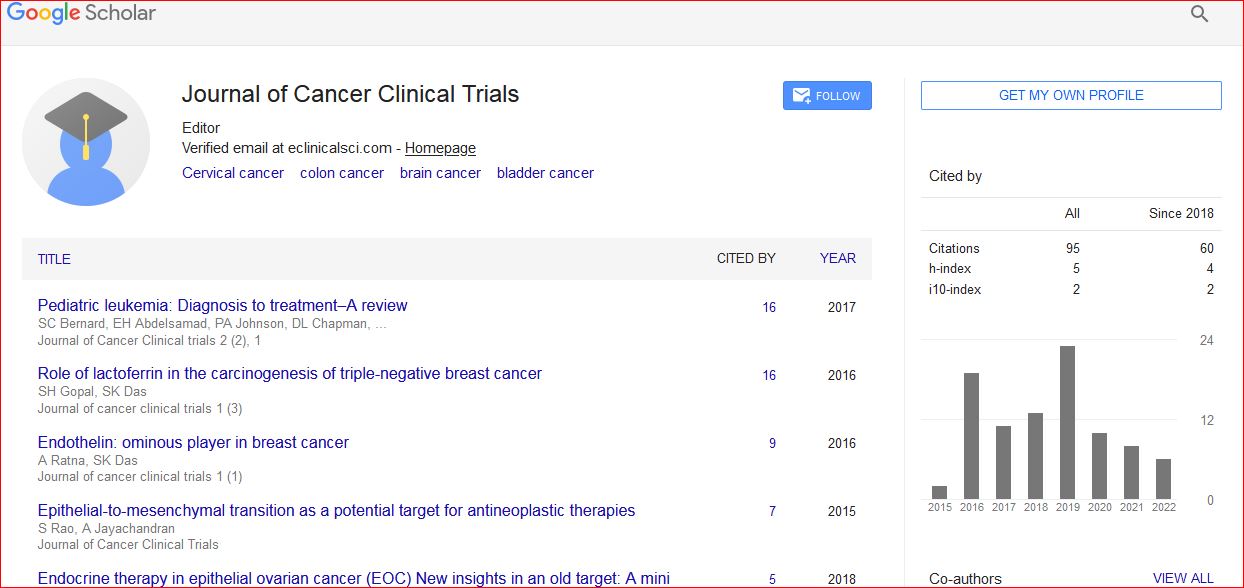
Journal of Cancer Clinical Trials received 95 citations as per Google Scholar report