Perspective - (2025) Volume 9, Issue 4
Received: 01-Aug-2025, Manuscript No. ahbs-26-182504;
Editor assigned: 04-Aug-2025, Pre QC No. P-182504;
Reviewed: 18-Aug-2025, QC No. Q-182504;
Revised: 22-Aug-2025, Manuscript No. R-182504;
Published:
29-Aug-2025
, DOI: 10.37421/2952-8097.2025.9.330
Citation: Khan, Farida. ”Ethical Frameworks for Animal Health
and Research.” J Anim Health Behav Sci 09 (2025):330.
Copyright: © 2025 Khan F. This is an open-access article distributed under the terms of the Creative Commons Attribution License, which permits unrestricted use, distribution
and reproduction in any medium, provided the original author and source are credited.
The ethical landscape surrounding animal research, particularly in the realms of health and behavior, necessitates robust frameworks to ensure the well-being of sentient beings involved in scientific inquiry. A primary concern revolves around the principles of minimizing pain and distress, employing the fewest animals feasible, and establishing humane endpoints that prioritize animal welfare throughout research protocols. Transparency and accountability are paramount, advocating for the integration of ethical review boards and active public engagement to foster trust and elevate research standards in this critical field [1].
The examination of ethical considerations within animal behavior studies underscores the vital importance of utilizing non-invasive methodologies and accurately interpreting animal signals to gain meaningful insights. It is crucial to comprehend natural behaviors by minimizing human interference and ensuring that experimental designs do not provoke abnormal responses, thereby preserving the integrity of observed behaviors. Furthermore, the ethical implications of extrapolating findings from animal behavior research to human contexts warrant careful consideration and demand a cautious approach with rigorous validation steps [2].
Within veterinary research, specific ethical considerations arise concerning diagnostic procedures and therapeutic interventions aimed at improving animal health. The fundamental principle of 'do no harm' guides researchers, alongside the responsibility to guarantee that all interventions are scientifically sound and ethically justifiable. A review of current guidelines and the proposal of best practices for ethical conduct in clinical trials involving animals are essential for advancing this area responsibly [3].
The advancement of the 3Rsâ??Replacement, Reduction, and Refinementâ??in animal research offers innovative strategies to minimize animal use and enhance welfare in both health and behavioral studies. This involves the development and validation of alternative methods, such as in vitro models and computational approaches, along with a thorough consideration of their ethical implications. A proactive approach to implementing the 3Rs across all stages of research is strongly advocated [4].
Research involving animals with compromised health or behavioral conditions presents unique ethical challenges. These challenges involve balancing the pursuit of scientific inquiry with the imperative to protect vulnerable animals from further suffering. Developing guidelines for establishing humane endpoints and ensuring appropriate care and monitoring throughout research protocols are critical for ethically managing these situations [5].
The integration of advanced technologies, including genetic engineering and artificial intelligence, into animal health and behavioral research introduces novel ethical frontiers. Careful ethical review of these emerging approaches is essential to prevent unintended consequences and safeguard animal well-being. Interdisciplinary collaboration is crucial for developing comprehensive ethical guidelines for these rapidly evolving technologies [6].
Understanding and addressing the emotional well-being of animals engaged in research is an ethical imperative. This involves appreciating animal cognition and sentience to design research protocols that minimize psychological distress. The integration of positive reinforcement techniques and enrichment strategies is vital for promoting good welfare and ensuring ethical research practices [7].
The ethical challenges associated with the rehoming and post-research care of animals are significant. Researchers bear the responsibility of ensuring that animals transition successfully to new environments and receive appropriate care following their involvement in research. Establishing ethical guidelines for responsible animal welfare that extend beyond the research setting is therefore essential [8].
Ethical perspectives in animal behavior research, particularly within neuroscience, emphasize minimizing invasiveness and considering the animal's subjective experience. Ensuring that behavioral manipulations are scientifically justified and ethically sound is paramount. The nuances of interpreting animal behavior in the context of experimental manipulation require careful and ethical consideration [9].
Societal responsibility and public perception are integral to the ethics of animal research. Transparency, public engagement, and clear communication of ethical standards are vital for building and maintaining public trust. A strong ethical foundation is fundamental to the continued acceptance and support of animal health and behavioral research by society [10].
The ethical considerations surrounding animal research, particularly in health and behavioral studies, are multifaceted and demand rigorous frameworks to ensure animal welfare. Key principles include minimizing pain and distress, reducing the number of animals used, and implementing humane endpoints. Transparency and accountability in research practices, alongside the integration of ethical review boards and public engagement, are crucial for building trust and improving research standards [1].
In the domain of animal behavior research, the focus is on employing non-invasive methods and correctly interpreting animal signals. Minimizing human interference is vital for understanding natural behaviors, and experimental setups must be designed to avoid inducing abnormal responses. The ethical implications of applying findings from animal behavior studies to human contexts require cautious interpretation and further validation [2].
Veterinary research faces unique ethical challenges related to diagnostic procedures and therapeutic interventions. Adherence to the 'do no harm' principle and ensuring that interventions are both scientifically sound and ethically justified are paramount. The development and adherence to current guidelines and best practices for ethical conduct in clinical trials involving animals are essential [3].
The application of the 3Rs (Replacement, Reduction, Refinement) is a cornerstone for advancing animal welfare in research. Innovative strategies to minimize animal use and improve conditions in health and behavioral studies involve developing and validating alternative methods, such as in vitro models and computational approaches, while carefully considering their ethical dimensions. A proactive implementation of the 3Rs across all research stages is encouraged [4].
Research involving animals with compromised health or behavior presents specific ethical dilemmas. The critical balance lies between scientific inquiry and the duty to protect these vulnerable animals from further suffering. Establishing clear guidelines for humane endpoints and ensuring adequate care and monitoring throughout research protocols are vital components of ethical management [5].
The use of advanced technologies like genetic engineering and artificial intelligence in animal health and behavioral research introduces new ethical considerations. These novel approaches require thorough ethical review to prevent unforeseen consequences and to guarantee animal well-being. Fostering interdisciplinary collaboration is essential for creating appropriate ethical guidelines for these emerging technologies [6].
The emotional well-being of animals in research settings is a critical ethical concern. Researchers must strive to understand animal cognition and sentience to design protocols that minimize psychological distress. The implementation of positive reinforcement techniques and enrichment strategies actively promotes good welfare and ethical research practices [7].
Ethical considerations extend to the post-research life of animals, including rehoming and ongoing care. Researchers have a responsibility to facilitate smooth transitions to new environments and ensure appropriate care after the research concludes. Developing ethical guidelines for responsible animal welfare beyond the research context is an important undertaking [8].
In behavioral neuroscience, ethical principles guide the use of animals by emphasizing reduced invasiveness and consideration of the animal's subjective experience. Behavioral manipulations must be scientifically justified and ethically sound. The interpretation of animal behavior within experimental contexts requires careful ethical deliberation [9].
Public perception and societal responsibility play a significant role in the ethics of animal research. Transparency, public engagement, and clear communication of ethical standards are key to fostering public trust. A strong ethical foundation is indispensable for the continued societal acceptance and support of animal health and behavioral research [10].
This collection of research highlights the critical ethical considerations in animal health and behavioral research. It emphasizes the need for rigorous ethical frameworks that prioritize animal welfare, including minimizing pain and distress, reducing animal use, and implementing humane endpoints. The papers discuss the importance of non-invasive methods in behavior studies, ethical challenges in veterinary research, and the application of the 3Rs to improve animal welfare. Furthermore, the research addresses the ethical management of vulnerable animals, the implications of advanced technologies, and the emotional well-being of research animals. Ethical practices for post-research care and rehoming are also explored, alongside the specific ethical perspectives in behavioral neuroscience. Finally, the importance of public trust, transparency, and societal responsibility in shaping the future of animal research ethics is underscored.
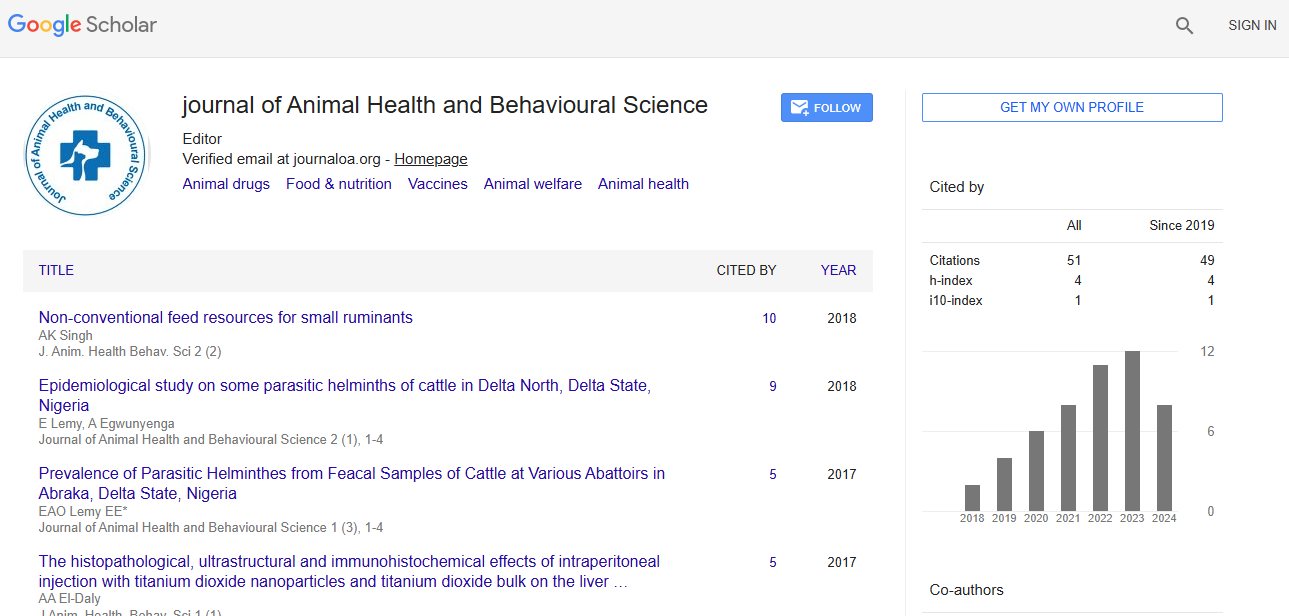
Journal of Animal Health and Behavioural Science received 38 citations as per Google Scholar report