Opinion - (2025) Volume 11, Issue 6
Received: 03-Nov-2025, Manuscript No. OHCR-25-167874;
Editor assigned: 05-Nov-2025, Pre QC No. P-167874;
Reviewed: 17-Nov-2025, QC No. Q-167874;
Revised: 22-Nov-2025, Manuscript No. R-167874;
Published:
29-Nov-2025
, DOI: 10.37421/2471-8726.2025.11.215
Citation: Donato, Curcumin. “Ethical Considerations in Modifying Natural Oral Constitution for Cosmetic Gain.” Oral Health Case Rep 11 (2025): 215.
Copyright: © 2025 Donato C. This is an open-access article distributed under the terms of the Creative Commons Attribution License, which permits unrestricted use, distribution and reproduction in any medium, provided the original author and source are credited.
Cosmetic dentistry has evolved beyond functional rehabilitation into a realm where patients increasingly seek elective procedures aimed solely at improving appearance. Treatments such as tooth reshaping, whitening, enameloplasty, and gingival contouring often involve altering a patientâ??s natural oral constitution, raising important ethical questions. While these interventions can enhance confidence and self-esteem, they may also compromise biological integrity for aesthetic gain. Dentists must navigate a complex landscape where patient autonomy, clinical judgment, and ethical responsibility intersect. Performing irreversible treatments on structurally sound teeth or tissues purely for visual enhancement prompts debates on professional boundaries. As aesthetic demands grow, so too does the need for a critical ethical framework guiding decisions. Practitioners must consider long-term consequences, informed consent, and whether procedures align with the fundamental principle of â??do no harmâ? [1].
The ethical challenges surrounding cosmetic dental modification center on balancing patient desires with professional accountability. Patients may request procedures driven by societal pressures, personal insecurities, or unrealistic expectations factors that can cloud clinical reasoning. While the patientâ??s right to choose is paramount, dentists hold the responsibility to assess whether a cosmetic intervention is necessary, safe, and appropriate. Ethical concerns arise particularly when procedures involve significant alteration of healthy enamel, over-treatment, or promotion of idealized beauty standards. The growing market for elective cosmetic services increases the risk of commodifying oral care, potentially prioritizing profit over patient welfare. Therefore, clinicians must maintain a principled approach, emphasizing education, transparency, and conservative treatment planning. Understanding the ethical dimensions of cosmetic enhancement is essential for preserving trust, professionalism, and the integrity of dental care [2].
Modifying the natural oral constitution for aesthetic purposes involves altering tissues that are often biologically intact, raising critical ethical considerations. Enamel reduction, for instance, is irreversible and may increase long-term risks of sensitivity, decay, or structural compromise. Although patients may consent to these procedures for cosmetic reasons, the dentist is ethically obligated to ensure that such choices are informed, evidence-based, and medically justified. Cosmetic interventions must not undermine oral health or violate the principle of non-maleficence. This principle mandates that clinicians avoid harm, even when patients request high-risk modifications. Ethical practice also demands that alternatives be discussed, such as orthodontics or whitening, which may offer aesthetic improvements with fewer biological costs. In many cases, pressure to meet beauty ideals promoted through media or advertising may drive patients toward unnecessary interventions. Dentists must recognize and mitigate these influences by maintaining objectivity and providing guidance based on health, function, and individualized need. Documenting risks, expectations, and outcomes is crucial for both legal and ethical accountability. Ultimately, the clinicianâ??s role is not merely to fulfill cosmetic requests, but to act as a gatekeeper who upholds ethical standards and protects patient well-being. Judicious decision-making is key to balancing artistic enhancement with professional responsibility [3].
Patient autonomy is a foundational principle in healthcare ethics, granting individuals the right to make decisions about their own treatment. However, in cosmetic dentistry, this autonomy must be carefully balanced with the practitionerâ??s duty of beneficence and professional integrity. Patients may request procedures such as veneers on healthy teeth, aggressive gum contouring, or extensive whitening based on aesthetic ideals rather than clinical need. While respecting their choices is important, dentists must assess whether fulfilling such requests constitutes responsible care. Ethical dilemmas arise when patients are unaware of long-term consequences or when their expectations are shaped by distorted images of beauty. The dentistâ??s responsibility includes educating patients about risks, offering realistic alternatives, and sometimes refusing treatment that could cause harm or compromise oral function. Informed consent should involve more than signing a form it requires a dialogue that helps patients understand the implications of altering natural structures. Moreover, ethical dentistry encourages a focus on health-based aesthetics, where interventions enhance appearance without undermining biological integrity. Practitioners must resist the pressure to commercialize care or reduce it to a transactional service. Upholding ethical standards not only protects patients but also preserves the trust placed in the dental profession as a healthcare discipline grounded in both science and moral judgment [4].
The commercialization of cosmetic dentistry has amplified ethical concerns by introducing market-driven motives into clinical decision-making. As elective procedures grow in popularity, dentists may face pressure to deliver results that prioritize appearance over health. Marketing campaigns and social media can promote idealized dental aesthetics, such as â??perfectâ? white smiles or symmetrical gum lines, which may not be attainable or advisable for every patient. This trend risks fostering a consumer mentality, where dental care is perceived more as a product than a healthcare service. Ethical practice requires clinicians to resist overtreatment and focus on evidence-based approaches that preserve natural tissues whenever possible. Additionally, cultural sensitivity plays a role, as perceptions of beauty vary widely, and imposing one aesthetic standard may marginalize or devalue individual diversity. Dentists must cultivate ethical awareness by continuously reflecting on their motivations and maintaining transparency with patients. Peer collaboration and continuing education in dental ethics can help practitioners navigate these complex situations with integrity. Ultimately, decisions regarding cosmetic modifications should be grounded in mutual respect, clinical justification, and a commitment to doing what is genuinely in the patientâ??s best interest. When properly managed, cosmetic dentistry can enhance well-being without compromising the ethical core of dental practice [5].
Google Scholar Cross Ref Indexed at
Google Scholar Cross Ref Indexed at
Google Scholar Cross Ref Indexed at
Google Scholar Cross Ref Indexed at
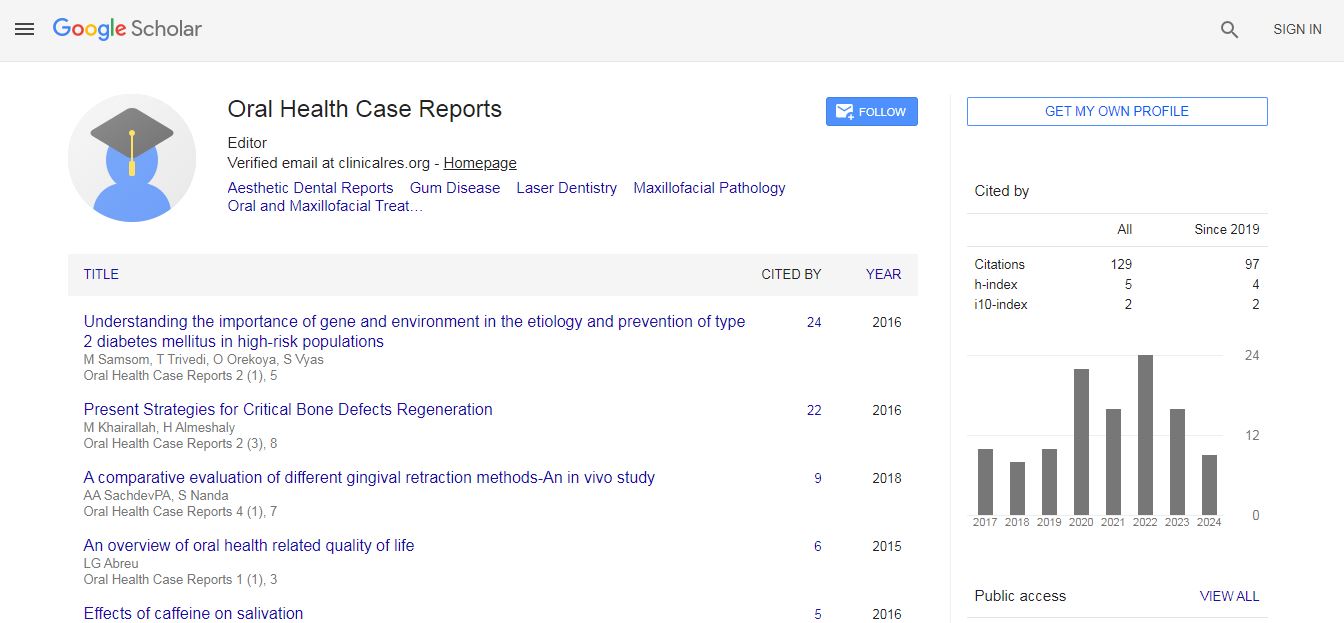
Oral Health Case Reports received 120 citations as per Google Scholar report