Commentary - (2025) Volume 10, Issue 4
Received: 01-Jul-2025, Manuscript No. apn-26-179140;
Editor assigned: 03-Jul-2025, Pre QC No. P-179140;
Reviewed: 14-Jul-2025, QC No. Q-179140;
Revised: 22-Jul-2025, Manuscript No. R-179140;
Published:
29-Jul-2025
, DOI: 10.37421/2573-0347.2025.10.439
Citation: Laurent, Sophia. âEssential APN Leadership: Skills for Better Care.â J Adv Practice Nurs 10 (2025):439.
Copyright: © 2025 Laurent S. This is an open-access article distributed under the terms of the Creative Commons Attribution License, which permits unrestricted use,
distribution and reproduction in any medium, provided the original author and source are credited.
The landscape of advanced nursing practice is increasingly characterized by the demand for robust leadership capabilities to navigate complex healthcare environments and drive meaningful advancements in patient care. Advanced Practice Nurses (APNs) are uniquely positioned to assume these leadership roles, leveraging their clinical expertise to influence practice, policy, and organizational culture. This burgeoning need necessitates a deep understanding of the specific competencies that underpin effective leadership in this domain. Strategic thinking, for instance, is paramount for APNs to anticipate future healthcare trends and position their practice for sustainable success. This involves not only clinical foresight but also an understanding of broader organizational and societal factors influencing health outcomes. The ability to develop and articulate a clear vision for nursing practice is a cornerstone of effective leadership, enabling teams to align their efforts toward common goals. Change management emerges as another critical leadership skill, as healthcare systems are in a constant state of evolution. APNs must be adept at leading their teams through transitions, fostering buy-in, and mitigating resistance to new practices or technologies. This requires a nuanced understanding of organizational dynamics and human behavior. Advocacy is intrinsically linked to APN leadership, extending beyond patient-centered care to encompass the championing of the nursing profession and the broader healthcare agenda. This involves speaking out on behalf of patients, colleagues, and systemic improvements, often requiring engagement with policymakers and other stakeholders. Interprofessional collaboration represents a fundamental competency, recognizing that optimal patient care is achieved through seamless teamwork across disciplines. APNs must be skilled in fostering positive working relationships with physicians, allied health professionals, and support staff, promoting a culture of mutual respect and shared responsibility. In parallel, the development of leadership skills within the nurse practitioner (NP) role is a subject of growing interest. Formal education and experiential learning play crucial roles in equipping NPs with the necessary behaviors for successful leadership, including effective communication and decisive decision-making. The lived experiences of clinical nurse specialists (CNSs) in leadership roles offer valuable insights into the practical challenges and rewards of advancing nursing practice. Their journeys highlight the importance of adaptability and strong interpersonal skills in navigating organizational complexities and driving positive change. The influence of emotional intelligence on APN leadership cannot be overstated. Empathetic communication, self-awareness, and adept relationship management are crucial for building trust, motivating teams, and cultivating a supportive work environment that ultimately enhances patient care quality. Transformational leadership offers a powerful framework for APNs to inspire and empower their colleagues. By adopting strategies that promote innovation and evidence-based practice, APNs can foster a culture of continuous improvement, directly impacting patient safety and outcomes. Finally, the engagement of APNs in policy development and advocacy is essential for shaping the future of healthcare. Developing competencies in political astuteness and collaborative engagement allows APNs to effectively influence health legislation and champion the needs of patients and the nursing profession.
The critical leadership competencies for advanced practice nurses (APNs) in navigating complex healthcare systems are multifaceted, encompassing strategic thinking, change management, advocacy, and interprofessional collaboration. These skills are vital for APNs to effectively lead teams, influence policy, and ultimately improve patient outcomes, translating clinical expertise into impactful leadership roles to enhance care quality and accessibility [1].
The development of leadership skills in nurse practitioners (NPs) is often achieved through formal education and experiential learning. Key leadership behaviors such as effective communication, sound decision-making, and adept conflict resolution are identified as crucial for successful NP roles, underscoring the importance of targeted leadership development programs to prepare NPs for leadership positions and advocacy efforts [2].
Qualitative studies exploring the lived experiences of clinical nurse specialists (CNSs) in leadership positions reveal the inherent challenges and rewards associated with leading practice changes, mentoring staff, and influencing organizational culture. Resilience, adaptability, and strong interpersonal skills are highlighted as essential for CNSs to effectively lead and advance nursing practice [3].
The role of emotional intelligence in advanced nursing practice leadership is significant, with empathetic communication, self-awareness, and relationship management being fundamental for APNs to build trust, motivate teams, and foster a positive work environment. Enhancing emotional intelligence is suggested to improve leadership effectiveness and contribute to better patient care [4].
Transformational leadership principles are explored in the context of advanced nursing practice, outlining how APNs can utilize these strategies to inspire and empower colleagues, promote evidence-based practice, and drive innovation. Such leadership has the potential to create a culture of continuous improvement and enhance patient safety [5].
The engagement of APNs in healthcare policy development and advocacy requires specific competencies, including political astuteness, communication skills, and collaborative engagement. These abilities are essential for APNs to effectively interact with policymakers, influence health legislation, and champion the needs of patients and the nursing profession [6].
Critical thinking and clinical reasoning skills form the bedrock of effective leadership in advanced nursing practice. APNs utilize these cognitive abilities to analyze complex patient situations, evaluate treatment options, and make informed clinical decisions, thereby leading by example and influencing best practices within their teams [7].
Interprofessional collaboration is recognized as a core leadership competency for APNs, enabling them to foster effective teamwork with physicians, allied health professionals, and other stakeholders. This collaboration is crucial for improving care coordination, patient safety, and overall healthcare outcomes, emphasizing the importance of communication, mutual respect, and shared decision-making [8].
APNs play a pivotal role in leading quality improvement initiatives within healthcare organizations. Competencies such as data analysis, project management, and change leadership are necessary for APNs to identify areas for improvement, implement evidence-based strategies, and evaluate the impact of changes on patient care and organizational performance [9].
Ethical leadership challenges faced by APNs require specific competencies in ethical decision-making, moral courage, and patient rights advocacy. An ethical framework guides APNs in providing responsible and compassionate care while leading their teams, ensuring a commitment to patient well-being and professional integrity [10].
This collection of research highlights essential leadership competencies for advanced practice nurses (APNs) and nurse practitioners (NPs). Key skills identified include strategic thinking, change management, advocacy, and interprofessional collaboration, which are crucial for navigating complex healthcare systems and improving patient care. The development of these skills is supported by formal education and experiential learning. Emotional intelligence and transformational leadership approaches are emphasized for their role in fostering positive team dynamics and driving innovation. Furthermore, the importance of critical thinking, clinical reasoning, policy engagement, quality improvement leadership, and ethical decision-making is underscored. These competencies collectively enable APNs to lead effectively, influence practice and policy, and enhance healthcare outcomes.
None
None
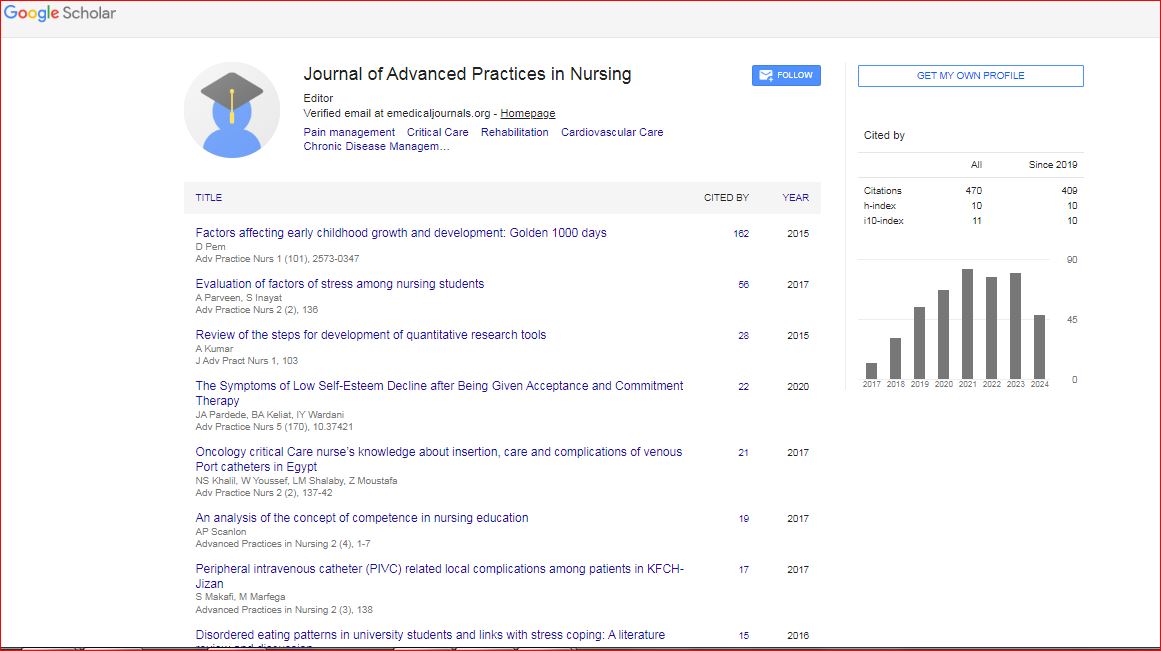
Journal of Advanced Practices in Nursing received 410 citations as per Google Scholar report