Perspective - (2025) Volume 14, Issue 4
Received: 01-Dec-2025, Manuscript No. jms-25-177893;
Editor assigned: 03-Dec-2025, Pre QC No. P-177893;
Reviewed: 17-Dec-2025, QC No. Q-177893;
Revised: 22-Dec-2025, Manuscript No. R-177893;
Published:
29-Dec-2025
, DOI: 10.37421/2167-0943.2024.13.428
Citation: Nunez, Abril. ”ESH 2023 Guidelines: Advancements in Hypertension Care.” J Metabolic Synd 14 (2025):428.
Copyright: © 2025 Nunez A. This is an open-access article distributed under the terms of the Creative Commons Attribution License, which permits unrestricted use, distribution and reproduction in any medium, provided the original author and source are credited.
The 2023 European Society of Hypertension guidelines provide updated recommendations for diagnosing and managing arterial hypertension [1].
These guidelines cover various aspects including blood pressure measurement techniques, treatment thresholds, lifestyle interventions, and pharmacological strategies, all aimed at reducing cardiovascular risk and improving patient outcomes [1].
In line with evolving medical understanding, recent advancements in hypertension management are increasingly focusing on personalized approaches [2].
This includes integrating new pharmacological agents, improved blood pressure monitoring technologies, and refined treatment algorithms [2].
The ultimate goal here is to enhance treatment efficacy and improve patient outcomes through precision medicine [2].
Understanding the global burden of hypertension is paramount for effective public health strategies [3].
Detailed analyses of worldwide data illuminate prevalence, incidence, and associated risk factors, revealing significant regional disparities and highlighting the escalating challenge hypertension presents to healthcare systems around the globe [3].
Beyond global epidemiology, specific lifestyle factors like dietary sodium and potassium intake play a crucial role in blood pressure regulation [4].
Reviews in this area delve into the physiological mechanisms and clinical outcomes linked to these electrolytes, offering insights into effective dietary interventions for both prevention and management of hypertension [4].
However, not all hypertension cases are straightforward; resistant hypertension, characterized by uncontrolled blood pressure despite optimal treatment with three or more antihypertensive drugs, remains a significant clinical challenge [5].
Detailed studies address the diagnostic workup, evaluation of secondary causes, and comprehensive management strategies required for this complex condition [5].
The genetic underpinnings of hypertension are also complex and varied [6].
Current research explores genetic determinants, including single nucleotide polymorphisms and gene-environment interactions [6].
This emerging field of pharmacogenomics is becoming increasingly important in guiding personalized antihypertensive therapy [6].
A critical aspect of hypertension's impact is its strong association with chronic kidney disease (CKD) [7].
Hypertension acts as a major risk factor for CKD, and paradoxically, CKD can exacerbate hypertension, creating a difficult vicious cycle [7].
Research in this area meticulously examines the intricate relationship between these two conditions, covering pathophysiology, diagnostic challenges, and therapeutic strategies focused on preserving renal function [7].
In a rapidly advancing world, digital health interventions are offering innovative solutions for managing hypertension [8].
Reviews evaluate a range of digital tools, such as mobile applications, wearable devices, and telehealth platforms, assessing their effectiveness in areas like improving blood pressure control, medication adherence, and patient engagement [8].
Another important aspect influencing cardiovascular outcomes in hypertensive patients, independent of mean blood pressure, is blood pressure variability (BPV) [9].
Investigations into BPV explore its clinical significance, both short-term and long-term, its measurement methodologies, and the crucial implications it holds for risk stratification and the development of tailored treatment strategies [9].
Lastly, primary aldosteronism stands out as a common, yet frequently undiagnosed, cause of secondary hypertension [10].
Updated reviews shed light on the latest diagnostic protocols, including essential screening tests and confirmatory procedures [10].
They also discuss contemporary treatment options, emphasizing targeted therapies designed to achieve improved patient outcomes [10].
The landscape of arterial hypertension management is in constant flux, significantly shaped by comprehensive updates. For instance, the 2023 European Society of Hypertension (ESH) guidelines offer detailed recommendations crucial for both diagnosing and effectively managing this prevalent condition [1]. These guidelines extend to cover a spectrum of critical areas: they provide specific guidance on precise blood pressure measurement techniques, establish clear treatment thresholds, promote various lifestyle interventions, and outline optimal pharmacological strategies. Each recommendation is meticulously crafted with the primary aim of reducing overall cardiovascular risk and ultimately improving patient outcomes [1]. In parallel with these foundational guidelines, recent advancements are pushing hypertension management towards increasingly personalized approaches. This paradigm shift involves the thoughtful integration of innovative pharmacological agents, the deployment of more sophisticated blood pressure monitoring technologies, and the refinement of existing treatment algorithms. The overarching objective of these updates is to substantially enhance treatment efficacy and improve individual patient outcomes, a goal that aligns perfectly with the principles of precision medicine [2].
From a broader public health perspective, understanding the global burden of hypertension is absolutely fundamental. Extensive analysis of worldwide data on its prevalence, incidence, and associated risk factors vividly reveals significant regional disparities, serving to underscore the escalating challenge hypertension presents to healthcare systems across the globe [3]. Amidst this global context, specific complex presentations of hypertension demand specialized attention. Resistant hypertension, which is clinically defined by uncontrolled blood pressure even after optimal treatment with three or more antihypertensive drugs from different classes, represents a particularly challenging clinical scenario. Managing this condition effectively necessitates a meticulous diagnostic workup to identify contributing factors, a comprehensive evaluation for any underlying secondary causes, and the implementation of robust, multifaceted management strategies [5]. Moreover, primary aldosteronism often stands as a common, yet frequently underdiagnosed, cause of secondary hypertension. Recent updated reviews are vital in elucidating the latest diagnostic protocols, which include essential screening tests and confirmatory procedures. They also detail contemporary treatment options, placing a strong emphasis on targeted therapies engineered for improved patient outcomes in this specific etiology of hypertension [10].
Delving deeper into the etiology of hypertension, several fundamental physiological and genetic factors are recognized as playing pivotal roles. Dietary intake, particularly of sodium and potassium, demonstrably influences blood pressure regulation. Research in this domain meticulously explores the intricate physiological mechanisms and observable clinical outcomes directly linked to these essential electrolytes. This body of work provides invaluable insights into practical dietary interventions that can be effectively employed for both the prevention and ongoing management of hypertension [4]. Simultaneously, the genetic underpinnings of hypertension are widely acknowledged as complex and remarkably varied. Contemporary reviews in this field systematically explore the current understanding of genetic determinants, encompassing crucial elements such as single nucleotide polymorphisms (SNPs) and the dynamic interactions between genes and environmental factors. This evolving understanding is fueling the emerging field of pharmacogenomics, which holds considerable promise in guiding the development of highly personalized antihypertensive therapies, moving towards treatments tailored to an individual's unique genetic profile [6].
The intricate web of hypertension's impact extends to its strong association with other significant health conditions. Hypertension is well-established as a major risk factor for the development and progression of chronic kidney disease (CKD). Conversely, CKD itself can further exacerbate existing hypertension, creating a challenging and often self-perpetuating vicious cycle between the two conditions. Consequently, a detailed examination of their shared pathophysiology, the diagnostic complexities involved, and the development of targeted therapeutic strategies aimed at preserving renal function are paramount for effective patient care [7]. Beyond overt organ damage, another crucial prognostic indicator in hypertensive patients is blood pressure variability (BPV). Studies indicate that BPV, whether short-term or long-term, acts as an important independent predictor of cardiovascular outcomes, distinct from an individual's average blood pressure. Understanding the clinical significance of BPV, reliable methods for its measurement, and its far-reaching implications for accurate risk stratification and the formulation of personalized treatment strategies is increasingly essential for optimal management [9].
Embracing technological advancements, digital health interventions are presenting truly innovative solutions for the modern management of hypertension. This rapidly expanding field involves a diverse array of digital tools, which critically include user-friendly mobile applications, sophisticated wearable devices capable of continuous monitoring, and accessible telehealth platforms. Extensive reviews are currently evaluating the effectiveness of these digital tools in several key areas. They assess their capacity to improve overall blood pressure control, enhance patient adherence to medication regimens, and boost active patient engagement in their own care. These interventions offer promising new avenues for comprehensive and proactive hypertension management, potentially transforming how patients interact with their treatment plans and healthcare providers [8].
The latest 2023 European Society of Hypertension (ESH) guidelines offer comprehensive recommendations for diagnosing and managing arterial hypertension, covering blood pressure measurement, treatment thresholds, lifestyle, and pharmacological strategies to reduce cardiovascular risk and improve outcomes. This is complemented by recent advancements focusing on personalized approaches, new drugs, improved monitoring, and refined algorithms, aiming for enhanced efficacy through precision medicine. Understanding the global burden of hypertension is crucial, with analyses of worldwide prevalence, incidence, and risk factors revealing regional disparities and escalating healthcare challenges. Dietary factors like sodium and potassium intake significantly influence blood pressure, with insights into physiological mechanisms guiding prevention and management. Complex conditions such as resistant hypertension, defined by uncontrolled blood pressure despite optimal multi-drug treatment, require detailed diagnostic workup and tailored management strategies. The genetic underpinnings of hypertension, including single nucleotide polymorphisms and gene-environment interactions, are being explored, with pharmacogenomics guiding personalized therapy. Hypertension also has a critical link with chronic kidney disease (CKD), forming a vicious cycle that demands specific therapeutic strategies to preserve renal function. Digital health interventions, including mobile apps, wearables, and telehealth, offer innovative solutions for improving blood pressure control, adherence, and patient engagement. Blood pressure variability (BPV) is recognized as an independent predictor of cardiovascular outcomes, necessitating understanding of its measurement and implications for risk stratification. Finally, primary aldosteronism, an often-undiagnosed cause of secondary hypertension, requires updated diagnostic protocols and targeted therapies for improved patient outcomes.
None
None
Indexed at, Google Scholar, Crossref
Indexed at, Google Scholar, Crossref
Indexed at, Google Scholar, Crossref
Indexed at, Google Scholar, Crossref
Indexed at, Google Scholar, Crossref
Indexed at, Google Scholar, Crossref
Indexed at, Google Scholar, Crossref
Indexed at, Google Scholar, Crossref
Indexed at, Google Scholar, Crossref
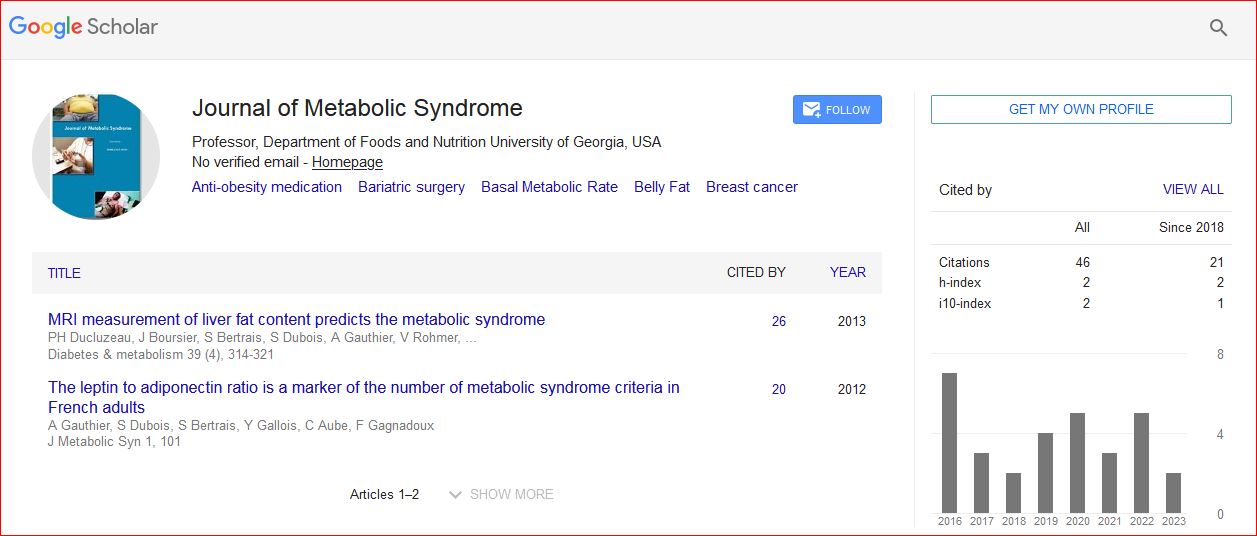
Journal of Metabolic Syndrome received 48 citations as per Google Scholar report