Brief Report - (2025) Volume 14, Issue 2
Received: 01-Apr-2025, Manuscript No. jbfa-25-174129;
Editor assigned: 03-Apr-2025, Pre QC No. P-174129;
Reviewed: 17-Apr-2025, QC No. Q-174129;
Revised: 22-Apr-2025, Manuscript No. R-174129;
Published:
29-Apr-2025
, DOI: 10.37421/2167-0234.2025.14.519
Citation: Grant, Alexander. ”ESG, Tech, Governance: Pillars of Profitability.” J Bus Fin Aff 14 (2025):519.
Copyright: © 2025 Grant A. This is an open-access article distributed under the terms of the Creative Commons Attribution License, which permits unrestricted use, distribution and reproduction in any medium, provided the original author and source are credited.
This study, a meta-analysis, really shows a consistent positive relationship between a firm's environmental, social, and governance (ESG) performance and its financial results. What this means is companies doing well on ESG measures tend to see better stock market returns, stronger operational efficiency, and improved accounting performance. The positive effect is more pronounced in developed markets and for firms with stronger corporate governance, which makes sense when you think about stakeholder pressures and regulatory environments.[1] This paper investigates how going digital impacts the financial performance of Small and Medium-sized Enterprises (SMEs), with innovation capabilities playing a crucial middle role. What they found is interesting: while digitalization itself can boost financial performance, its full potential is really unlocked when it enhances a firm's ability to innovate. This suggests that just adopting digital tools isn't enough; SMEs need to integrate them into their innovation processes to see significant financial gains.[2] Here's the thing about corporate social responsibility (CSR) disclosure and financial performance in Saudi Arabia: this study found that when companies share more about their CSR efforts, it actually improves their financial standing, particularly in terms of profitability and market value. It looks like transparency around social and environmental initiatives isn't just good for society; it's also a smart business move, especially for firms aiming for sustained growth.[3] What this study reveals about Latin American firms is pretty telling: both CEO characteristics and the diversity of the board play significant roles in a company's financial performance. Specifically, CEO attributes like educational background and tenure, alongside board diversity in terms of gender and independence, really influence profitability and market value. It highlights the idea that who leads and governs a company matters immensely for its bottom line.[4] Let's break down how green supply chain management (GSCM) affects financial performance: this meta-analysis indicates a clear positive link. Companies that actively adopt green practices throughout their supply chainsâ??from eco-design to reverse logisticsâ??tend to see improved financial outcomes. This really means that environmental responsibility isn't just about compliance; it can be a competitive advantage that translates into better profits and market standing.[5] This research looks at how adopting Artificial Intelligence (AI) impacts the financial performance of manufacturing firms. The key takeaway is that integrating AI technologies can significantly improve profitability and efficiency. What's more, the benefits aren't uniform; they depend on how well a firm can strategically implement AI and whether it has the right organizational structure to support it. This shows that AI isn't a silver bullet, but a powerful tool when used thoughtfully.[6] This literature review takes a deep dive into the connection between corporate governance and a company's financial performance. It's clear that strong governance mechanisms, like independent boards and effective audit committees, tend to positively influence firm value and profitability. What this really means is that how a company is steered and overseen is crucial not just for ethical reasons, but for its financial health and long-term sustainability.[7] This meta-analysis focuses on intellectual capital and its influence on financial performance. The key finding is a robust positive relationship: companies that effectively manage and leverage their intellectual assetsâ??things like human capital, structural capital, and relational capitalâ??consistently achieve better financial results. What this really means is that in today's knowledge-driven economy, investing in and developing these intangible assets is just as crucial, if not more, than traditional tangible assets for boosting the bottom line.[8] This study delves into how technological innovation impacts financial performance, especially considering market competition. The key finding is that while innovation generally boosts financial performance, the intensity of market competition can either enhance or diminish this effect. This means firms in highly competitive markets might need a more nuanced innovation strategy to truly translate their technological advancements into superior financial results.[9] This research examines the critical role of enterprise risk management (ERM) in shaping financial performance, particularly during the unprecedented challenges of the COVID-19 pandemic. What they found is compelling: firms with robust ERM frameworks generally demonstrated greater financial resilience and better performance compared to those with weaker risk management during the crisis. This really highlights ERM not just as a compliance function, but as a strategic asset for navigating uncertainty and safeguarding profitability.[10]
The relationship between corporate practices and financial performance is a central theme in recent academic discourse. Companies that demonstrate strong environmental, social, and governance (ESG) performance consistently show a positive link to financial results, including better stock market returns and operational efficiency. This effect is often more pronounced in developed markets and for firms with robust corporate governance, reflecting the impact of stakeholder pressures and regulatory environments [1]. Similarly, transparent corporate social responsibility (CSR) disclosure significantly improves financial standing, particularly profitability and market value, suggesting that sharing social and environmental initiatives is a smart business move for sustained growth [3].
Beyond individual firm actions, green supply chain management (GSCM), encompassing practices from eco-design to reverse logistics, also positively impacts financial outcomes. This positions environmental responsibility as a competitive advantage rather than just compliance, translating directly into better profits and market standing [5].
Technological adoption presents another powerful avenue for financial enhancement. Digitalization, particularly for Small and Medium-sized Enterprises (SMEs), can substantially boost financial performance. However, its full potential is realized when digitalization actively enhances a firm's innovation capabilities, implying that integrating digital tools into core innovation processes is key for significant financial gains [2]. In manufacturing firms, adopting Artificial Intelligence (AI) technologies can improve profitability and efficiency. Yet, its benefits are not universal; they depend on strategic implementation and suitable organizational structures [6]. Additionally, while technological innovation generally contributes to better financial performance, the intensity of market competition can either magnify or diminish this effect, necessitating a nuanced innovation strategy in competitive landscapes [9].
Leadership and governance structures are crucial determinants of financial success. A literature review highlights that strong corporate governance mechanisms, such as independent boards and effective audit committees, positively influence firm value and profitability, underscoring their importance for both ethical conduct and long-term financial health [7]. Evidence from Latin American firms further illustrates this, showing that CEO characteristics like educational background and tenure, along with board diversity in terms of gender and independence, significantly impact profitability and market value. This emphasizes that effective leadership and diverse governance are fundamental to a company's bottom line [4].
Finally, managing intangible assets has emerged as a critical factor. Intellectual capital, encompassing human, structural, and relational capital, shows a robust positive relationship with financial performance. Companies that effectively manage and leverage these intellectual assets consistently achieve better financial results, highlighting that investing in and developing these intangible resources is increasingly crucial in knowledge-driven economies [8]. Furthermore, the strategic importance of enterprise risk management (ERM) became particularly evident during the COVID-19 pandemic. Firms with strong ERM frameworks demonstrated greater financial resilience and superior performance during the crisis, proving ERM to be a strategic asset for navigating uncertainty and safeguarding profitability, rather than merely a compliance function [10].
Companies face a complex landscape where diverse factors shape their financial success. Research indicates that prioritizing sustainability initiatives, such as strong environmental, social, and governance (ESG) performance and transparent corporate social responsibility (CSR) disclosures, consistently correlates with improved financial outcomes, including better stock market returns and operational efficiency. Green supply chain management further reinforces this trend, showing that ecological responsibility can be a competitive advantage leading to higher profits. Beyond sustainability, technological adoption plays a critical role. Digitalization significantly boosts Small and Medium-sized Enterprises (SMEs) financial performance, especially when integrated with innovation capabilities. Similarly, the strategic implementation of Artificial Intelligence (AI) can enhance manufacturing firms' profitability and efficiency, though its impact depends on organizational structure and deployment strategy. Technological innovation generally improves financial results, but market competition can modulate this effect, requiring nuanced approaches. Internal organizational dynamics are equally important. Effective corporate governance, characterized by independent boards and audit committees, directly influences firm value and profitability. Leadership attributes, like CEO characteristics and board diversity, are also crucial for a company's bottom line. Finally, managing intangible assets, such as intellectual capital, consistently leads to better financial results in knowledge-driven economies. Robust enterprise risk management frameworks are essential for navigating uncertainties, as seen during the COVID-19 pandemic, safeguarding profitability and demonstrating resilience.
None
None
Indexed at, Google Scholar, Crossref
Indexed at, Google Scholar, Crossref
Indexed at, Google Scholar, Crossref
Indexed at, Google Scholar, Crossref
Indexed at, Google Scholar, Crossref
Indexed at, Google Scholar, Crossref
Indexed at, Google Scholar, Crossref
Indexed at, Google Scholar, Crossref
Indexed at, Google Scholar, Crossref
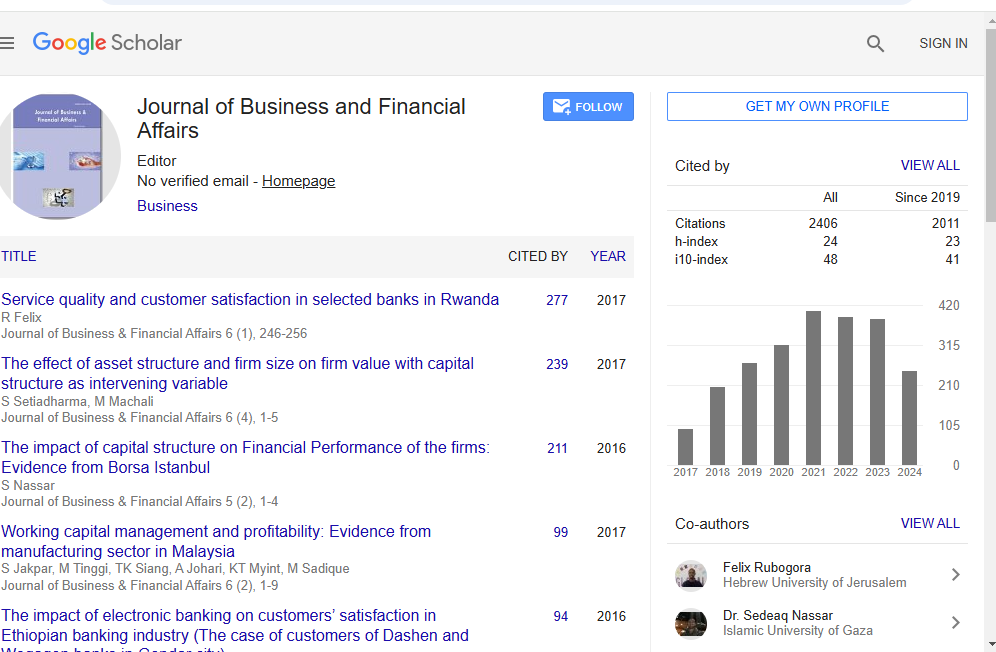
Journal of Business & Financial Affairs received 1726 citations as per Google Scholar report