Opinion - (2025) Volume 14, Issue 6
Received: 01-Dec-2025, Manuscript No. jsp-26-182286;
Editor assigned: 03-Dec-2025, Pre QC No. P-182286;
Reviewed: 17-Dec-2025, QC No. Q-182286;
Revised: 22-Dec-2025, Manuscript No. R-182286;
Published:
29-Dec-2025
, DOI: 10.37421/2165-7939.2025.14.752
Citation: Bennett, Matthew S.. ”Ergonomics: Your Spine’s Best Defense.” J Spine 14 (2025):752.
Copyright: © 2025 Bennett S. Matthew This is an open-access article distributed under the terms of the Creative Commons Attribution License, which permits unrestricted use, distribution and reproduction in any medium, provided the original author and source are credited.
Ergonomics is fundamental to maintaining spinal health, playing a critical role in mitigating biomechanical stress during daily activities and in professional settings [1].
By focusing on proper posture, effective workstation design, and safe lifting techniques, individuals can significantly lower their susceptibility to musculoskeletal disorders, including prevalent issues like back pain and disc injuries. A solid understanding of ergonomic principles empowers individuals to proactively adapt their environments and behaviors, thereby fostering greater spinal well-being. The pervasive influence of prolonged sitting on spinal loading and the subsequent development of lower back pain represents a significant public health concern in modern society [2].
Ergonomic interventions specifically aimed at reducing sedentary time, encouraging regular movement breaks, and optimizing the configuration of chairs and desks are crucial for alleviating undue pressure on the lumbar spine and preventing the onset of chronic spinal issues. Workstation ergonomics, particularly within the context of office environments, exhibits a direct and profound link to overall spinal health [3].
The strategic implementation of adjustable desks, ergonomically designed chairs, and appropriately positioned monitors is paramount in establishing a supportive workspace. Such a setup effectively reduces strain on the neck, shoulders, and back, ultimately preventing the occurrence of common occupational injuries. Manual handling and lifting techniques are identified as critical determinants in the prevention of acute spinal injuries across a diverse range of occupational settings [4].
Comprehensive ergonomic training that meticulously emphasizes proper body mechanics, thorough load assessment, and the judicious use of lifting aids can substantially decrease the incidence rates of debilitating back sprains and strains. The role of posture in sustaining optimal spine health is unequivocally significant, and it is ergonomic principles that effectively guide individuals in achieving and consistently maintaining ideal postural alignment [5].
This crucial aspect encompasses cultivating an acute awareness of natural spinal curves and adopting postures that ensure an even distribution of load, thereby averting excessive stress on delicate spinal structures. Ergonomic considerations are of paramount importance in the design of vehicles, especially for professional drivers, as they directly contribute to the prevention of occupational back pain [6].
Factors such as the design of the driver's seat, the thoughtful layout of the dashboard, and effective vibration reduction strategies all play a vital role in diminishing the biomechanical forces exerted on the spine during extended periods of operation. The well-established connection between repetitive tasks and increased spinal strain underscores the necessity for targeted ergonomic solutions [7].
The implementation of strategies such as optimizing tool design, reducing the force requirements for tasks, and incorporating varied movements can effectively mitigate the inherent risk of cumulative trauma disorders that specifically affect the spine. Ergonomic principles are also extensively applied within the fields of physical therapy and rehabilitation for individuals managing spinal conditions [8].
The integration of therapeutic exercises and precise postural correction, guided by a deep ergonomic understanding, can significantly accelerate the recovery process and enhance long-term spinal functionality. The evolving landscape of technological advancements presents new challenges and opportunities for workstation ergonomics and, consequently, spine health [9].
The introduction of novel tools and software necessitates diligent ergonomic evaluation to ensure that these innovations do not inadvertently introduce new risks for spinal injury. Ultimately, designing for optimal spine health demands a comprehensive and holistic ergonomic approach that seamlessly integrates fundamental biomechanical principles with the unique needs of individuals and the specific demands of their tasks [10].
This encompasses not only the implementation of physical modifications but also the crucial provision of education and the encouragement of behavioral changes to promote sustained spinal well-being.
Ergonomics is recognized as a cornerstone in the preservation of spinal health, primarily by minimizing biomechanical stress during both routine daily activities and demanding workplace environments [1].
The adoption of proper posture, the thoughtful design of workstations, and the application of safe lifting techniques are all instrumental in substantially reducing the risk of developing musculoskeletal disorders, such as back pain and disc injuries. Acquiring knowledge of ergonomic principles equips individuals with the capacity to modify their surroundings and behaviors in ways that actively support and enhance spinal well-being. The detrimental effects of prolonged sitting on spinal loading and the consequent emergence of lower back pain are a subject of considerable concern in contemporary life [2].
Ergonomic interventions that prioritize the reduction of sedentary time, encourage regular movement breaks, and ensure optimal chair and desk setups are vital for relieving pressure on the lumbar spine and preventing the development of chronic spinal ailments. In office settings, workstation ergonomics is directly and powerfully correlated with the maintenance of spinal health [3].
The judicious use of adjustable desks, ergonomically designed chairs, and correctly positioned monitors is essential for creating a workspace that provides adequate support and minimizes strain on the neck, shoulders, and back, thereby averting common occupational injuries. Manual handling and the techniques employed for lifting are crucial factors in preventing acute spinal injuries across a wide array of occupational contexts [4].
Engaging in ergonomic training that thoroughly covers proper body mechanics, careful assessment of loads, and the effective utilization of lifting aids can lead to a significant reduction in the occurrence of back sprains and strains. The integral role of posture in maintaining spine health is undeniable, and it is the application of ergonomic principles that guides individuals toward achieving and sustaining optimal postural alignment [5].
This involves fostering a keen awareness of the natural spinal curves and adopting postures that ensure an equitable distribution of load, which in turn prevents undue stress on the spinal structures. Within the automotive industry, ergonomic considerations in vehicle design, particularly for professional drivers, are of utmost importance in the prevention of occupational back pain [6].
Key elements such as the design of the driver's seat, the arrangement of the dashboard, and measures to reduce vibration all contribute significantly to lessening the biomechanical forces acting upon the spine during prolonged driving periods. The established relationship between repetitive tasks and increased spinal strain highlights the need for effective ergonomic solutions [7].
These solutions, which may include refining tool design, decreasing the physical force required for tasks, and integrating varied movements, are designed to mitigate the risk of cumulative trauma disorders that can impact the spine. Ergonomic principles are widely applied in the field of physical therapy and rehabilitation for individuals suffering from various spinal conditions [8].
By employing therapeutic exercises and postural correction techniques informed by ergonomic understanding, the process of recovery can be accelerated, leading to improved long-term spinal function. The ongoing advancements in technology present unique ergonomic challenges and necessitate innovative solutions concerning workstation design and, by extension, spine health [9].
New tools and software require thorough ergonomic assessment to confirm they do not introduce novel risks for spinal injury. Fundamentally, the design process for promoting spine health must adopt a holistic ergonomic approach, integrating biomechanical principles with individual requirements and the specific demands of different tasks [10].
This comprehensive strategy includes not only physical adjustments but also vital educational components and the promotion of behavioral changes to ensure the long-term sustainability of spinal well-being.
Ergonomics is critical for spinal health, reducing stress and preventing musculoskeletal disorders through proper posture, workstation design, and safe lifting techniques. Prolonged sitting negatively impacts spinal loading, highlighting the need for ergonomic interventions like movement breaks and optimized setups. Office workstations require ergonomic adjustments to prevent neck, shoulder, and back strain. Manual handling and lifting techniques are key to avoiding acute spinal injuries, with ergonomic training proving effective. Posture's role in spine health is guided by ergonomic principles for even load distribution. Vehicle design, especially driver seats and vibration reduction, is crucial for preventing occupational back pain. Repetitive tasks increase spinal strain, necessitating ergonomic solutions like tool design improvements and varied movements. Ergonomics also plays a role in physical therapy and rehabilitation for spinal conditions, accelerating recovery. Technological advancements require ergonomic evaluation to avoid new spinal injury risks. A holistic ergonomic approach, combining biomechanics, individual needs, and education, is essential for sustainable spinal well-being.
None
None
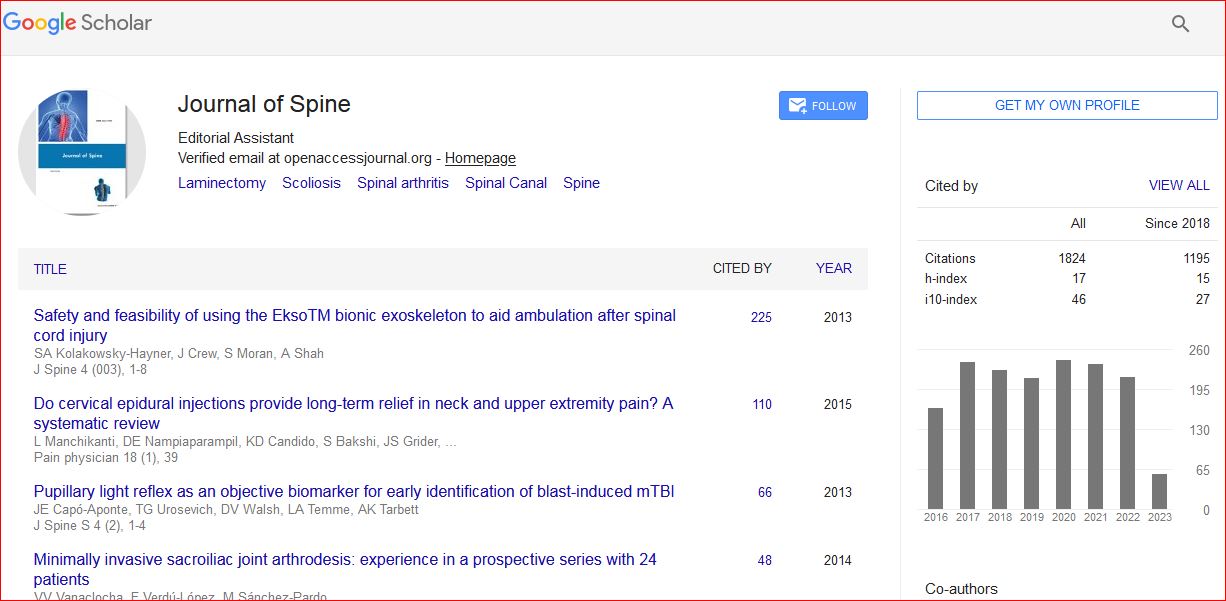
Journal of Spine received 2022 citations as per Google Scholar report