Perspective - (2025) Volume 11, Issue 3
Received: 01-Jun-2025, Manuscript No. elj-25-173005;
Editor assigned: 03-Jun-2025, Pre QC No. P-173005;
Reviewed: 17-Jun-2025, QC No. Q-173005;
Revised: 23-Jun-2025, Manuscript No. R-173005;
Published:
30-Jun-2025
, DOI: 10.37421/2472-0895.2025.11.330
Citation: Blythe, Rowan. ”Epilepsy Seizure Onset: Research, Prediction, Therapy.” Epilepsy J 11 (2025):330.
Copyright: © 2025 Blythe R. This is an open-access article distributed under the terms of the Creative Commons Attribution License, which permits unrestricted use, distribution and reproduction in any medium, provided the original author and source are credited.
When you look at how a seizure starts, computational models offer a real insight into that brain's transition from a stable state to an ictal one. These models often highlight crucial mechanisms like declining inhibition or rising excitability, really showing how the system hits a critical point and crosses into sustained seizure activity [1].
This modeling approach provides a fundamental understanding of the underlying biophysical processes that lead to epileptic activity, suggesting targets for therapeutic intervention by identifying the precise conditions under which the brain's electrical activity destabilizes. This study leveraged stereo-EEG to really dig into how seizures begin in genetic generalized epilepsies. What they found were quite distinct electrical patterns compared to focal epilepsies, often showing a quick, widespread engagement across both sides of the brain's networks [2].
This distinction is important because it informs diagnosis and treatment strategies, as the diffuse nature of onset in generalized epilepsies necessitates different clinical approaches than those targeting a specific focal point. Here's the thing about high-frequency oscillations: they might just be key biomarkers. Researchers are looking at them not just to pinpoint where a seizure starts, but also to understand how it spreads, which is super useful when planning surgery [3].
Identifying these subtle electrical signals offers a promising avenue for improving surgical outcomes by more precisely delineating the epileptogenic zone, thereby enhancing the efficacy of resective procedures. This work really opens up new possibilities. By combining dynamic functional connectivity with machine learning, they've found a way to decode when seizures might start and when they might end. What this really means is we're moving closer to smart devices that can predict and even prevent seizures [4].
Such predictive capabilities would revolutionize epilepsy management, allowing for timely interventions that could mitigate or even avert impending seizures, significantly improving patients' quality of life. Using stereo-EEG, this investigation mapped out how seizures start and spread in individuals with Tuberous Sclerosis Complex. It really highlighted that seizure patterns can vary quite a bit, making it tricky but important to accurately identify where the epilepsy originates [5].
The variability underscores the complexity of epilepsy in such syndromes, demanding highly individualized approaches to diagnosis and treatment to ensure the best possible outcomes for patients. This study showed just how dynamic brain networks are as a seizure begins in focal epilepsy. What often happens is you see a strengthening of local connections first, then a wider recruitment of the network, which tells us a lot about how these seizures build and spread [6].
Understanding these evolving network dynamics provides critical insights into the pathophysiology of focal seizures, offering potential targets for therapies that aim to disrupt the recruitment process. Researchers looked at specific seizure onset patterns in focal cortical dysplasia and their connection to how well surgery works. It turns out certain patterns can actually predict a better outcome after removing the affected brain tissue [7].
This prognostic value is invaluable for surgical planning, enabling clinicians to make more informed decisions about patient selection and expected benefits from resective surgery, thereby optimizing patient care. This paper introduces a deep learning method to automatically spot different ways seizures begin from intracranial EEG recordings. This could really boost how accurately we diagnose and figure out where in the brain a seizure is starting [8].
Automated detection with deep learning has the potential to overcome the limitations of manual analysis, providing consistent and rapid identification of onset patterns, which is crucial for efficient and effective clinical decision-making. This article dives into the thalamus's role in initiating and spreading seizures, using intracranial EEG data. It shows that the thalamus is dynamically involved, influencing how excitable the cortex is and basically helping drive the seizure activity [9].
Pinpointing the thalamus's active contribution deepens our understanding of subcortical influences on seizure generation and propagation, opening new avenues for neuromodulation strategies. To get a clearer picture of the seizure onset zone in drug-resistant epilepsy, this study used directed functional connectivity analysis on intracranial EEG. It really provides a more refined understanding of the network dynamics that kick off a seizure [10].
This advanced analytical technique is essential for precise localization in challenging cases of drug-resistant epilepsy, where defining the seizure onset zone is paramount for successful surgical intervention.
Understanding how seizures emerge from a stable brain state is a complex challenge, one that computational models are uniquely positioned to address. These models offer a powerful lens into the brain's transition to an ictal state, highlighting critical shifts such as declining inhibition or rising excitability [1]. They demonstrate how the neural system can reach a tipping point, leading to sustained seizure activity. What this really means is that by simulating brain dynamics, researchers can pinpoint the fundamental biophysical changes that initiate a seizure, providing insights that are difficult to obtain through direct observation alone.
The presentation of seizure onset varies significantly across different epilepsy types. For instance, studies using stereo-EEG have illuminated distinct electrical patterns in genetic generalized epilepsies, often characterized by a rapid, widespread engagement across both sides of the brain's networks, which stands apart from patterns seen in focal epilepsies [2]. Similarly, in conditions like Tuberous Sclerosis Complex, stereo-EEG investigations reveal a diverse range of seizure onset and propagation patterns, emphasizing the need for precise identification of the epilepsy's origin due to this inherent variability [5]. In focal epilepsy, researchers have observed dynamic changes in brain networks during seizure onset. Thereâ??s often an initial strengthening of local connections, followed by a broader recruitment of the network, which helps us understand how these seizures build and spread [6]. Furthermore, specific seizure onset patterns in focal cortical dysplasia have been linked to predictive value for surgical outcomes, indicating that certain patterns can signal a better prognosis after the removal of affected brain tissue [7].
Innovation in diagnostic and predictive technologies is rapidly transforming epilepsy care. High-frequency oscillations (HFOs), for example, are proving to be key biomarkers. Researchers are looking at HFOs not just to pinpoint where a seizure starts, but also to understand how it spreads, making them incredibly useful for surgical planning [3]. On the predictive front, combining dynamic functional connectivity with machine learning techniques has opened up new possibilities. This approach has shown the ability to decode both seizure onset and termination, meaning we're getting closer to developing smart devices that can predict and even prevent seizures from happening [4]. Expanding on this, deep learning methods are now being introduced to automatically detect various seizure onset patterns directly from intracranial EEG recordings [8]. This automation could significantly boost the accuracy of diagnosis and the precise localization of seizure foci. To get an even clearer picture of the seizure onset zone in drug-resistant epilepsy, directed functional connectivity analysis on intracranial EEG is being utilized, offering a more refined understanding of the complex network dynamics involved in initiating a seizure [10].
Beyond localized patterns, the broader brain network and specific deep brain structures play crucial roles. The thalamus, for instance, is dynamically involved in initiating and spreading seizures, as insights from intracranial EEG data reveal. It actively influences cortical excitability, basically helping to drive the seizure activity [9]. This highlights that seizure generation is not always confined to a focal cortical area but can involve complex interactions across subcortical and cortical regions. The detailed understanding gained from all these studiesâ??from identifying biomarkers like HFOs [3], predicting onset with machine learning [4], to precisely characterizing onset zones [10]â??is incredibly valuable. What this really means is that this cumulative knowledge directly supports efforts to improve surgical planning for drug-resistant epilepsy, guiding more effective resection and potentially leading to better post-surgical outcomes [7]. Ultimately, the goal is to develop more accurate diagnostic tools and sophisticated interventions, moving towards a future where seizures can be better managed, predicted, and even prevented.
Understanding how seizures begin is a big deal in epilepsy research, with various approaches shedding light on this complex brain event. Computational models offer real insight into the brain's transition from a stable to an ictal state, often highlighting crucial mechanisms like declining inhibition or rising excitability that push the system to a critical point and into sustained seizure activity. Researchers frequently employ stereo-EEG to meticulously map out seizure onset and propagation patterns, revealing distinct electrical signatures. For instance, studies on genetic generalized epilepsies have shown quick, widespread engagement across brain networks, contrasting with focal epilepsies. Similarly, investigations in Tuberous Sclerosis Complex demonstrate varied seizure patterns, emphasizing the need for accurate identification of the epilepsy's origin. Another important area focuses on high-frequency oscillations (HFOs), which are increasingly recognized as key biomarkers. These oscillations are valuable for not only pinpointing where a seizure starts but also for understanding how it spreads, which is incredibly useful for planning surgical interventions. On the technological front, combining dynamic functional connectivity with advanced machine learning techniques offers new possibilities to decode seizure onset and termination. What this really means is we are moving closer to developing smart devices capable of predicting and potentially preventing seizures. Furthermore, the field is seeing the introduction of deep learning methods to automatically detect different seizure onset patterns from intracranial EEG recordings, which significantly boosts diagnostic accuracy and the ability to localize seizure origins. Investigations into specific brain regions highlight the thalamus's dynamic involvement in initiating and spreading seizures, influencing cortical excitability. In focal epilepsy, dynamic brain network changes during seizure onset show a progression from local connection strengthening to wider network recruitment. This detailed understanding of network dynamics, including directed functional connectivity analysis on intracranial EEG, helps characterize seizure onset zones in drug-resistant epilepsy, providing a more refined picture. Ultimately, this collective research aims to improve diagnosis, refine surgical strategies, and pave the way for predictive and preventive therapies for epilepsy.
None
None
Indexed at, Google Scholar, Crossref
Indexed at, Google Scholar, Crossref
Indexed at, Google Scholar, Crossref
Indexed at, Google Scholar, Crossref
Indexed at, Google Scholar, Crossref
Indexed at, Google Scholar, Crossref
Indexed at, Google Scholar, Crossref
Indexed at, Google Scholar, Crossref
Indexed at, Google Scholar, Crossref
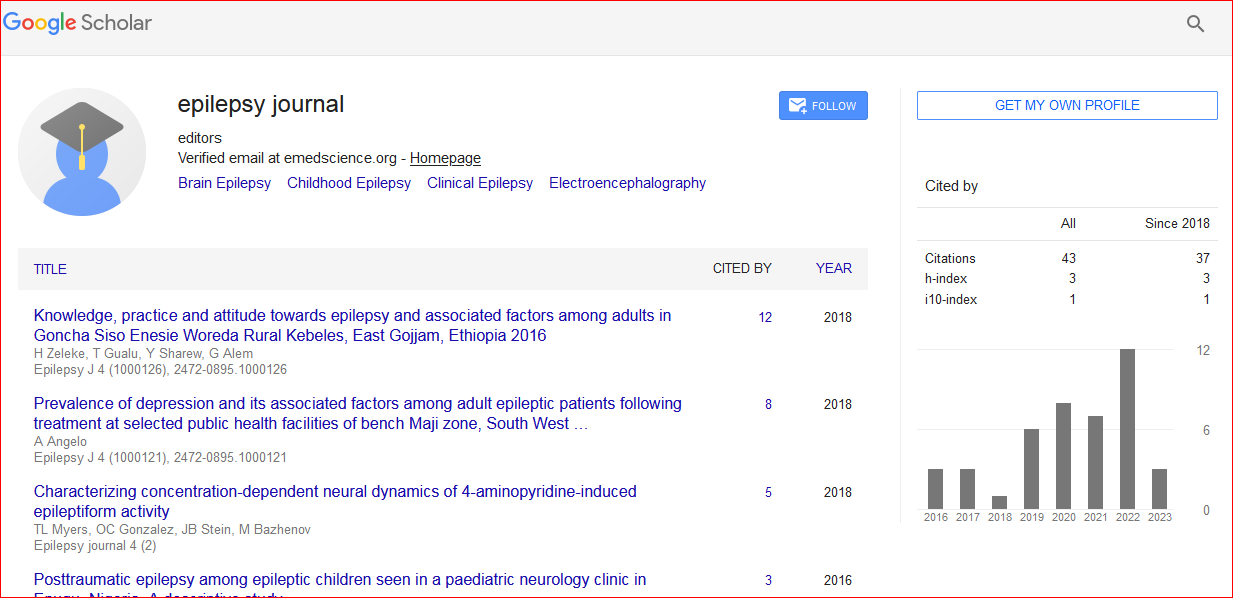
Epilepsy Journal received 41 citations as per Google Scholar report