Short Communication - (2025) Volume 15, Issue 4
Received: 01-Jul-2025, Manuscript No. jtese-26-184242;
Editor assigned: 03-Jul-2025, Pre QC No. P-184242;
Reviewed: 17-Jul-2025, QC No. Q-184242;
Revised: 22-Jul-2025, Manuscript No. R-184242;
Published:
29-Jul-2025
, DOI: 10.37421/2165-8064.2025.15.666
Citation: Zahra, Fatima. ”Enzymes: Greener, Better Textile Finishing Methods.” J Textile Sci Eng 15 (2025):666.
Copyright: © 2025 Zahra F. This is an open-access article distributed under the terms of the Creative Commons Attribution License, which permits unrestricted use, distribution and reproduction in any medium, provided the original author and source are credited.
The textile industry is undergoing a significant transformation, driven by the urgent need for sustainable manufacturing practices to mitigate its considerable environmental footprint. Traditional textile processing methods often rely on harsh chemicals, substantial water consumption, and energy-intensive operations, leading to pollution and resource depletion. In this context, enzyme-based finishing techniques have emerged as a promising eco-friendly alternative, offering a paradigm shift towards greener production cycles. These biological catalysts provide targeted and efficient solutions for various finishing processes, reducing the reliance on synthetic chemicals and their associated environmental hazards. The application of enzymes in textile manufacturing allows for improved fabric properties while simultaneously minimizing waste and energy usage, aligning with the growing global demand for sustainable products. The inherent specificity and biodegradability of enzymes make them ideal candidates for developing cleaner and more responsible textile production systems. Furthermore, the integration of enzymatic treatments can lead to enhanced fabric quality, offering consumers products that are not only environmentally sound but also superior in terms of feel and performance. This approach represents a crucial step in decoupling textile production from its negative environmental consequences, fostering a more circular and sustainable industry. The continuous advancement in enzyme technology further expands the possibilities for innovative and eco-efficient textile finishing, promising a future where fashion and environmental stewardship go hand in hand. One key area of exploration involves the application of cellulase, amylase, and lipase treatments, particularly on cotton and polyester blends, to improve fabric softness and durability while promoting sustainability in manufacturing. These enzymes offer eco-friendly alternatives to traditional harsh chemical processes, significantly reducing water and energy consumption, and minimizing effluent pollution, thereby contributing to a more environmentally conscious textile industry. [1] The use of laccase enzymes for denim bio-stonewashing presents a compelling case for sustainable garment finishing. This method demonstrates a substantial reduction in water usage and effluent discharge when compared to conventional pumice stone techniques, offering a greener approach to achieving desirable aesthetic effects on denim fabrics. [2] Enzymatic desizing of cotton fabrics using amylase is highlighted as an environmentally advantageous alternative to acid or alkali-based methods. This process leads to improved biodegradability of the treated fabric and a reduction in the chemical oxygen demand (COD) of wastewater, contributing significantly to more sustainable textile processing operations. [3] The combined effect of cellulase and pectinase enzymes for bio-polishing and softening of cotton knitwear is investigated to enhance fabric comfort and aesthetic qualities. This approach assesses the impact on fabric hand, pilling tendency, and tensile strength, demonstrating a pathway to reduced environmental impact in textile finishing. [4] Proteases are explored for their application in modifying wool fabrics to improve shrink resistance and handle without compromising fabric strength. This research analyzes enzyme specificity and reaction conditions to achieve desired outcomes sustainably, thereby decreasing the need for harsh chemical treatments like chlorination. [5] Bio-scouring of cotton fabrics using pectinases and pectin lyases is examined as an eco-friendly alternative to traditional alkali scouring methods. The efficiency in removing non-cellulosic impurities is evaluated, comparing it to conventional methods in terms of whiteness, absorbency, and environmental impact, with a particular emphasis on reducing wastewater pollution. [6] The potential of lipases for enzymatic finishing of polyester fabrics is investigated with a focus on improving dyeability and surface properties. This study discusses the challenges and opportunities associated with the enzymatic modification of synthetic fibers and its role in creating more sustainable textile materials. [7] The synergistic effects of combining cellulase with other finishing agents, such as softeners, are explored to achieve multi-functional enzymatic finishes. This research assesses the impact on fabric comfort, handle, and dimensional stability, showcasing a method for integrated and sustainable textile finishing processes. [8] A detailed kinetic study and optimization of cellulase enzyme activity in cotton bio-polishing is presented. This investigation examines kinetic parameters, optimal enzyme application conditions, and the resulting changes in fabric surface morphology and dye uptake, emphasizing the importance of precise control for achieving sustainable outcomes. [9] The potential of using immobilized enzymes in continuous textile finishing processes is discussed, highlighting the benefits of enzyme reuse, improved process efficiency, and reduced enzyme consumption. This approach paves the way for more cost-effective and environmentally friendly industrial textile applications. [10]
The textile industry's environmental impact necessitates a shift towards sustainable practices, with enzyme-based finishing techniques emerging as a critical innovation. These methods offer eco-friendly alternatives to conventional chemical processes, significantly reducing water and energy consumption while minimizing effluent pollution. The application of enzymes like cellulase, amylase, and lipase to cotton and polyester blends, for instance, enhances fabric properties such as softness and durability, marking a step towards greener manufacturing. [1] A notable advancement in sustainable garment finishing is the use of laccase enzymes for denim bio-stonewashing. This enzymatic process drastically cuts down water usage and effluent discharge compared to traditional pumice stone methods, providing an environmentally sound approach to achieve desired aesthetic effects on denim fabrics. [2] Enzymatic desizing of cotton fabrics, specifically using amylase, presents a clear environmental advantage over conventional acid or alkali-based methods. This technique not only improves the biodegradability of the fabric but also lowers the chemical oxygen demand (COD) in wastewater, thereby contributing to more sustainable textile processing. [3] The synergistic application of cellulase and pectinase enzymes for bio-polishing and softening cotton knitwear is being explored to enhance fabric comfort and aesthetic appeal. This research quantifies the effects on fabric hand, pilling tendency, and tensile strength, demonstrating how enzymatic treatments can improve product quality while reducing environmental impact. [4] For wool fabric modification, proteases are being utilized to enhance shrink resistance and handle without compromising fiber strength. By carefully analyzing enzyme specificity and reaction conditions, this research aims to achieve sustainable outcomes, reducing the reliance on environmentally taxing chemical treatments like chlorination. [5] In the realm of bio-scouring, pectinases and pectin lyases are being investigated for their effectiveness on cotton fabrics. These enzymes offer an eco-friendly alternative to traditional alkali scouring, showing promise in removing non-cellulosic impurities while exhibiting reduced environmental impact in terms of wastewater pollution, improved whiteness, and absorbency. [6] The application of lipases for the enzymatic finishing of polyester fabrics is a growing area of interest, particularly for improving dyeability and surface characteristics. This research explores the potential and challenges of enzymatically modifying synthetic fibers to create more sustainable textile materials. [7] Investigating the combined effects of cellulase with other finishing agents, such as softeners, has led to the development of multi-functional enzymatic finishes. These integrated processes aim to enhance fabric comfort, handle, and dimensional stability, offering a more sustainable approach to textile finishing. [8] A detailed kinetic study of cellulase enzyme activity during cotton bio-polishing provides crucial insights into optimal application conditions. By examining kinetic parameters and their impact on fabric morphology and dye uptake, this research underscores the importance of precise control for achieving sustainable and effective results. [9] The utilization of immobilized enzymes in continuous textile finishing processes represents a significant step towards industrial sustainability. This approach allows for enzyme reuse, enhances process efficiency, and reduces overall enzyme consumption, leading to more cost-effective and environmentally friendly textile manufacturing. [10]
This collection of research explores the significant environmental benefits and improved performance offered by enzyme-based finishing techniques in the textile industry. Various enzymes, including cellulase, amylase, laccase, pectinase, protease, and lipase, are being utilized for diverse applications such as bio-stonewashing, desizing, bio-polishing, shrink resistance, bio-scouring, and enhancing fabric properties on cotton, polyester, and wool. These enzymatic treatments significantly reduce water and energy consumption, minimize chemical use and wastewater pollution, and improve fabric quality, representing a sustainable alternative to traditional methods. The research also delves into optimization studies, synergistic effects of enzyme combinations, and the potential of immobilized enzymes for continuous industrial processes, paving the way for a greener and more efficient textile manufacturing sector.
None
None
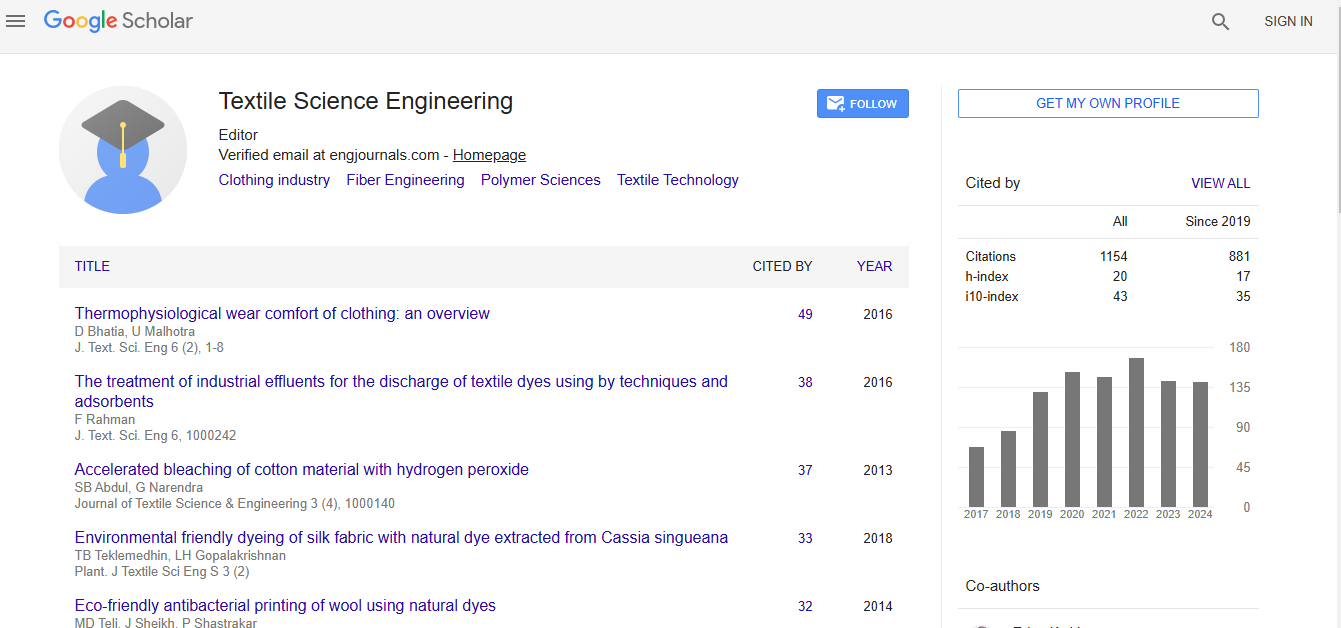
Journal of Textile Science & Engineering received 1008 citations as per Google Scholar report