Perspective - (2025) Volume 14, Issue 2
Received: 01-Apr-2025, Manuscript No. jeom-26-188154;
Editor assigned: 03-Apr-2025, Pre QC No. P-188154;
Reviewed: 17-Apr-2025, QC No. Q-188154;
Revised: 22-Apr-2025, Manuscript No. R-188154;
Published:
29-Apr-2025
, DOI: 10.37421/2169-026X.2025.14.522
Citation: Yamamoto, Hiroshi. ”Entrepreneurial Mindset: Keys to Business Success.” J Entrepren Organiz Manag 14 (2025):522.
Copyright: © 2025 Yamamoto H. This is an open-access article distributed under the terms of the Creative Commons Attribution License, which permits unrestricted use, distribution and reproduction in any medium, provided the original author and source are credited.
The entrepreneurial mindset has emerged as a critical determinant of success in the contemporary business landscape, characterized by a unique blend of resilience, the ability to recognize opportunities, and a proactive approach to problem-solving. These inherent qualities are fundamental for individuals and organizations aiming to thrive in dynamic markets [1].
Furthermore, the development of psychological capital, encompassing hope, efficacy, resilience, and optimism, has been demonstrably linked to an entrepreneurial mindset and, consequently, to improved new venture performance. Cultivating these psychological resources is therefore paramount for aspiring entrepreneurs [2].
Established firms too can leverage an entrepreneurial mindset to foster innovation and refine their competitive strategies. By instilling a culture that embraces risk-taking, learns from failures, and actively seeks out new market opportunities, companies can gain a significant competitive advantage [3].
Cognitive styles also play a pivotal role, with a proactive, opportunity-driven approach, when combined with an entrepreneurial mindset, showing a strong correlation with enhanced business performance, particularly in environments marked by uncertainty and change [4].
Leadership behaviors are instrumental in nurturing an entrepreneurial mindset within organizations. Practices such as employee empowerment, encouragement of experimentation, and championing new ideas create an environment ripe for entrepreneurial endeavors [5].
The impact of entrepreneurial education is also noteworthy, as it equips individuals with the essential knowledge, skills, and attitudes required to identify opportunities and successfully launch new businesses, thereby shaping a robust entrepreneurial mindset [6].
At its core, the entrepreneurial mindset is shaped by distinct psychological underpinnings, including self-efficacy, locus of control, and risk propensity, which collectively enable individuals to recognize and pursue opportunities and persevere through challenges [7].
A growth mindset, distinct from a fixed one, is vital for fostering entrepreneurial resilience and adaptability. Individuals with a growth mindset are more adept at learning from setbacks and adjusting strategies in response to market shifts [8].
Beyond individual attributes, social networks and an entrepreneurial mindset interact to enhance the performance of small and medium-sized enterprises. Strong social capital, combined with an entrepreneurial orientation, facilitates access to resources and knowledge, leading to sustained business success [9].
Finally, the ability to recognize and exploit opportunities is a defining characteristic of entrepreneurial success, intrinsically linked to the entrepreneurial mindset. This capacity is deeply embedded in an entrepreneur's cognitive and behavioral patterns [10].
The entrepreneurial mindset is defined by a constellation of traits including resilience, the adeptness at recognizing opportunities, and a proactive stance towards problem-solving, all of which are foundational to achieving success in business ventures. These attributes empower individuals and organizations to effectively navigate market volatility, adapt to evolving conditions, and spearhead innovation, thereby securing sustainable growth and a competitive edge within the corporate entrepreneurship sphere [1].
Research indicates a strong positive correlation between psychological capitalâ??comprising hope, self-efficacy, resilience, and optimismâ??and the cultivation of an entrepreneurial mindset. This interplay directly influences the performance of new ventures, underscoring the importance of developing these psychological resources for individuals aspiring to be successful entrepreneurs [2].
Established corporations can strategically foster an entrepreneurial mindset internally to enhance their capacity for innovation and strengthen their competitive strategies. By actively encouraging risk-taking, cultivating a learning orientation from failures, and promoting the identification of novel market opportunities, organizations can leverage this mindset to their strategic advantage [3].
Furthermore, cognitive styles are deeply intertwined with entrepreneurial success. A cognitive style characterized by proactivity and opportunity-driven thinking, when paired with a well-developed entrepreneurial mindset, significantly contributes to higher business performance, particularly within dynamic and unpredictable market environments [4].
Effective leadership plays a crucial role in embedding an entrepreneurial mindset within organizational cultures. Key leadership practices, such as empowering employees, encouraging experimentation, and actively championing innovative ideas, create an environment conducive to entrepreneurial activities and success [5].
The value of entrepreneurial education in shaping an entrepreneurial mindset is substantial. Well-structured educational programs can equip individuals with the requisite knowledge, practical skills, and appropriate attitudes needed to identify viable business opportunities and successfully launch new ventures [6].
Understanding the psychological foundations of an entrepreneurial mindset is key. Factors such as self-efficacy, an internal locus of control, and a propensity for calculated risk-taking are integral to an individual's capability to identify and seize opportunities, persist through adversity, and ultimately achieve business success [7].
The cultivation of a growth mindset is instrumental in building entrepreneurial resilience and adaptability. Individuals who believe in the developability of their abilities are better equipped to learn from challenges, embrace setbacks as learning opportunities, and dynamically adjust their business strategies in response to market fluctuations [8].
Beyond individual capabilities, the synergy between social networks and an entrepreneurial mindset significantly influences the performance of small and medium-sized enterprises (SMEs). Robust social capital, combined with a strong entrepreneurial orientation, enhances SMEs' access to critical resources and knowledge, leading to sustained business success [9].
Ultimately, the core of entrepreneurial success lies in the ability to recognize and effectively exploit new opportunities. This capability is a defining characteristic of successful entrepreneurs and is fundamentally rooted in their ingrained cognitive and behavioral orientations, forming the essence of an entrepreneurial mindset [10].
The entrepreneurial mindset, characterized by resilience, opportunity recognition, and proactive problem-solving, is essential for business success. It enables adaptation to market changes and drives innovation. Psychological capital, including hope and efficacy, predicts entrepreneurial behavior and venture performance. Established firms can foster innovation and competitive advantage by cultivating this mindset internally, encouraging risk-taking and learning from failure. Cognitive styles, leadership behaviors, and entrepreneurial education all play significant roles in developing an entrepreneurial mindset. Psychological factors like self-efficacy and locus of control are crucial. A growth mindset enhances resilience and adaptability. Social networks, combined with an entrepreneurial mindset, boost SME performance. The ability to recognize and exploit opportunities is a hallmark of successful entrepreneurs and is rooted in their mindset.
None
None
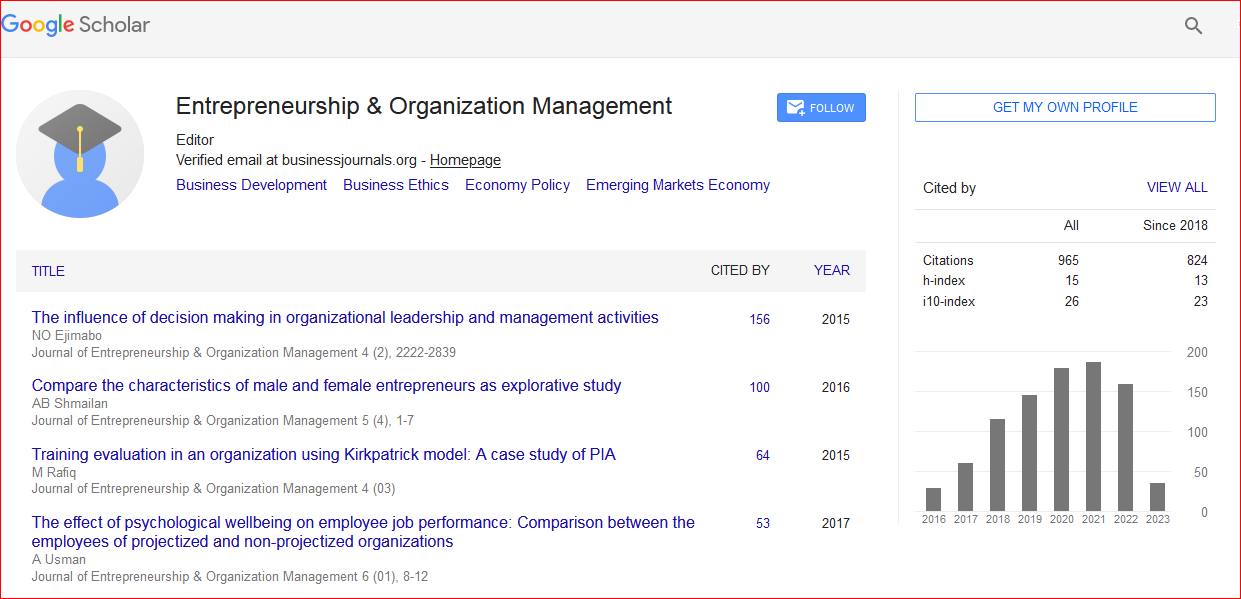
Entrepreneurship & Organization Management received 1115 citations as per Google Scholar report