Perspective - (2025) Volume 14, Issue 6
Received: 01-Nov-2025, Manuscript No. pbt-25-178164;
Editor assigned: 03-Nov-2025, Pre QC No. P;
Reviewed: 17-Nov-2025, QC No. Q-178164;
Revised: 24-Nov-2025, Manuscript No. R-178164;
Published:
29-Nov-2025
, DOI: 10.37421/2167-7689.2025.14.515
Citation: Petrova, Elena. ”Ensuring Drug Safety and Efficacy: A Regulatory Imperative.” Pharmaceut Reg Affairs 14 (2025):515.
Copyright: © 2025 Petrova E. This is an open-access article distributed under the terms of the Creative Commons Attribution License, which permits unrestricted use, distribution and reproduction in any medium, provided the original author and source are credited.
Ensuring the safety and efficacy of pharmaceutical products is a fundamental responsibility within the realm of pharmaceutical regulatory affairs. This critical endeavor relies on comprehensive preclinical and clinical testing, robust post-market surveillance, and vigilant pharmacovigilance to identify and address potential risks associated with medicines. Regulatory agencies are indispensable in their role of evaluating scientific data and establishing stringent standards that serve to safeguard public health while simultaneously promoting access to novel therapeutic agents. The intricate process of drug development necessitates a collaborative and communicative approach, involving close partnerships between the pharmaceutical industry, regulatory bodies, and healthcare professionals, all of whom are vital in maintaining the high standards of safety and efficacy for medicinal products [1].
The increasing complexity inherent in modern drug development mandates the establishment and adherence to sophisticated regulatory frameworks. A significant evolution in this domain is the growing integration of real-world evidence (RWE) into the decision-making processes of regulatory authorities. RWE offers invaluable insights into the performance of drugs within diverse patient populations, extending beyond the controlled environments of clinical trials. Despite the significant potential of RWE to inform safety and efficacy assessments, challenges persist in standardizing its collection and analysis to ensure its reliability and applicability in regulatory submissions [2].
Adverse event reporting systems stand as a crucial pillar for the continuous monitoring of drug safety throughout a medication's lifecycle. Enhancements to these systems, particularly in improving data quality and ensuring the timeliness of reporting, are paramount for the effective identification of emerging safety signals. The transformation of reported adverse events into actionable insights is dependent upon rigorous data analysis and a systematic framework for risk assessment and management. This continuous feedback loop is fundamental to fostering and maintaining public trust in the pharmaceutical products available on the market [3].
The globalization of pharmaceutical regulation underscores the immense importance of harmonizing regulatory standards across international borders. Such harmonization is essential for streamlining drug development processes and ensuring equitable access to medicines worldwide. Collaborative international efforts aimed at aligning the requirements for drug safety and efficacy assessments significantly facilitate cross-border regulatory reviews, thereby reducing the necessity for redundant testing. This global collaboration fosters a more consistent and predictable approach to drug approval, ultimately benefiting patients globally by providing them with timely access to safe and effective treatments [4].
Pediatric drug development presents a unique set of challenges specifically related to the assessment of safety and efficacy in younger populations. To address these specific needs, regulatory pathways have been developed and refined to incentivize research into pediatric medicines and to guarantee that children have access to treatments that have been appropriately studied and approved. Paramount in this specialized area of drug regulation are the ethical considerations that guide research involving children, as well as the critical need for age-specific formulations and dosages that are tailored to their physiological characteristics [5].
The rigorous evaluation of drug efficacy is fundamentally dependent on the design and execution of well-controlled clinical trials. These trials must convincingly demonstrate a statistically significant and clinically meaningful benefit of the therapeutic intervention. The interpretation of trial outcomes necessitates careful consideration of the intended patient population, the chosen endpoints that measure treatment effects, and the potential for various sources of bias to influence the results. Transparency in the reporting of all trial outcomes, irrespective of whether they are positive or negative, is absolutely essential for fostering informed clinical practice and supporting sound regulatory decision-making [6].
Post-marketing surveillance represents a dynamic and ongoing process dedicated to continuously monitoring the safety profiles of approved drugs once they are available to the wider patient population. This surveillance involves the systematic collection and meticulous analysis of data derived from a variety of sources, including spontaneous adverse event reports, observational studies, and patient registries. A critical function of post-marketing pharmacovigilance is its capacity to detect rare or long-term adverse events that might not have been apparent during the controlled conditions of clinical trials, thus providing essential safety information [7].
The regulatory review process for new drug applications is meticulously designed to be both thorough and scientifically rigorous. This comprehensive evaluation is conducted by a multidisciplinary team of experts who critically assess all available data pertaining to a drug's safety and efficacy before marketing authorization is granted. The ongoing challenge lies in striking an appropriate balance between fostering pharmaceutical innovation and ensuring the utmost patient safety, a consideration that remains paramount throughout the entirety of this stringent evaluation process [8].
Pharmacogenomics is emerging as a transformative field, offering personalized approaches to drug therapy. The core aim of pharmacogenomics is to optimize therapeutic efficacy and minimize the occurrence of adverse drug reactions by considering an individual's unique genetic makeup. The successful integration of pharmacogenomic data into regulatory assessments and everyday clinical practice holds the promise of leading to more precisely targeted and inherently safer drug use. This rapidly evolving area of science is poised to significantly enhance overall drug safety and efficacy by enabling treatments to be tailored to the specific needs of individual patients [9].
The pervasive threat of counterfeit medicines presents a significant and ongoing danger to public health, directly undermining both the safety and efficacy of legitimate pharmaceutical products. In response to this global challenge, regulatory bodies and international organizations are actively implementing multifaceted strategies. These strategies include the widespread adoption of serialization and the deployment of advanced tracking technologies to combat the proliferation of substandard and falsified medicines. Alongside these technological interventions, public awareness campaigns play a crucial role in educating consumers about the inherent risks associated with the purchase of unverified or illicit medications [10].
The cornerstone of pharmaceutical regulatory affairs lies in the unwavering commitment to ensuring drug safety and efficacy. This fundamental objective is achieved through a multifaceted approach encompassing rigorous preclinical and clinical testing, continuous post-market surveillance, and diligent pharmacovigilance activities aimed at identifying and mitigating potential risks. Regulatory agencies are instrumental in this process, tasked with the critical evaluation of scientific data and the establishment of robust standards designed to protect public health while facilitating the availability of innovative therapies. The successful navigation of this complex landscape hinges on effective communication and synergistic collaboration among industry stakeholders, regulatory authorities, and healthcare professionals, all of whom are essential for upholding the high safety and efficacy profiles of medicinal products [1].
Modern drug development is characterized by its inherent complexity, necessitating the implementation of sophisticated and adaptive regulatory frameworks. A prominent trend within these frameworks is the increasing incorporation of real-world evidence (RWE) into regulatory decision-making processes. RWE provides invaluable insights into how drugs perform in real-world clinical settings and across diverse patient populations, thereby complementing data obtained from controlled clinical trials. While challenges remain in establishing standardized methodologies for RWE collection and analysis to ensure its reliability and utility in regulatory submissions, its potential to significantly inform safety and efficacy assessments is undeniable [2].
Adverse event reporting systems are indispensable for the ongoing monitoring of drug safety once a product is on the market. Continuous improvement in these systems, focusing on enhancing data quality and ensuring timely reporting of events, is vital for the early detection of new safety signals. The effective translation of reported adverse events into actionable strategies requires robust data analysis capabilities and a systematic approach to risk assessment and management. This cyclical process of reporting, analysis, and action forms the bedrock of maintaining public confidence in pharmaceutical products [3].
Global harmonization of regulatory standards is a critical factor in optimizing drug development timelines and improving patient access to medicines worldwide. International cooperation and alignment on requirements for drug safety and efficacy assessments streamline regulatory reviews across different jurisdictions and reduce the need for duplicative testing. This collaborative spirit fosters a more uniform global regulatory environment, ultimately benefiting patients by accelerating their access to safe and effective treatments [4].
Pediatric drug development presents unique scientific and ethical challenges that require specialized regulatory consideration. Regulatory pathways tailored for pediatric medicines are designed to encourage research and ensure that children receive appropriately studied and approved treatments. Key considerations in this specialized area include ethical research practices and the development of age-appropriate formulations and dosages, which are paramount for ensuring the safety and efficacy of medications in this vulnerable population [5].
The assessment of drug efficacy is fundamentally reliant on the design and execution of well-controlled clinical trials that can demonstrate a statistically significant and clinically meaningful benefit. The interpretation of trial findings must meticulously consider the intended patient population, the selected endpoints used to measure efficacy, and the potential for bias to affect the results. Transparency in the reporting of all clinical trial outcomes, regardless of whether they are positive or negative, is essential for informing clinical practice and supporting robust regulatory decision-making [6].
Post-marketing surveillance is a dynamic and essential component of drug safety monitoring that extends throughout a drug's lifecycle. This process involves the continuous collection and analysis of data from a diverse range of sources, including spontaneous reports from healthcare professionals and patients, observational studies, and dedicated patient registries. A critical function of post-marketing surveillance is its ability to identify rare adverse events or those that may only emerge after prolonged use, which may not have been evident during clinical trials [7].
The regulatory review process for new drugs is characterized by its scientific rigor and comprehensiveness. This process involves a multidisciplinary team of experts who meticulously evaluate all available data regarding a drug's safety and efficacy prior to granting marketing authorization. A continuous consideration throughout this demanding evaluation is the careful balancing act between encouraging pharmaceutical innovation and rigorously ensuring patient safety [8].
Pharmacogenomics represents a significant advancement in personalized medicine, offering the potential to optimize drug therapy by tailoring treatments based on an individual's genetic profile, thereby enhancing efficacy and reducing adverse reactions. The integration of pharmacogenomic data into regulatory assessments and clinical practice promises to lead to more targeted and safer medication use. This evolving field is instrumental in advancing drug safety and efficacy through personalized treatment strategies [9].
The global challenge posed by counterfeit medicines represents a serious threat to public health, compromising both drug safety and efficacy. Regulatory agencies and international bodies are actively implementing strategies, such as serialization and advanced tracking technologies, to combat the spread of substandard and falsified medicines. Public awareness and education campaigns are also vital in informing consumers about the risks associated with acquiring medications from unverified sources [10].
Ensuring drug safety and efficacy is a critical aspect of pharmaceutical regulatory affairs, involving extensive testing, post-market surveillance, and pharmacovigilance. Regulatory agencies play a key role in data evaluation and standard setting. The integration of real-world evidence is transforming regulatory decision-making, although standardization remains a challenge. Robust adverse event reporting systems are vital for ongoing safety monitoring and risk management. Global harmonization of regulatory standards facilitates drug development and access. Pediatric drug development requires specialized regulatory pathways due to unique challenges. Clinical trials are essential for demonstrating drug efficacy, with transparency in reporting being crucial. Post-marketing surveillance identifies rare or long-term adverse events. The drug approval process involves thorough scientific review to balance innovation with patient safety. Pharmacogenomics offers personalized medicine approaches to enhance drug safety and efficacy. Counterfeit medicines pose a significant threat, requiring regulatory strategies and public awareness to combat their proliferation.
None
None
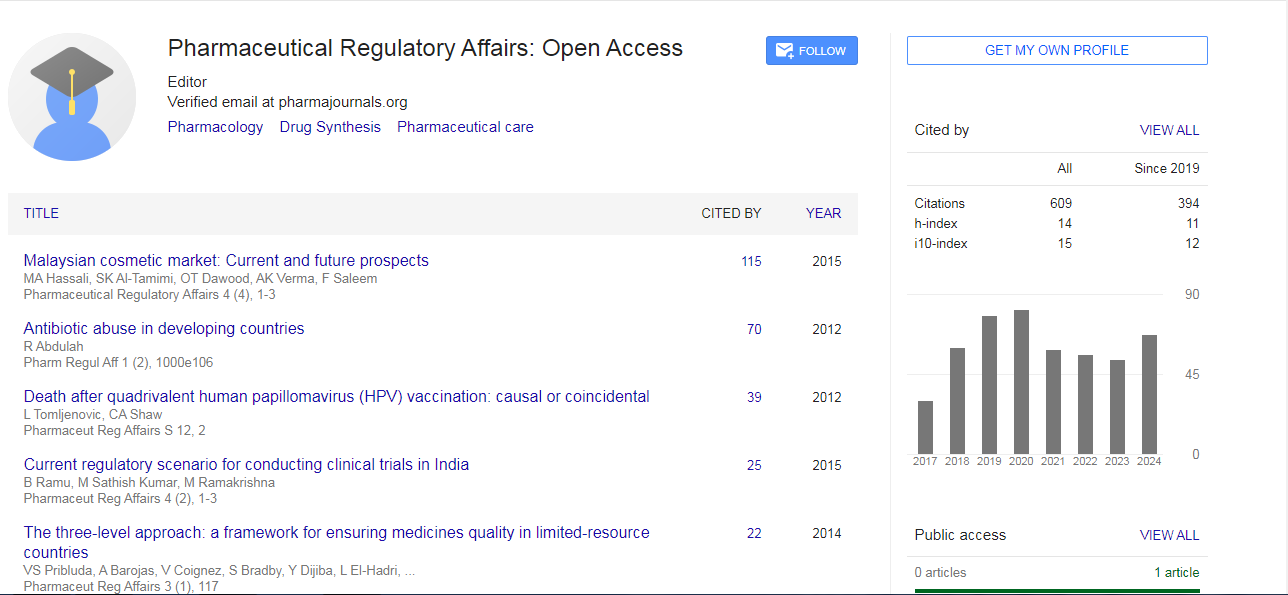
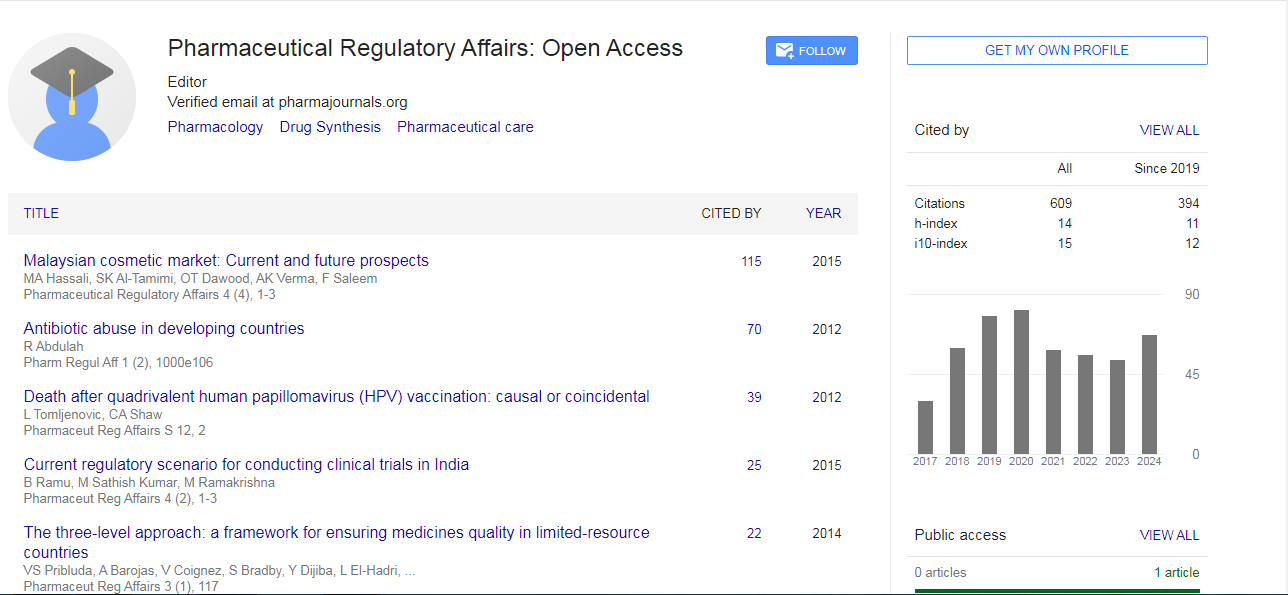
Pharmaceutical Regulatory Affairs: Open Access received 533 citations as per Google Scholar report